

e meet Pica (Toby Smith), the protagonist of Cauleen Smith’s excellent Drylongso (1998), in the middle of a part-time wheatpasting shift doing something she hopes not to have to do much longer: plastering, in the dead of night, bright orange posters advertising an upcoming community meeting. This meeting is being called because there is a serial killer on the loose in her Oakland neighborhood, claiming new victims on a near-nightly basis since last May and alternating the gender of his targets with every strike. Though media coverage has been constant — reporters have settled on the Westside Slasher as the inevitably lurid nickname — the police have deemed an investigation a low priority, tacitly owing to these murders happening in a predominantly Black area with exclusively Black victims as his prey. Community action seems the surest way to end his reign of terror.
This all may sound like the beginnings of a thriller. But we soon understand that Drylongso isn’t a movie interested in neatly adhering to any one genre. The film actually could most simply be classified as a portrait of a young woman. It looks to capture through its grainy 16mm lenses the vagaries of a life where anxieties over the safety of oneself and one’s community co-exist with — are often inextricable from — the joys of creative breakthrough and new friendship.
A driving focus of Pica’s, on the day to day, is her budding creative life, which is currently being most developed in a 35mm-photography class she’s taking at a nearby college. Not because she’s learning a lot from the course itself — her attendance is spotty at best, and she audaciously doesn’t intend on getting a 35mm camera — but because it’s helping motivate her to complete her first big creative project.
Pica’s been dutifully taking Polaroid portraits of young Black men around her neighborhood. She’s doing it because she fears that Black men are becoming an endangered species, and that if she doesn’t make it a point to chronicle their existence then there will be scarce tangible proof they were here at all. (She’ll share, with almost robotic efficiency, a litany of evidentiary statistics if you think she’s exaggerating.) The project is lent a new urgency by the killer — some of whose victims are among Pica’s subjects. Her patient professor (Salim Akil, who also co-wrote the movie) is exasperated by the bad attendance and the temerity to sign up for a 35mm-photography class and refuse to use the right camera. But you can tell he sees as much talent in her as he can’t other students who use nonsensical strings of two-dollar words to make it seem like their uninteresting projects aren’t creatively bankrupt. He knows how much of a mistake it would be to discourage her.
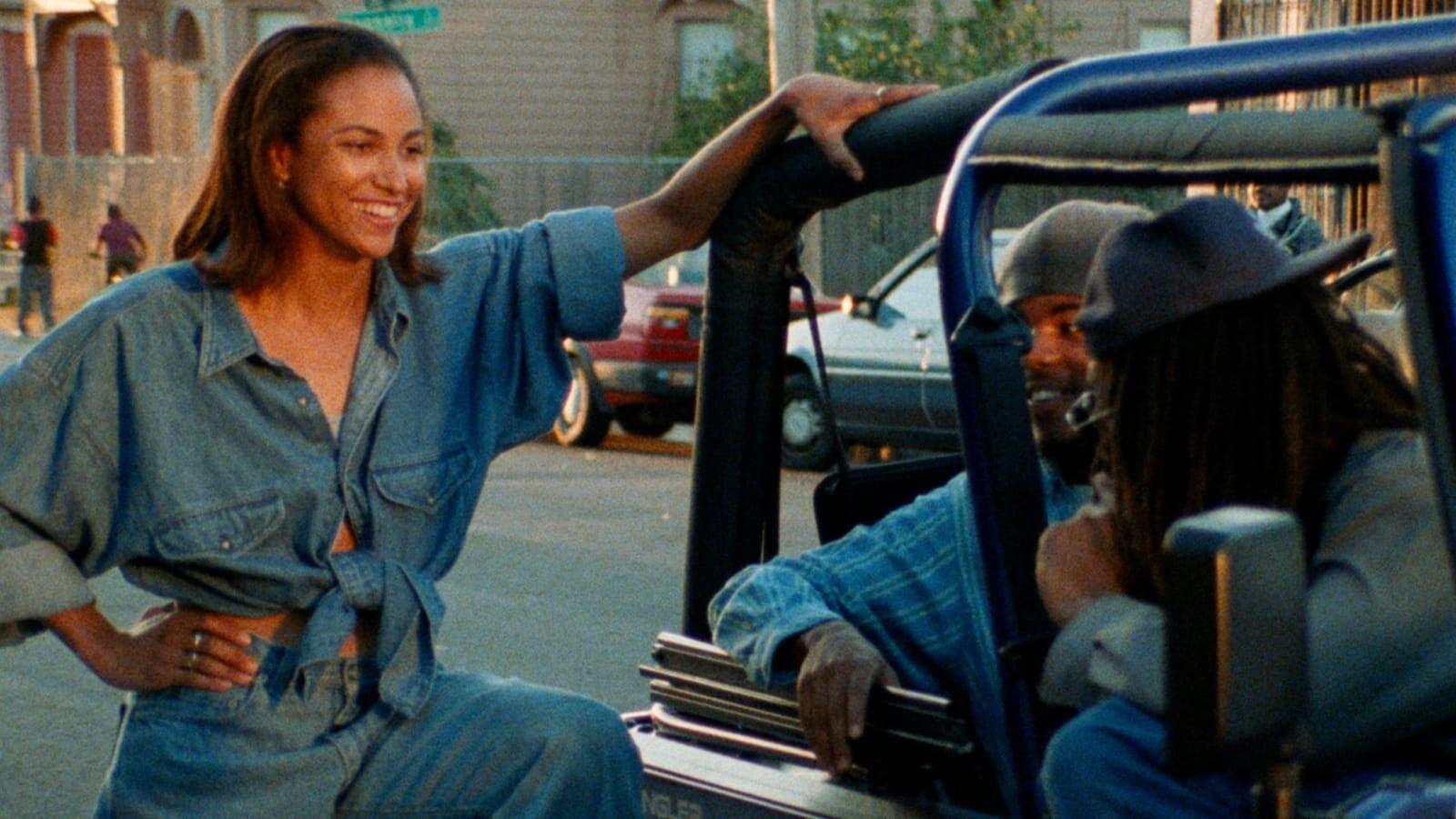
April Barnett in ‘Drylongso.’
Pica’s sense of creative purpose may be stronger than it’s ever been. She’s also finding purpose in a new friendship with Tobi (April Barnett), a young woman she calls a cab for when she sees her getting roughed up by her bad-news boyfriend, and in a cut-tragically-short romance with Malik (Will Power), a too-sweet-for-this-world designer who often sells his distinctive wares by the water. Tobi and Pica’s increasing closeness especially takes up residency in Drylongso. They have in common vexed relationships with their mothers. Tobi’s is a popular singer always on tour who seems to conflate financial support with love; Pica’s (Channel Schafer), who makes her pay rent in the Barbie-pink family home that sticks out like a sore thumb on the block, is hard-partying and prone to apathy, though at least is truly loving and supportive when it counts the most. (I’ll fess to getting a little choked up at how excited Pica’s mom gets when her daughter requests near the end of the movie that she prepare some trays of food for her upcoming photography showcase.)
And there’s a certain harmony in how Pica and Tobi express themselves in a way that shirks expectations. Pica refuses to comply with class procedure because it would too calamitously disrupt her artistic aims. After the violent confrontation that brings her and Pica together in the first place, Tobi decides to rend her traditionally feminine style for something more classically masculine to keep straight male attention away from her. She finds some power — and long-elusive feelings of safety — in the inconspicuousness afforded in baggy flannels and a head alternately covered by bandanas or hoods. Toby Smith and Barnett, both wonderful, have great friendship chemistry, reveling in the fun of their new bond while treading lightly with each other when sore spots are in danger of being hit. They’re the film’s foremost source of one of its guiding interests: exploring how art and friendship can provide comfort and clarity in a world where death and danger, both so hard to make sense of and accept, run rampant.
Drylongso originated for Cauleen Smith while she was an MFA student at UCLA. (The film itself was shot in the summer of 1995.) Much of its narrative borrows directly from her life. She herself had been steadily taking Polaroid portraits of young Black men, thinking the snapshots would either one day fill out an installation or maybe even be used in a film. She also was working a news-transcription service job and was frustrated by how there was clearly a serial killer on the prowl — later revealed to be Lonnie David Franklin, Jr., also known as The Grim Sleeper — and she felt like she was the only one picking up that this series of deaths might be connected to one another. Pica feels like something of a proxy for Smith: a burgeoning artist working through a frustrating, chaotic reality through art.
Drylongso is a major achievement. It’s also the kind of discovery where disappointment tempers some of our excitement. In a just world, Drylongso would have been the first movie of many for a first-time feature filmmaker for whom fully formed, rather than merely promising, is a more accurate descriptor. Drylongso was acclaimed on the festival circuit back when it was still new; it notably won one Independent Spirit Award and was nominated for another. But it never got a proper theatrical release, and after some dispiriting experiences in Hollywood, Smith never ended up making another feature-length movie, pursuing a career in multimedia art instead.
One will naturally wonder how Smith’s career might have unfolded had gatekeepers met her subsequent attempts at a follow-up with enthusiasm. Restored and now finally getting the release it didn’t receive 25 years ago (it’s currently playing at SIFF), Drylongso is more and more being deservingly recognized as a quasi-lost masterwork — the sort of bittersweet arc of delayed triumph that has befallen other Black women filmmakers who dishearteningly also only got one shot at feature filmmaking, from Julie Dash to Ayoka Chenzira, from Leslie Harris to Kathleen Collins. But in eschewing Hollywood, Smith still ultimately found a fulfilling career where her interests could be pursued and explored without having to make the commercially minded concessions that would squander her vision — a victory echoing how Pica, in rejecting the artistic limitations imposed on her, uncovers a creative sensibility that only gets stronger the more she follows its lead.
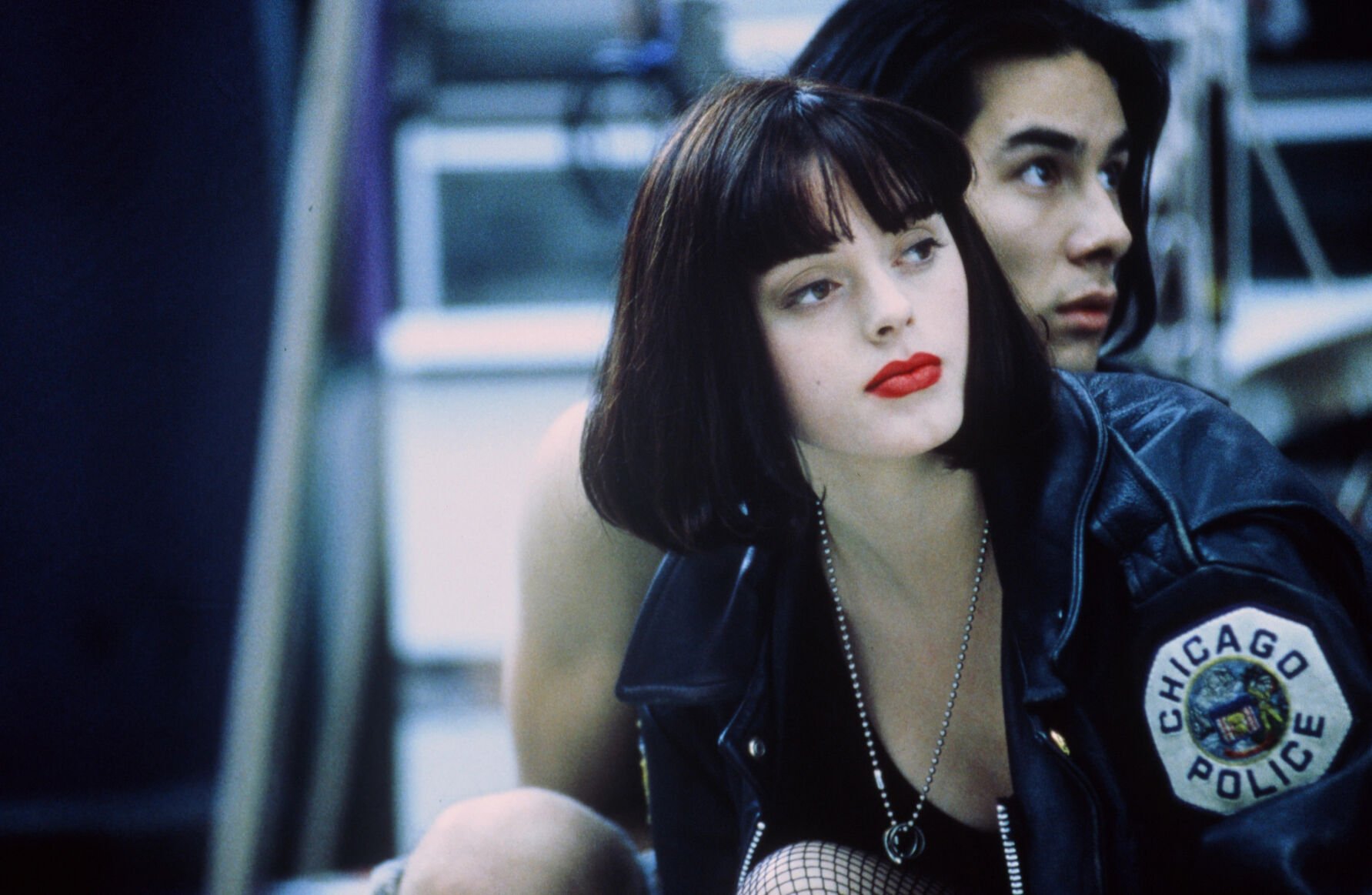
Rose McGowan and James Duval in ‘The Doom Generation.’
I SAW GREGG ARAKI’S The Doom Generation (1995) for the first time almost exactly three years ago, and all I can really remember about it was that I liked it so much less than everything else he made that decade — all movies I at least liked a lot and at most loved — that I wondered if something was wrong with me. But it turns out the version of the long hard-to-track-down “heterosexual movie” I’d illicitly scrounged up got that reaction from me probably because it was either the one that premiered at Sundance in 1995 with several scenes removed or an R-rated cut Araki recently lamented was so butchered beyond recognition that he’d “prefer people not watch it at all than watch that copy of it.”
After being shown at Sundance earlier this year — a sort of corrective to the cuttings of 1995 — a new, more official version of The Doom Generation has made its way onto The Criterion Channel, reinstating Araki’s original vision and newly visually crisp thanks to a 4K restoration he supervised. (Enviable hotel rooms its characters stay at — one monochromatically bubblegum pink and another resembling a checkerboard trying to swallow you — never looked better.) It’s been long enough that I couldn’t pinpoint the changes in the cut of The Doom Generation I saw in 2020 versus the one I watched over the weekend, but either the differences are very dramatic or I’m now in a much better place to receive it, because a movie I’d once found grating, obnoxiously grasping to be edgy, now strikes me as charmingly helter-skelter. Edginess is still gunned for — everything the cast buys comes to $6.66, billboards only exist to declare things like “THE RAPTURE IS COMING,” and severed body parts still wiggle around post-lobbing; a character who rattles off insults like she would eventually birth and raise Juno MacGuff has tattooed her knuckles to say KILL — only now most of the obnoxiousness hits me as endearing.
The Doom Generation, bookended by 1993’s Totally F***ed Up and 1997’s Nowhere, is the second installment of Araki’s so-called “teenage apocalypse trilogy.” It rejiggers the sense of sprawl generated by its trilogy-mates’ pretty big ensemble casts of troubled queer youths by pitting its three main characters against the wide-open possibilities of the road. It starts innocently enough: with teenage couple Amy and Jordan (Rose McGowan and James Duval) agreeing to take home Xavier (Jonathon Schaech), a guy they help outside a club after he’s physically assaulted right outside their car. Then the three are forced on the run when a convenience-store stop for snacks on the way turns deadly.
Xavier is more than probably a threat to his new companions’ safety, offhandedly reminiscing about some gruesome deaths he’s responsible for. But he also, thanks to freakish good looks Herb Ritts might have loved to capture in pearly black and white, embodies a dangerous sexiness that has a way of overpowering Amy’s commitment to her monogamy and her general reservations about him. There’s also much homoerotic friction between him and the far gentler Jordan, which gets a comic lift because Jordan, a little more moon-eyed and oblivious than the people he’s traveling with, might only think he’s just being nice.
The ways Xavier will ingratiate himself into this relationship is one of the main tensions of the movie. So are the questions of whether this trio will get caught, and whether Amy’s knack for appearing places and having random people not only mistake her for someone else but someone else they’re homicidally mad at will lead to permanent trouble. (The inimitable Parker Posey, donning big heart-shaped sunglasses and a wig suggesting a blonde cartoon character who’s just been electrocuted, is the most memorable of those delusional opponents.) Everything culminates in an ending I’d maybe find a little more shocking if it didn’t feel like Araki, his provocations so constant they’re like a stream, was so eager for a shocking final destination. I would say that he outdoes himself.
This column originally appeared in 425 magazine.
 Peterson Reviews