
Neither Robert Rodriguez nor Quentin Tarantino is privy to putting out a movie that doesn’t sound like a big gamble when you first get a load of the premise. In the spring of 2007, the friends and filmmakers in arms, empowered by each other and the gatekeepers who too saw something in their vision, released what arguably remains both of their riskiest projects to date. The riskiness didn’t have to do with a provocative premise — at least not provocative in a way conflating with “potentially offensive.” The project’s riskiness had to do with it being couched in the kind of abstruse appeal friendlier to few-and-far-between video-store crate diggers than to mass audiences. It also had to do with asking its customers to sit in a theater for two movies straight.
Said project, Grindhouse, was designed to mimic the experience of going to the grimy “grindhouse” theaters that reached peak popularity in the 1970s before going extinct not long after. Grindhouse theaters were humid and sticky-floored and could be depended on to play cheaply made B films whose categorical specialties included slasher movies, zombie movies, women-in-prison movies, car movies, monster movies, and the like.
When a grindhouse theater customer 40-plus years ago bought a ticket, they often did it for a double feature to maximize their dollar. The same goes for Rodriguez and Tarantino’s Grindhouse. Audiences paid for a duo of movies — Rodriguez’s gross-out zombie thriller Planet Terror and Tarantino’s car-slash-hangout-slash-horror movie Death Proof — with those offerings somewhat cushioned by trailers for made-up movies with titles like Machete and Hobo with a Shotgun in between. (Both of those subsequently got outstretched into feature-length movies rather than the more promising of those trailers, namely a holiday-themed slasher movie called Thanksgiving from Eli Roth and a Hammer Horror pastiche from Edgar Wright called Don’t.)
Editing blips and onscreen film-strip scratches are thrown onto the visuals to evoke how audiences used to go to grindhouse theaters and likely not get the pristine print of the movies they were paying for. (In Planet Terror and Death Proof, full scenes are intentionally cut, usually when sex and/or nudity is involved, always with an “apology” intercut to suggest a sleazy projectionist running off with the reels in question.) These references and textures may not be familiar to most people, but Tarantino and Rodriguez offer them in a way that at once rewards the initiated without alienating those who tend not to scrounge up forgotten B movies from decades ago when searching for the night’s entertainment.
Buzzy press and audiences that largely liked what they saw didn’t translate to box-office success: new, then and still, for Tarantino; a harbinger of the things to come for Rodriguez. Grindhouse being better at drumming up fleeting publicity, then not making much of a cultural imprint once the hype died, then later being looked at as an undersung classic ironically puts it even more in league with the movies to which it’s paying tribute. Though some would break through, the more common fate of the ‘70s B movie was doom from its inception to never being embraced in a populist sense but potentially championed in a cultier one.
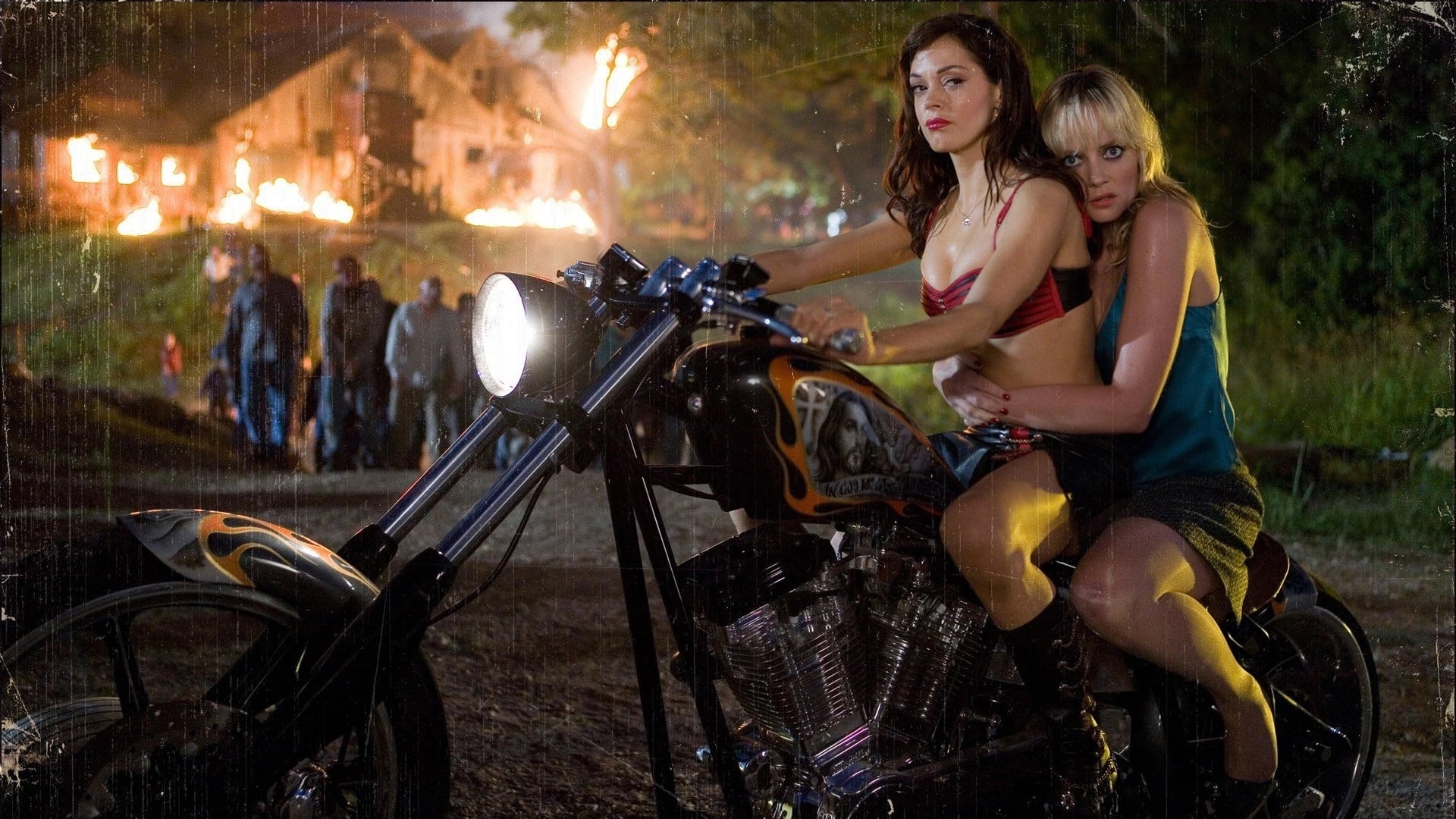
Rose McGowan and Marley Shelton in Planet Terror.
Hyperbolic praise is rarely applied these days to Planet Terror, though it’s nonetheless properly appreciated for its tongue-in-cheek carnage and indelible decision to have Rose McGowan skulk around with a machine gun freshly fitted to where the lower half of her leg, chopped off recently because of zombie-related woes, used to be. Death Proof, in the meantime, is sometimes inflated as Tarantino’s best movie and other times, actually more commonly, praised along the lines of A.O. Scott’s review in the New York Times. Scott extols it for being good enough that you watch it the way you would an actual movie, not purely an exercise. But he qualifies that by saying that it isn’t necessarily good enough to make it appealing to sit through Planet Terror, positioned first in the double feature, a second time just to get to the goods.
I too like Planet Terror less than I do Death Proof; the latter’s ensemble is so lovable that revisiting the movie can sometimes have the tenor of meeting up with old friends. But I still like Planet Terror a lot. It’s a zombie movie that uncovers early and then efficiently maintains the kind of balance between funny and freaky where, after a while, you almost can’t differentiate between the two.
The movie is set in a very small Texas town that becomes a zombie pandemic’s ground zero; it orbits around a small circle of survivors — including a just-retired stripper named Cherry (Rose McGowan) with dreams of standup comedy, her mysteriously goods-with-guns ex-boyfriend El Ray (Freddy Rodriguez), and an anesthesiologist named Dakota (Marley Shelton) who can’t catch a break. When she’s not being forced to fight off zombies, Dakota’s worrying about her vindictive husband (a mad doctor type played by Josh Brolin), who’s rageful upon learning that she’s planning on leaving him for a woman. Said woman is ill-fated — she comes to the hospital as a “no-brainer” (e.g., gurneyed in with her brain sucked out by the undead) — and played by Fergie.
Planet Terror telegraphs with ease the escalating chaos suffocating this pocket of Texas like the encroaching green clouds turning everyone undead. But it strikes you even more as a worthy showcase for McGowan, an actress that never really got showcases and, after Planet Terror, wouldn’t again. She gets to be funny and sharp-tongued in the way we’ve come to expect from her through movies like The Doom Generation (1995) and Scream (1996), but she finds real emotional resonance in a character who was already feeling bad about where her life was going before zombies decided to render her right leg useless first and her life’s ambitions second. It’s an inspiriting celebration of her.
It’s also a celebration hard to fully enjoy in the last few years, since McGowan made it clear recently that Rodriguez, whom she was dating at the time, hardly had her best interests in mind on a movie that would eventually be sold to the now-disgraced mogul who assaulted her. That knowledge reveals another queasy form of tribute to the B movies Grindhouse so reveres, which regularly saw the actresses lending them so much of their appeal treated poorly during production.

Mary Elizabeth Winstead, Rosario Dawson, Zoë Bell, and Tracie Thoms in Death Proof.
Death Proof is all about a guy from the movie world treating women more than a little poorly. His name is Stuntman Mike (a slippery-good Kurt Russell). Perhaps you’re familiar with some of the work he thinks necessitates putting his occupation in front of what would usually be his forename, from doubling Gary Clarke on episodes of The Virginian to Lee Majors on The Six Million Dollar Man. We soon gather that the reason, or at least one of the reasons, behind this over-the-hill stuntman’s most notable and most recent credits being so far behind him has to do with how all his attention lately has been spent on serial killing.
Not serial killing in the knife-happy way the movies have gotten us used to — though Tarantino at multiple points references that in some way, mostly with some music choices and visual compositions invoking Italy’s proto-slasher giallo genre — but in a way befitting a stuntman whose infatuation with being good at avoiding death has warped into homicidality. He’s equipped his car, a black Chevy Nova from 1970 with a skull and bolts of lightning standing in for crossbones painted white on the hood, so that he can intentionally crash his car into another car. Preferably it’s one full of beautiful young women; preferably he’s doing it with such force that his victims stand no chance of surviving. He stalks them, inconspicuously taking photos from the driver’s seat, for a little bit beforehand.
It’s a bizarre, super-specific modus operandi you’re surprised hasn’t been figured out sooner. (Though it’s also so strange that you could see how no one’s mind would automatically go there.) Death Proof is presented like a diptych. One side follows a group of fun-loving Austin women (Vanessa Ferlito, Sydney Poitier, and Jordan Ladd, all effervescent) whose night out is ruined when Mike picks them out as the people to lethally crash into head-on. The other follows another group of fun-loving women (Rosario Dawson, Mary Elizabeth Winstead, Tracie Thoms, and Zoë Bell), though this time they hail from all over the place; are involved in and brought together by the movie business themselves (one’s an actress and another is a stunt double, for instance); and, once they get a sense of what Mike is trying to do, are adamant about not letting him drive away scot-free. (Their introduction to him is a memorable one: with the girls, stopped in middle-of-nowhere Tennessee during a lull on the production they’ve been working on, getting crashed into by him while deciding to play “Ship’s Mast” on the 1970 Dodge Challenger they’ve all but swindled a local out of.)
Planet Terror is fueled by its narrative momentum and its close-to-relentless action. The whole bravura Ship’s Mast stretch of the movie the exception, the laid-back Death Proof is most pleasurable as a straightforward hangout movie, where watching these two groups of jovial friends talking about the dramas of their lives becomes so much fun that we notice how much we like hanging out with them. Mike’s presence really is a pain, even if Russell getting to go all in on a role where he’s playing against type isn’t itself bad to sit through. Although there’s a moment late in the movie with Winstead and the local in the second half that feels like a baffling betrayal of what the film had until then been going for, Death Proof at times feels less reverential of cheaply made car movies in the Monte Hellman ilk than it does the simple power one is instilled with by friendship.
The first section of Death Proof is recast, ultimately, as a tragedy. The second section, ending in a victory that dovetails with what might be among the greatest last few minutes of a movie of its decade, invigoratingly reclaims the power Mike had deluded himself into thinking he’d always have without any challenge. The nearly all-women ensemble is terrific; I hate that nobody in it, aside from the by-then already-pretty-established Dawson and Winstead, would really get anywhere professionally major post-release. It shouldn’t have been that way, and it shouldn’t have been that way for so many of the better-than-the-material B-movie actresses presaging them, either.
 Peterson Reviews