

012, like every other year, was the year of a lot of things. One of the many things it was the year of was the year that Taylor Kitsch, newly freed from his obligations on Friday Night Lights as the “teen” heartthrob du jour, was briefly positioned to be a next-generation movie star who could maybe lead high-profile films. It sounded foolproof on paper: three big movies, each made by a director who had proven his stuff. There was John Carter, a meant-to-be-a-blockbuster fantasy adventure from Disney based on Edgar Rice Burroughs’ pulpy sci-fi novel The Princess of Mars. Soon after came Battleship, a Michael Bay-esque action movie where the Navy noisily defends Earth from vaguely defined alien invaders. Then there was Savages, a twisty drug-trade thriller from Oliver Stone.
Either forgotten by most people or tinged with infamy for those who remember, the positioning of Kitsch as a cinematic next big thing went badly in a way that was maybe ultimately beneficial to his career in the long-term, even though, in the short-term, it at best rendered him an object of pity and at worst not dissimilar to a punching bag. John Carter and Battleship were such widely disliked box-office disasters, and were released in such close succession, that many of the inevitable digs in critical pieces of the time took aim at their trying to “make Kitsch happen.” Savages did better at the box office and generally got good reviews, but Kitsch, by then, had taken such a beating in public perception that he’d have to give the performance of his career in it to rectify things — which he would not. (He’s fine in the movie; the trouble is that nearly everyone else in the cast is giving far flashier performances much more worth expending column inches on.) Here are some bummer headlines from the time speaking to the kind of discourse with which his name was associated: “Taylor Kitsch Had a Very Bad Year” (The New York Times); “They don’t make flops like they used to. Ask Taylor Kitsch” (cleveland.com); “’John Carter’: Will Taylor Kitsch’s career suffer?” (Entertainment Weekly); “How Many Big Chances Will Taylor Kitsch Get?” (Vulture).
The trio of movies’ lack of success at helping lift Kitsch into a new strata of stardom did little but reaffirm what was already suggested about him by Friday Night Lights alone: that this actor, whom the critic Zac Baron aptly concluded was a “romantic lead in an action hero’s body,” was much better suited to the smaller-scale — to roles more reserved than showy. The low-profile career to follow has only proven that.
Among the triumvirate making up Kitsch’s infamous year, it’s only Battleship that’s truly unwatchable — that finds Kitsch actively giving a bad performance. (Though even then, it’s a performance where more of the fault lies in miscasting and bad writing.) John Carter is enjoyable enough epic science fiction in the school of Flash Gordon (1980) if Flash Gordon were less visually stunning and of Krull (1983) if Krull were more entertaining than taking a nap. Though not a movie where Kitsch is by any stretch of the imagination the standout, Savages is grimy fun.
John Carter was probably the most derided of these movies, in large part because its promotion was so misguided for a movie that cost as much as it did. (That was about $300 million, which its marketing team seemed to forget.) What you’re the most struck by, particularly after watching all three of his 2012 movie projects, is how Kitsch is actually the best cast in it of these films. There’s a meta flourish to his casting. Kitsch was being thrown into an arena that would turn out to be too big for him; John Carter is also flung somewhere so overwhelming that the character spends most of the movie in a daze, unclear what he’ll do next. Kitsch doesn’t have to convince us that he was born an action hero the way he’s meant to in Battleship — the character is acutely aware he’s not. (Carter is only being slotted into that position because of bad timing and a normal response to gravity that others don’t know is normal.)
The gravity I’m talking about is the gravity on Mars, where the Civil War-era character of the title — unfortunately a former captain for the Confederacy — is accidentally teleported after wading too far into a cave holding a magical medallion whose properties and attached stakes I can’t remember. The “others” I’m talking about are a community of aliens living on the planet that sees Carter as a sort of chosen-one figure because gravity, to his humanly body, makes each of his steps unintentionally turn into a skyrocket-high leap if he isn’t careful. In the movie, he will be caught in the middle of an extraterrestrial civil war whose minutiae I didn’t bother with truly grasping. He will also develop romantic feelings for a human princess (Lynn Collins) being used as a pawn to ostensibly bring peace through marriage.
I don’t have any authority to say whether John Carter is an effective adaptation — though I’ve heard it’s not — because I haven’t read its source material. But I found it to be an effective, if not particularly inspired, space opera. It’s drawn unfavorable comparisons to Star Wars — rich because the novel the movie is based on was itself an inspiration on George Lucas. John Carter isn’t memorable; it might have been had it been released closer to when the book came out. But it’s pleasant — sometimes even more. Kitsch is a surprisingly sturdy anchor through it all, though Collins may be better as a smart and capable woman who keeps, against her will, being hemmed into the clothes that wear the damsel in distress by virtue of being a royal rather than a civilian. Heroes are made from men who aren’t supposed to be, heroines from women who could be sooner if they weren’t thwarted all the time, in a movie meant to take off that wouldn’t.
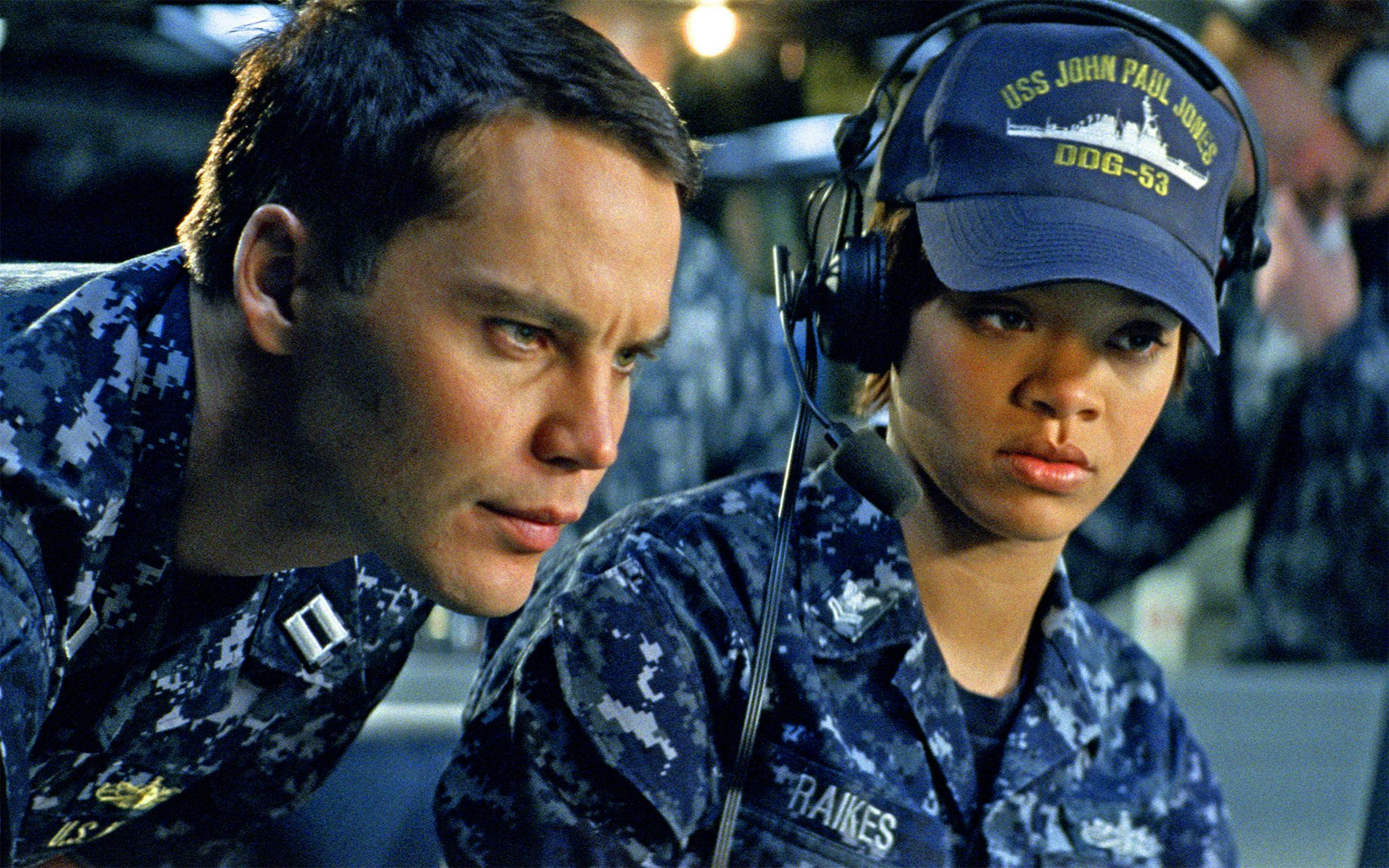
Kitsch and Rihanna in Battleship.
Battleship, directed by Peter “Friday Night Lights” Berg, is a nothing movie, which is to say that it’s the kind of movie where it wouldn’t matter whether you were giving it your full attention or you had it on as background noise while doing Sunday-afternoon chores. It’s probably better to watch it the second way: you could feel good, at least, about getting something done. It’s impossible to offer it all your attention for a full 131 minutes without also being unendingly haunted by the distinct feeling that you’re wasting your time.
If John Carter made it clear that Kitsch is not really a movie star, Battleship clarifies it to the point that the movie has hardly gotten started before it feels like an argument is being unnecessarily drawn out. He plays Alex, a Navy lieutenant trying to move on from his perpetual-fuckup past who, along with the rest of his fleet, is forced to battle an invading squadron of aliens hailing from a planet similar to Earth. That’s about all there is to the movie. Battleship tries hard to find a kinship with the movies of Michael Bay; it has in common with his films of that period the noisy patriotism, hyper-saturated visuals, clobbering attempts at humor, and, of course, a barrage of death and destruction so insistent that if you had at any point been thrilled because of something related to either, you eventually find yourself too numbed to care.
In Battleship, you’re numb even before you’ve gotten the chance to feel anything. (If I ever felt anything, it was exasperation: I of course went into the movie knowing how propagandistic by way of the military industrial complex it likely would be, though what good does that kind of preparation really do when you’re stuck in the moment?) Naturally some of the numbness comes from there not being much to the story. But more of it, I think, has to do with how unlike Bay, who often had genuine movie stars at his disposal (Will Smith, Sean Connery, Bruce Willis, and Nicolas Cage among them) helping ground things, Battleship slots anyone of note to the sidelines.
Battleship is awash in actors who are pretty, which I won’t complain about, but are pretty vacant as star personalities, which I will. There are some exceptions. Liam Neeson is one, though he doesn’t get to do a lot besides be an authority figure and also someone Alex fears. (He’s the disapproving father of the young woman, played by Brooklyn Decker, Alex wants to marry.) Rihanna is another, though her bad-gal magnificence is watered down, albeit not so much that I can’t cop to feeling a twinge of satisfaction when she, confronted by a rogue alien, coolly intoned “mahalo, motherfucker,” and then promptly blasted him. That’s the thing with this movie: anything semi-redeemable about it comes with a qualifier. I guess, because this is a corporation I’m going to say this about, I’m glad Mattel has found success in the movies a decade later with Barbie. Sorry, Hasbro.

Kitsch, Blake Lively, and Aaron Taylor-Johnson in Savages.
Ophelia (Blake Lively), or “O” for short, teases in voiceover at the start of Oliver Stone’s Savages that what’s about to unfold is the kind of violent story where we shouldn’t be taking her narration as proof that she for sure will be alive at the end. (Who knows: maybe she’s giving this testimony just before she bit it.) Of course, teasing that sort of thing is another way of guaranteeing that her pulse will still be going once the credits start to roll. It’s tantamount to aggressively winking. But it still functions well as a way to immediately get us intrigued by a movie that will not disappoint in its twistiness, its capacity for violence, and, not surprisingly for a director as prone to over-the-topness as Stone has always been in his visual style and dialogue, dark humor.
O is probably the most moral person in Savages. But not by much. When we first meet her, she’s living blissfully in a polyamorous household with Ben and Chon (Aaron Taylor-Johnson and Taylor Kitsch), young and handsome best friends who are also somehow definitely the most talented and successful pot growers in Laguna Beach and probably the U.S. more broadly. Here are the secrets to their preternatural success. Chon, which you’re supposed to pronounce the way you would “Shawn,” used to be a Navy SEAL, and he illicitly brought enough top-of-the-line marijuana seeds back with him from Afghanistan to keep the business sustained for years. Ben, who studied botany, knows how to cultivate them to perfection. Both have the kind of business acumen that has made them very successful, if not successful enough to completely comprehend how easily things could come crashing down.
They get that rude awakening when they get a threatening video message from a Mexican drug cartel named Elena (Salma Hayek, styled like an evil Bettie Page) that is mostly just footage of chopped-up drug workers that subliminally says, “you will work for me from now on or this will be you.” Ben and Chon, though, decide to play hooky for a lot longer than Elena, who didn’t really think she was at any point suggesting anything like a choice, would like. And so the movie descends into a series of negotiations. Some involve other shady characters like Elena’s favorite hitman, Lado (Benicio Del Toro), and a greasy DEA agent (John Travolta) who acts like he’s on everybody’s side but more than likely is not on anybody’s at all. Everything is lent a new urgency when Elena kidnaps O and forces Ben and Chon into a job that will need to be done quickly if O wants to live. (O, who’s scooped up because Ben and Chon didn’t think it would be a bad idea to let her go shopping alone after they’d gotten that video, so much doesn’t want to look down the barrel of this situation’s severity that she complains about not getting a toothbrush or home-cooked meals — she’s sick of pizza! — as a hostage.)
The two young male leads are not that compelling, probably because they’re played by Kitsch and Taylor-Johnson, who are slices of white bread compared to everybody else. O is more compelling mostly because of her self-delusions and because she is given more compelling scenes to work with. A favorite is a late-in-the-movie dinner she has with Elena where she treats the drug lord a little like a distant relative she’s trying to get to know rather than someone she ought to be scared shitless in front of. But it’s also easy to not seem that compelling when you have a trio of veteran actors (Hayek, Travolta, and Del Toro) doing hammy, unceasingly fun-to-watch work. Hayek is the best of all, especially when she’s doing the sort of snarling she hasn’t often gotten to do as someone who’s mostly played agreeable, rather than villainous, roles that make her famous sexiness more inviting than flushed with menace. Savages’ twisty-turniness is entertaining on its own, but it’s Hayek and her seasoned co-stars’ operatic committedness that makes it magnetic. It’s for the best that Kitsch doesn’t get in the way.
 Peterson Reviews