
This is the third edition of Odds & Ends, a new capsule-review column collecting brief notes on movies taken throughout the month.
Over-Exposed (1956), dir. Lewis Seiler
Over-Exposed is very good until it arrives at a misogynistic, basically inexorable-for-the-era ending in which a woman deciding to forgo her professional aspirations for a man’s sake is presented like an ultimate happy ending. The movie otherwise is about a scrappy young woman (a magnetic Cleo Moore, in her penultimate film) who reinvents herself as a successful society photographer named Lila Crane. Not without the trouble, though, brought by the shady figures who frequent the nightclub where she does much of her work, or by a journalist love interest (Richard Crenna) who is so whinily vocal about her ambitiousness that you mostly only ever want to smack him when you’re not attempting to shake some sense into Lila for doubting herself on account of anything he says. If you pretend the movie doesn’t end with Lila acquiescing to his wants and not her own, Over-Exposed is mostly an invigorating story about a woman who cleverly claws her way up to the sort of life she could have once only ever dreamed of.
Renaissance: A Film by Beyoncé (2023), dir. Beyoncé
The crux of what’s tiresome about the generally enjoyable Renaissance: A Film by Beyoncé is epitomized by the choice, late in the movie, to abruptly cut to a behind-the-scenes clip of its subject not very convincingly telling the cameras that she’s learned to stop giving a fuck post-40 in lieu of showing one of the best parts of the concert the documentary is highlighting: the extended moment, during “Pure/Honey,” when the stage becomes something like a ballroom, her mélange of dancers temporarily reveling in the spotlight. Beyoncé actually giving a lot of fucks, as it relates to her public narrative specifically, is what time and again thwarts the movie from being the electrifying concert documentary it seems to want to be as much as it does an earnest work of self-portraiture it’s better at excelling as.
Almost every time things begin to pick up momentum on stage, Beyoncé cuts away to inconsistently crucial moments behind the scenes. Among the ones that are are her reflections on her Houston upbringing; her artistically inspiring relationship to her late Uncle Johnny; and the hard-working, disparate touring party she clearly adores. Ideally we’d get two separate documentaries culling from Beyoncé’s Renaissance era — one just the uncut concert, which here is at least shown in nearly all its glory, vast assortment of astonishing costuming and all, and the other just Truth or Dare (1991)–style behind-closed-doors dramas — with both made by a secondary party without as much of a tendency to calculatedly editorialize and apoliticize. It’s a fascinating, frustrating companion piece to what is almost certainly Beyoncé’s greatest album and second-best live showcase. (The first is unequivocally Homecoming.)
Citizen X (1995), dir. Chris Gerolmo
Made for HBO in the mid-1990s, Citizen X chronicles in fewer than two hours the nearly decade-long hunt for Andrei Chikatilo, the Soviet serial killer who in 1992 was at last convicted for his vicious murders of 52 women and children. It’s among the least sensationalist serial killer-related movies I can think of. Giving its Chikatilo (hauntingly played by Jeffrey DeMunn) no more screen time than it needs to, it narratively prioritizes the maddening bureaucratic failures that led to Chikatilo getting away with his crimes for so long, and the doggedness of the forensic specialist turned lead investigator (Stephen Rea) who becomes so emotionally involved with the case that it isn’t uncommon for him to cry while performing an autopsy.

Fantasy A in Fantasy A Gets a Mattress. Courtesy of SIFF.
Fantasy A Gets a Mattress (2023), dir. Noah Zoltan Sofian and David Norman Lewis
It’s hard to be an artist in Seattle, a city it’s difficult to afford living in even when your income streams in steadily. Fantasy A Gets a Mattress, which follows the travails of a fictionalized version of the eponymous local rapper and those in his orbit, manages to substantially grapple with that dire reality while maintaining an amiable absurdism never outré just for the sake of it. It only reinforces, to paraphrase The Stranger’s Charles Mudede, how incoherent a city can feel when there seems not a corner of it hospitable to your creative passions. Fantasy A is funny, seething with double take-worthy line readings, but you notice the bruises once you stop laughing.
Rouge (1988), dir. Stanley Kwan
The devastations of Kwan’s haunting, sumptuously shot romantic fantasy have hit harder in the years following the tragic, premature deaths of its leads. In the film, Leslie Cheung and Anita Mui play star-crossed lovers — he’s a wannabe actor from an upper-crust family, she’s a courtesan sold into sex work as a teenager — who intentionally overdosed on opium so that they could be together in an afterlife that hopefully would be more accepting than the class-obsessed 1930s society that rejected their union. The film traverses between their doomed love story as it unfolded and a modern-day narrative where Mui’s ghost enlists a journalist couple (Alex Man and Irene Wan) to help her find Cheung by placing an ad in the newspaper they work for. (Mui believes Cheung has somehow lost his way traveling between the mortal world and the afterlife, and after 50 years she’s ready to do some investigating herself.) It’s less the romance of Rouge that I found shattering than Mui’s performance. Playing a woman treated perpetually badly who yearns for something more than the cruel circumstances she’s been dealt even in death, Mui got me to the point where I struggled to so much as look at her without wanting to cry.
Personal Velocity (2002), dir. Rebecca Miller
Three women — one (Kyra Sedgwick) restarting her life with her kids after leaving her abusive husband; one (Parker Posey) a talented editor struggling with monogamy married to a guy she finds sweet but boring (Tim Guinee); and one (Fairuza Balk) newly pregnant and running away from her life’s responsibilities— get their stories told in separate vignettes in this affecting drama from writer-director Miller. It isn’t totally a success. Miller’s decision to shoot digitally and mostly in a handheld style is mostly an unconvincing attempt to make things feel more texturally “real,” and though I’m sure she has her reasons, it feels incongruous that the narrator of a movie broadly about women liberating themselves from the guys in their lives who hold them back from reaching their full potential be narrated by a man. (It’s provided by John Ventimiglia, of Sopranos fame, with literary panache.) But the strength of the uniformly great performances, plus Miller’s perceptive, unwaveringly empathetic approach to stories of women whose decision-making society writ large might reserve harsh judgment for, carries it through.
Even Hell Has Its Heroes (2023), dir. Clyde Petersen
Petersen’s documentary about Earth, not the planet but a Pacific Northwest band that makes an almost soothingly somnolent form of metal music, is among the canniest fusions of subject matter and aesthetic presentation I’ve seen in a music documentary, a genre frequently so preoccupied with dispensing information that how it looks and feels becomes an afterthought. Earth’s ghostly sound complements the fuzzy textures of 8mm lenses often taking in dreary Northwest vistas and hypnotically torpid live performances but never the garden-variety talking-head testimonials that so regularly make music documentaries feel like not much more than interviews captured on camera. (The film usually opts for testimonials recorded off camera deployed via voiceover.) You get used to music docs speaking at you; like the music inspiring it, Even Hell Has Its Heroes envelopes you.
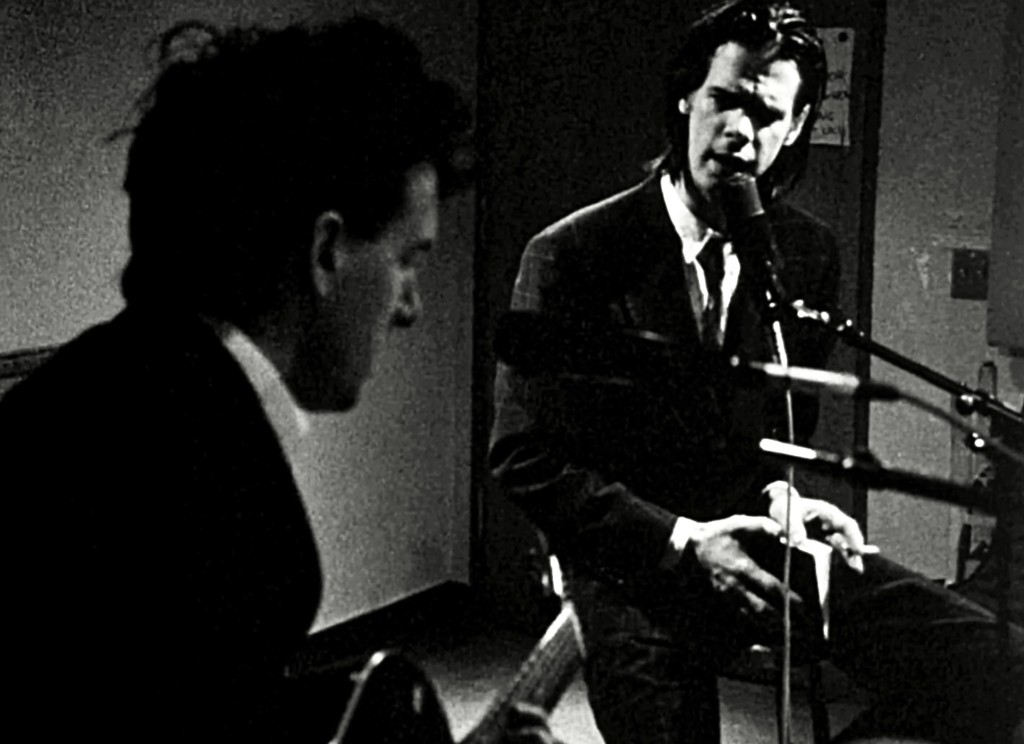
From The Song.
The Song (1991), dir. Uli M. Schüppel
My immediate reaction to this barely-20-minute short watching Nick Cave & the Bad Seeds’ work on the (kind of) title track for Wim Wenders’ Until the End of the World (1991) in the studio was that I hated the editing, but then I rethought things. Sure I would have liked it if this clip had been longer and more comprehensive and not just quick glimpses of recording-studio breakthroughs we almost never get to linger in. (Schüppel is always moving into the next moment with an abrupt fade.) But the way the short is put together I think evocatively mirrors what it feels like to reflect on one’s creative process for a project after things have wrapped up. It’s a blurry constellation of frustrations and epiphanies, the finished product almost striking you — that is if it’s a good finished product — like a miracle.
Lone Wolf & Cub: Baby Cart at the River Styx (1972), dir. Kenji Misumi
I thoughtlessly watched the second of the nine-movie-long Lone Wolf & Cub series first, though I don’t think, based on what I’ve read, that foreknowledge is that major a requirement for enjoyment before dipping in. Adapted from an influential manga, it’s part of a saga about an assassin-for-hire who himself is on the kill lists of many (Tomisaburo Wakayama) moving across 19th-century Japan trying to keep his cherubic young son safe. It’s a thriller with balletically elegant cinematography and action choreography, even the blood splatter — materializing with gobs of red paint — finding a way to look artfully lovely rather than byproducts of violence whose gore the film never skimps on. I look forward to watching the rest of the Lone Wolf & Cub movies; I’ll be more conscious of linearity next time.
Maestro (2023), dir. Bradley Cooper
I don’t that much better know conductor Leonard Bernstein and his actress wife, Felicia Montealegre, after watching Bradley Cooper’s Maestro. This handsomely made movie, eschewing a conventional biopic focus on its eponymous figure to home in on the pair’s marriage (made tumultuous by Bernstein’s open affairs with men and his workaholism), keeps everything at the surface and doesn’t probe much deeper than that. Cooper, who plays Bernstein, is good, but he also can’t shake the feeling that you’re watching him imitate someone for whom being larger than life is alchemical — as natural as breathing. Mulligan, in contrast, is fantastic, the film at its best when she’s the one holding a scene down. (Maestro is similar to Cooper’s A Star is Born in that way, which is to say that I cared the most about it when it’s the woman lead I’m being made to exclusively think about.) Cooper’s passion for his subject is at least tangible and feels genuine; it helps soften, though doesn’t neutralize completely, ideas of it being cynical, textbook Oscar bait. What eclipses that, though, is a hunger for greatness that ultimately feels more gestured at than earned.
Lady in the Lake (1947), dir. Robert Montgomery
You know you’re in trouble when a movie largely propelled by a gimmick inspires you to think a few minutes after starting that it would have been better off without said gimmick. Case in point with Lady in the Lake, an adaptation of Raymond Chandler’s same-named detective novel so alteration-heavy that it can’t even spell its shamus protagonist’s name right. (The movie erroneously gives Philip Marlowe’s forename an extra L.) Its gimmick is that everything is shot first-person style, an audacious move you can’t help but admire but also can’t help but notice makes most of the acting feel canned and speechy, with a mystery not compellingly written enough to make either problem not distracting. Montgomery himself — who only appears on camera, as Marlowe, a few times in mirrors — sounds like he’s doing his line readings from another room. The camera’s approximation of what he’s seeing is so unnaturally still (and unnaturally gingery when it’s moving) that the effect is more that the scene’s partner is a surveillance camera that can breathe. Still, it’s hard not to like at least a little a movie that takes such a big swing. The nicest thing I can say about it is that I’m not mad that it exists.

Tara Reid, Rachael Leigh Cook, and Rosario Dawson in Josie and the Pussycats.
Josie and the Pussycats (2001), dir. Harry Elfont and Deborah Kaplan
I don’t love the suggestion under which this music-industry satire operates (that all popular music is intrinsically shallow), but it’s so sharp about other things — the way pop is often cynically parlayed to sell products, and how frequently those products cajole its buyers into conforming to certain standards — that I don’t mind that much. It also helps that it’s absurdly funny — Parker Posey (as a sneering music executive) and Tara Reid (as the airheaded drummer of the titular band) are responsible for line readings amid the movie’s pointedly inescapable product placement that kept me laughing long after they’d been uttered — and that the music is pretty good, too.
Richland (2023), dir. Irene Lusztig
Toward the end of Richland, an eerie, ruminative documentary about the Washington town that played a pivotal part in the Manhattan project, a girl among a group of high-school students notes how badly hard conversations about the community’s legacy need to be had by its residents but are not. Since organizing them is not that straightforward an option as a means of portraitization, Lusztig instead surveys people of widely ranging perspectives, the results traversing from, to name a few impressions, devastating to self-incriminatingly gross to ambivalent. This documentary runs a little more than 90 minutes; I could have done with even more.
Dreamin’ Wild (2023), dir. Bill Pohlad
Dreamin’ Wild is a biopic about making sense of a bittersweet, complicated accomplishment: being celebrated for an album you made as a teenager nearly 30 years after its initial release came and went without any fanfare. This is what happened to Donnie and Joe Emerson, whose forgotten-about 1979 album Dreamin’ Wild, made when they were coming of age in middle-of-nowhere Washington, was accidentally discovered in 2008 by a record collector perusing an antique store that helped spearhead delayed hoopla for siblings who’d long ago given up on prospects of stardom. (The album’s centerpiece, “Baby,” now has more than 33 million streams on Spotify.) Pohlad’s movie dramatizes the pair’s rediscovery and its aftermath; it puts most of its focus on Donnie (Casey Affleck), who was the truly musical person in the pair and who had before the album’s resurgence been exerting his artistic bonafides on no-frills bar and wedding gigs with his wife (Zooey Deschanel).
Dreamin’ Wild slots an extraordinary story into a few too many as-to-be-expected biopic-narrative beats; it sometimes indulges the treacly as Donnie tries to grapple with what’s been lost even as something new is being gained. But those problems don’t completely diminish the sense of melancholy pulsing through the movie. What do you do with all the years spent believing that what had once felt like a breakthrough in the making was actually a failure? What do you do with people appreciating you not for who you are now but the person you once were? How many albums in the world are of a piece with Dreamin’ Wild, ripe for rediscovery and new emotional connections, that never have their random-find-at-an-antique-store rescue from the purgatory of the forgotten past? What Dreamin’ Wild effectively conveys is that it’s better not to dwell too long on the endless what-could-have-beens.
Repeat Performance (1947), dir. Alfred L. Werker
You’d think the heroine of Repeat Performance, an actress named Sheila (Joan Leslie), would be a little more freaked out about the bind she finds herself in. It’s New Year’s Eve; she’s just shot her murderous, alcoholic, and two-timing husband Barney (Louis Hayward) dead; and, moments later, finds that the year has completely rewound. (It seems that the universe is giving her a chance to redo what has been a terrible 1946.) But no — she just rolls with what, to me, sounds like a 365-day-long nightmare where she’s implicitly tasked with reversing the fate she knows could befall her. The gun-toting intro suggests the movie to come might be a thriller, but it proves to be more of a backstage melodrama where close to everybody is out to get a woman we never see be anything less than kind or considerate. That’s good for a yelling-at-the-screen style of engagement — you spent much of the movie wanting to punch the piece-of-shit husband Sheila for reasons we never understand is desperate to keep — but bad for any sort of real dramatic tension or emotional authenticity. The real highlight of the movie is Natalie Schafer, doing the sort of hoity-toity rich-woman comedy shtick foreshadowing the indelibly kooky work she’d do on Gilligan’s Island.
Anyone But You (2023), dir. Will Gluck
Watching Anyone But You in the theater the night before Christmas, I thought about how it felt like a Netflix original romantic comedy mistakenly put on a big screen before I thought about its probably intentional throwback resemblance to the kinds of fluffy, middle-of-the-road rom-coms to star someone like Jennifer Aniston, Kate Hudson, or Jennifer Lopez in the aughts and early 2010s. Depending on whom you ask, such is a sad testament to how long it’s been since one might have associated the genre with a theatrical outing rather than the end to some aimless scrolling on a streaming service. The movie is unlikely to spur anything like a revival of its kind the way some advance press has tried to position it as. But it’s charming and sometimes very funny, its nice-to-look-at enemies-to-lovers leads (Sydney Sweeney and Glen Powell) blessed with the kind of good chemistry that can make you forget that this is, to paraphrase the critic Kristen Yonsoo Kim, a movie about a conventionally hot, white cishet couple making a queer interracial wedding all about themselves.
 Peterson Reviews