This is the fourth edition of Odds & Ends, a capsule-review column collecting brief notes on movies taken throughout the month.
Crush (1992), dir. Alison Maclean
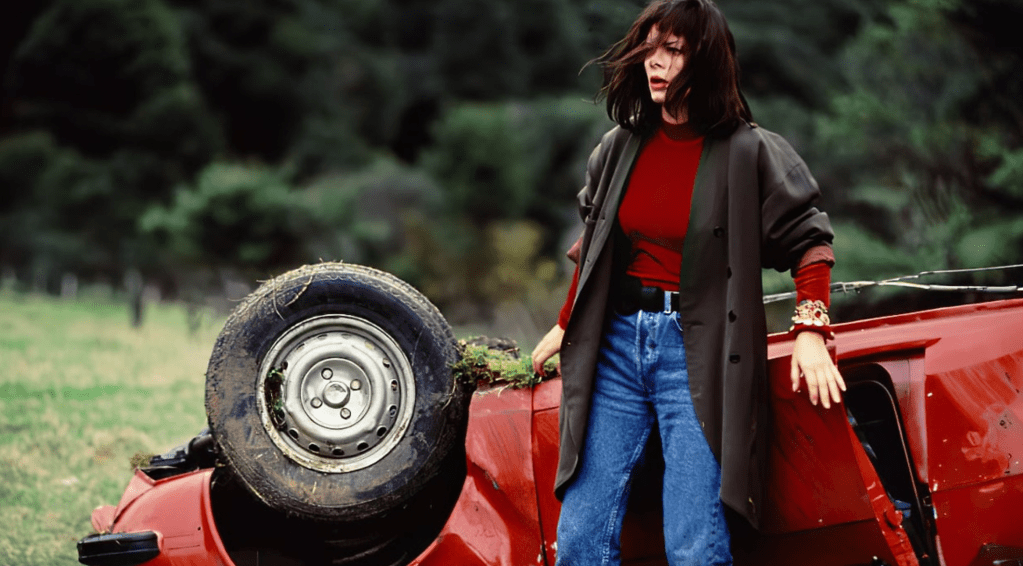
Slippery, sinister Crush begins with a bang. Or, it’s probably more accurate to say, the crash of a car, going something over 100 miles an hour on a snaky cliffside road before swerving and flipping. A woman named Lane (an excellent Marcia Gay Harden) is driving; Christina (Donogh Rees), her literary-critic friend en route to interview an acclaimed author, is in the passenger seat. Christina’s injuries put her in a coma. Lane is barely scraped. Lane waits out Christina’s up-in-the-air awakening by inserting herself in the lives of the author and his teenage daughter (Caitlin Bossley), the former romantically and the latter more antagonistically. Lane is the kind of prickly and inscrutable character who has a way of making you suspect she could maybe commit murder or something else heinous; just being around her puts you on edge. But the movie isn’t going for straightforward thrills the way a film featuring a character like her would. It’s a harder-to-categorize, unwaveringly unsettling story of guilt, misplaced blame, and ever-shifting power dynamics. I loved it.
News from Home (1977), dir. Chantal Akerman
Akerman’s follow-up to her magnum opus, Jeanne Dielman, 23 quai du Commerce, 1080 Bruxelles (1975), is more conspicuously personal than its predecessor and is, since it’s not 201 minutes long, I suppose more approachable. Otherwise it feels like, with how it centers domestic malaise, like the continuation of a conversation. News from Home visually consists only of long, static shots of often lonely New York City locations, taken three years after Akerman abandoned the new life she’d started there. (She resided in the city, nebulously hoping to “make it” as an artist, between 1971 and 1973, hiding her plans from her family until she was already in America.) The only sound in the movie comes from, naturally, streetside clangor, but also Akerman herself, who via voiceover reads aloud all the letters her mother sent her while she lived in the city.
Sometimes they’re general updates about what’s going on in the Belgium Akerman would eventually come back to. But more often they amount to the older Akerman passive-aggressively pleading with her daughter to write more consistently (“it’s all I have left”) and to be more considerate in her responses in letters the movie keeps out of its purview. The juxtaposition of the film’s setting and its storytelling powerfully speaks to the baggage one leaves behind, not just physically but emotionally, when one starts a life somewhere new. It also reminds you, whether looking from the point of view of the elusive Akerman or the woman who raised her, the way the absence of someone can become its own kind of presence, ideas of someone who isn’t there able to become perhaps more potent than being with them in the flesh.
Picasso Trigger (1988), dir. Andy Sidaris
Sidaris’ movies are not a lot more than action movie-themed Playboy spreads cinematized. It’s all omnipresent sexy posing from Playmates and Penthouse Pets (and a handful of token beefcake men) often done in usually Hawaiian locales rife with danger and narrative developments that don’t make sense. I don’t know why what I’ve seen from Sidaris doesn’t turn me off but endears (I am, for one thing, disadvantageously gay); it probably has something to do with being disarmed by his brand of summery vulgarity being presented less with a tongue in its cheek than with a straight face. But since no one in or behind the movie seems to be thinking that hard, I won’t either.
Bintou (2001), dir. Fanta Régina Nacro
In this short from Fanta Régina Nacro, a woman named Bintou (Alima Salouka) living in a Burkina Faso village is determined to send her only daughter (she has three kids) to school, and nothing, especially not her abusive husband who thinks it’s financially wasteful to educate a girl, will stop her. The amount of physical risk Bintou is taking for her daughter to have a future is a scary, never-far-away possibility, but the short overall is consonant with its eponymous character’s sunny determination, packing a lot of heart and emotional power in a half hour.

Cynthia Gibb, Virginia Madsen, and Daphne Zuniga in Modern Girls.
Modern Girls (1986), dir. Jeffrey Kramer
I get a little sad watching a “one crazy night”-style movie. I wonder how soon things will calcify for its characters (that is if things don’t get too out of hand) into a fond memory where the night’s highlights soften what had within been hard to deal with in real time. Modern Girls inspires much of that. The group of early-20-something-year-old women having the crazy night (played by Daphne Zuniga, Cynthia Gibb, and Virginia Madsen), for which the film clearly has a lot of affection, are trekking through the confusions of one’s early adulthood you can really only properly register as a so-called “crossroads” once you’re a few years older than they are. Modern Girls is a microcosm of those wilderness years. The movie isn’t without darkness — one scene implies a gang rape might have happened without intervention, for instance — but it largely keeps things unpredictably fun and fizzy, finding the humor and the poignancy in being young and thinking most things happening to you are life-and-death-severe when there’s still quite a bit of time to “figure things out.” Until there isn’t.
The Cat from Outer Space (1978), dir. Norman Tokar
I do not think that this Disney movie about a jewel-collared alien cat crash-landing his ship on Earth and amusingly manipulating some humans to get him back home is quote-unquote good. But it does make me want to go and immediately adopt an Abyssinian, an elegant breed the color of warm beach sand the film correctly sees as suitably ethereal. Because I would rather not hear that most Abyssinians are not what you would call a “lap cat,” or that there are none within a 100-mile radius of where I live, I’m going to stop researching and start manifesting.
Party Girl (1995), dir. Daisy von Scherler Mayer
The daughter of a woman said to have no common sense and a man said to have no conscience grows up to be a New York party girl who, when we first meet her, seems to have inherited their ostensibly defining traits, taking just about nothing in her life seriously except for the artfully mismatching outfits in which she swaggers around by night. That changes when she gets in some early-film legal trouble that gives her enough reason to try to straighten her life out, something she attempts by leveraging a family friendship to get a library job she turns out to excel at. Parker Posey plays the protagonist with trademark quirkiness that’s charming when not befouled by her character’s casual racism and homophobia; she’s the best thing about a movie that struggles to keep up with the originality of her arch and vital comic style.
The Hammer (2023), dir. Jeff Beesley
When Reba McEntire is having fun, so am I. I can’t imagine that she was not making The Hammer, a cozy TV movie where she acts alongside her boyfriend, exclusively wears products from her fashion line, and gets to play a tough-love small-town Nevada judge embroiled in a murder mystery who does things like continue extending a man’s jail sentence until he provably becomes a better husband to his wife, routinely drives 40 miles over the speed limit, and knocks disgruntled plaintiffs out with her gavel when they try something funny in the courtroom. Fuck with Reba at your own peril.

Teyana Taylor in A Thousand and One.
A Thousand and One (2023), dir. A.V. Rockwell
Teyana Taylor gives one of the best performances of the year — and, though one could argue that it’s early to say so, of the decade — as Inez. She’s introduced in Rockwell’s excellent feature-directing debut in 1994, the year she was released from a year-and-a-half-long stint at Rikers Island for theft; kidnapped her son, Terry (Aaron Kingsley), out of the foster system; and turned 22. (Terry says his last memory of Inez was, as a 2-year-old, being abandoned by her on a street corner.) The movie unfurls across a little more than a decade. Inez and Terry both try to trounce the difficult foundation of their early lives, but the former’s understandable but also illegal effort to retrieve the son snatched from her years ago will eventually catch up with them both. It’s a powerful, emotional melodrama; it’s also an incisive critique of the various systems basically colluding to fail Inez and Terry no matter how much they fight to escape them.
Mortuary (2005), dir. Tobe Hooper
I have only seen Denise Crosby in movies where moving to a new house is the worst thing you can do, which is another way of saying that I have only seen Denise Crosby in two movies. The first was Pet Sematary (1989). Now I’ve seen Mortuary, in which she plays a new widow who concludes that the best way to refresh her life as a single mom is to start a career as a mortician, a specialty in which she has no experience, and move her kids (Dan Byrd and Stephanie Patton) mid-schoolyear into a comically run-down mortuary-slash-farmhouse all the way across the country so that she can start a funeral-home business. Naturally the property turns out to be pretty much cursed — a second life as a zombie is promised if your corpse decomposes anywhere near the site — and naturally none of the characters is turned off by signs that they shouldn’t live here, from rapidly spreading black mold to a front yard slick with the remnants of a recently ruptured septic tank.
There’s something chilling in here about being helpless to your parents’ whims as a kid; the film also continues the long-standing Hooper obsession with family units and the places one might call “home” proving more of a breeding ground for horror than the outside world, which in his movies doesn’t seem all that cruel, as the typical description goes, but like a sort of haven, at least comparatively. But an inconsistent commitment to camp, paired with decision-making from the characters that goes beyond merely stretching credulity (people unhesitantly wander into pitch-black attics, open coffins, crypts), suggests an amateurishness that makes the movie feel ultimately depressing coming from a director responsible for one of the best horror movies ever made.
The Incredible Shrinking Man (1957), dir. Jack Arnold
I went into The Incredible Shrinking Man thinking it would be silly-fun sci-fi, not a movie keeping me teetering on the verge of tears. Yet I found myself there for most of the film. Mostly the movie is a heartbreaking allegory for sudden disability and feeling at a loss about how to navigate a world fundamentally inhospitable to you. Grant Williams is terrific as the unlucky eponymous character, fulfilling proto-action star expectations (they’re needed during the film’s wondrous effects-heavy final stretch) when not being heartrending as a diminutive tragic hero cursed with a fate he can’t reverse. He broke me when, mid-film, he laments to another character that he wishes he could forget the life he’d been living before he began inexplicably shrinking so that his current case would hurt less.
Caged (1950), dir. John Cromwell
Prison is more reactive and life-ruining than, as it’s ostensibly meant to be, remedial. Caged understands this while tracking the prison stint of a pregnant 19-year-old (Eleanor Parker) whose now-dead husband mixed her up in an armed robbery. It sometimes indulges the sort of campiness far more leaned into in the women-in-prison exploitation movies to proliferate in the 1970s — mostly to blame is a Satanically evil matron character played by a hard-voiced Faith Emerson — but it’s mostly just straightforwardly ruthless and damning of a cruel system. The ending’s bleakness feels like a triumph in an era where movies had to strictly abide by a production code that warned directors to, for instance, be cautious about how they portrayed public institutions and being overly sympathetic to criminals. Caged’s willingness to throw both those cautions to the wind gives it an abiding relevance in a country where the ills of incarceration depressingly remain fundamentally intact, if not worse.

Saleh Bakri and Maryam Kanj in The Present.
The Present (2020), dir. Farah Nabulsi
This 24-minute short, co-written and directed by Nabulsi, is about a father and daughter (Saleh Bakri and Maryam Kanj) going out to buy a birthday present — a fridge — for Mom. But the simple act is turned complex by this family living in the Palestinian enclaves — by having to go to the Israel-occupied Beitunia to retrieve it. The success of the trip hinges on them making it through a checkpoint where cruel Israel Defense Forces soldiers are determined to make the journey as difficult as possible. This is a harrowing, humane short concisely functioning as a simulacrum of the injustices of life under occupation.
Get Over It (2001), dir. Tommy O’Haver
Get Over It, a teen comedy whose 2001-ness is best embodied by Sisqó (he plays a best-friend character), can be very funny when its gratingly dweebish lead, Ben Foster, is not in a scene. Martin Short, as the drama teacher with failed songwriting ambitions organizing the school play around which much of the story is centered, is riotous as someone who says stuff like “Bill Shakespeare is a wonderful poet, but Burt Bacharach he ain’t” with a straight face. So are Swoosie Kurtz and Ed Begley, Jr., as sex-therapist parents with a son who wishes they’d stop being so cool and also so cool with everything. Foster, though, is unfortunately in most of the movie as the annoying, lovelorn lead, romantically rebounding with a songwriting protégé (a predictably charming Kirsten Dunst) after his girlfriend blindsides him with a breakup.
Trauma (1993), dir. Dario Argento
I am not the first to say that it’s weird that Argento would cast his daughter, Asia, in a movie requiring her to both do nude scenes and playact a romantic relationship with a man nearly twice her age. (Asia was 16 when the shoot started.) I am also not the first to note that Trauma, which complementarily has a major narrative thread about a toxic parent, is an otherwise pretty good thriller, nightmarish both visually (it’s almost always thunder-storming outside) and narratively (a serial killer keeps decapitating people with an electric garroting machine I can’t believe exists).
Jacqueline Novak: Get On Your Knees (2024), dir. Natasha Lyonne
I saw Get on Your Knees at The Crocodile in Seattle last year. I don’t think anything has made me laugh as hard as that since then, except maybe the live show for a podcast Novak co-hosts I went to not long ago, besides the same standup set in special form, which is now available to watch on Netflix. Novak doesn’t follow the one-joke-after-another format we’re used to in standup. Get on Your Knees is more a breathless stream of consciousness, the product of an overanalytical mind turning a topic over and over again until nothing else is left to think. Novak’s rapid-pace rambling makes the show itself, which runs a little more than 90 minutes, feel like a physical feat. It’s an intellectual one, too, focusing solely on, if you can believe it, just blow jobs and some adjacent tangents without it ever feeling like Novak is beating a dead horse or doing lazy sex-comic pandering. It’s only ever illuminating, and of course very funny, in the kind of way that makes you want to see Novak’s voluminous mind work through other subjects rarely given the same consideration.
 Peterson Reviews