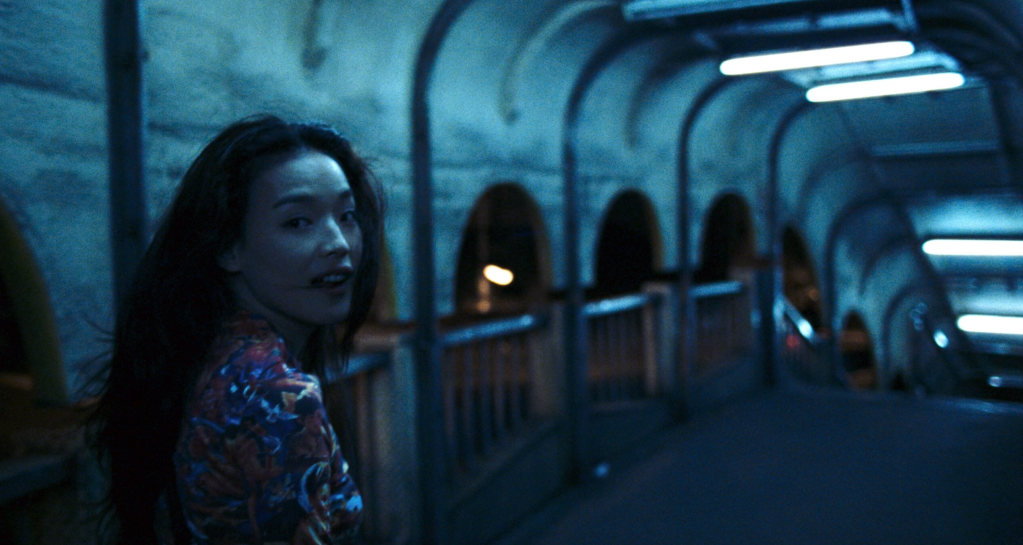
Vicky (Shu Qi), the heroine of Hou Hsiao-hsien’s Millennium Mambo (2001), narrates the movie from a distance — about a decade in the future, to be exact — and we come to hope that wherever she is, she’s happier than she is in the movie. When we meet her, Vicky is a young and aimless club fixture with little to her life besides the toxic relationship she’s been in with Hao-Hao (Tuan Chun-hao) — an insecure, generally bad-news DJ — since she was a teen. (An early encapsulation of their bad dynamic: Hao-Hao not waking her up for a final exam — one that would decide whether she graduated or not — because he didn’t like the idea of her getting her diploma and then moving on from him.)
Vicky has been with him ever since, always on the receiving end of emotionally aggressive outbursts that generally stem from his delusional jealousy. She’s stuck in a cycle where she works up the nerve to break up with him, then goes back to him after he pesters her enough. She eventually stakes some independence for herself with a job at a strip club, where she is, for seemingly once, looked out for, by a Buddhist gangster, Jack (Jack Kao), who’s there for her even at her worst.
There is not a lot more narratively to Millennium Mambo than this; in a New York Times piece from a few years ago, critic J. Hoberman likened the movie to a ballad, a form it takes after with the romanticized gloom of future Vicky’s narration, which sometimes tells us what’s happened off screen, whether far into the past or into the future, with the wizened detachment of someone who has moved on. Millennium Mambo’s lyricism lives in its visuals, too, throbbing often with neon and sometimes sedated with slow motion, injected to turn mundane joys — strutting down a subway tunnel with a cigarette in hand, enjoying the breeze from a car’s sunroof — euphoric. Hou’s insistence on sometimes imbuing the small with the grand suggests a young woman able to survive her life’s miseries because of the sporadic pleasures it can offer. Millennium Mambo doesn’t need us to know too much about its characters’ inner lives; it’s more about capturing feelings and moods — the listlessness of a woman floating through life because she isn’t sure what else to do.
The film sometimes moves the action out of the city and into Hokkaido, a snowy Japanese village where Vicky blissfully shoots the shit with a pair of brothers she met at the club. It’s here that she seems happiest, and that the movie isn’t forthright about whether these scenes are happening far in her past or well into the future kindle optimism that Vicky might eventually make it out of the troubled stasis of her life with Hao-Hao. You feel in them the beauty of youth Hou seems interested in: how it’s the age where there’s still time for messes to be cleaned and mistakes to be run away from, possibilities of starting anew a lot easier than they are later in life, when the baggage piles and it’s easier to get stuck precisely where you already are and don’t want to be.
 Peterson Reviews