This is the fifth edition of Odds & Ends, a capsule-review column collecting brief notes on movies taken throughout the month.
I Know Where I’m Going! (1945), dir. Michael Powell and Emeric Pressburger
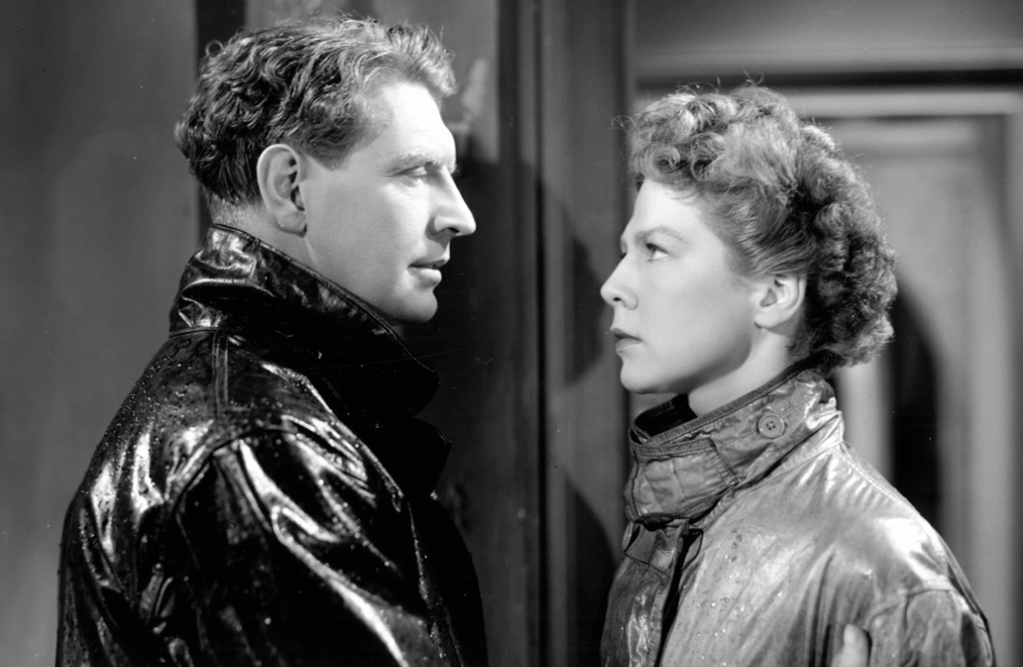
It feels redundant for the narrator of I Know Where I’m Going! to explicitly tell us at the beginning of the movie that Joan (Wendy Hiller), the movie’s headstrong, 25-year-old heroine, has always been the kind of person who lives up to the title. The take-no-prisoners, high-necked Hiller makes that clear even when she’s just sitting and saying nothing. The movie is a romance where Joan’s preternatural assuredness — this time imbuing a trip to the Scottish isle of Kiloran, where she’s headed to marry a way-older, never-seen industrialist — is tested by a weather-related necessity to stop for several days on the folksier isle of Mull. She tries as best she can to prevent herself from falling too much in love with the people there but particularly a naval officer (Roger Livesey, whose speaking voice is almost unbelievably sexy) who also is trying to get back to Kiloran. Powell and Pressburger, who direct soulfully — who capture the way a pastoral setting like Mull can recenter you, make you reflect on things you wouldn’t in your much-busier real life — don’t make a movie that seems, as it might happen in other movies of its era, like it’s trying to “tame” a stubborn woman. I Know Where I’m Going! feels more like a celebration of letting go from time to time — of indulging in what feels right rather than what logically makes sense.
Shredder (2003), dir. Greg Huson
Slasher movies always revisit the same crime scenes: college campuses, high schools, summer camps, suburban neighborhoods, a litany of abandoned city properties. So I appreciate Shredder for thinking outside the box and having much of its carnage take place on slopes and perpetrated by a snowboarder-hating killer who prefers stalking with skis locking his feet and killing ingeniously with things like icicles and ski-lift chairs. The movie is all just tongue in cheek enough to work, and features one of my favorite moments in a slasher movie: a mean blonde girl, who has just a few breaths left before she succumbs to her injuries, assuring her goody-two-shoes boyfriend that she never loved him.
The Wicked Lady (1945), dir. Leslie Arliss
Barbara (Margaret Lockwood) tells someone early on in The Wicked Lady that all she wants is to be admired and talked about. She will never quite be that first thing, but she will be the second, though only after impulsively deciding to become a black-masked stagecoach robber to stave off the tedium of being a noblewoman with a boring husband. (The movie is set in England in the 1600s.) When not anonymously menacing the roads, Barbara openly menaces high society, stealing married men and lying like she’d die if she didn’t. Lockwood is so good as an often scheming, often smirking anti-heroine that feels like a prototypical Joan Collins character; it’s inevitable, since the movie was released in 1945, that she won’t get away with her transgressions, but I will only remember her as triumphant.

From Death Walks at Midnight.
Death Walks at Midnight (1972), dir. Luciano Ercoli
Death Walks at Midnight’s driving murder mystery, and the obligatory, climactic explanation of it, does not make sense. But I didn’t mind, because I loved its heroine — a headstrong fashion model named Valentina (Susan Scott) with a lustrous head of stoplight-red hair that matches a very hot temper — so much. The giallo subgenre, of which this movie is loosely a part, generally likes its women leads passive and frightened — in need of a man to save them from the living nightmare in which they find themselves. Valentina is indeed frightened, but she’s too sure of herself to leave her fate up to someone else. She’s a much-needed departure from the genre’s gendered norms.
Red Eye (2005), dir. Wes Craven
The marvelously fleet Red Eye reminds me of a few things: that Rachel McAdams can do anything; Wes Craven doesn’t need many scraps of narrative to devise a blunt-edged, efficient thriller; and that one can never immediately trust Cillian Murphy in a movie because he is too pretty and has too blue of eyes. (Because he doesn’t have the warmth of Paul Newman, the only other actor I can think of with that bright of irises, Murphy puts you in mind of a husky you’re unsure whether you can safely pet.) Murphy is decisively not safe to be around in Red Eye; he plays a terrorist who intentionally gets a spot on a red-eye flight next to a workaholic hotel manager named Lisa coming back from a funeral (McAdams) so that he can threaten her into doing some maneuvering at work to ensure that the U.S. Deputy Secretary of Homeland Security is in a room in which it would be the easiest to carry out an assassination.
Like Roger Ebert, I enjoy that the deputy secretary, not the secretary proper, is worthy of that kind of thing in the film’s purview. I also enjoyed watching the scared and scrappy McAdams attempt to outwit who is effectively her captor on a cramped plane. This 76-minute-long movie doesn’t all take place on the plane — the intense cat-and-mouse climax is, for instance, set in the home of Lisa’s father (Brian Cox), who is being used as a pawn in the Murphy character’s games — but in your memory years after first watching it you might remember it that way. Craven so evocatively taps into the anxiety of being seated next to a personified nightmare on a long flight that, like McAdams when she first realizes that this guy is a menace and not the potential suitor she’d gotten along with so well in the waiting area, you can feel the way her stomach drops and stays there.
Miss Leslie’s Dolls (1972), dir. Joseph P. Mawra
Made for what looks like about a dollar, Miss Leslie’s Dolls is about three women and a guy on a road trip who break down near a cemetery in a rainstorm. They’d rather not tough it out and sleep in the car overnight, so they knock on the door of the first house they see. It belongs to a transgender woman — an identity the film inevitably, but not as aggressively as I thought it would, looks at as a signal of derangement — who lives alone, kept company by her beloved black cat and a fleet of “dolls” (i.e., the corpses of women she has embalmed and keeps propped up like mannequins in a special room) that suggest to the naïve boy in the visiting group that she is simply a “girl worshipper.” It feels like stating the obvious to say that Miss Leslie’s visitors won’t end up in better shape than the dead women their host uses like decor. The movie, besides the goofiness coming from the Miss Leslie character speaking at a snail’s pace so that a woman with a more traditionally feminine voice can dub her lines, is a surprising slog, a poor What Ever Happened to Baby Jane? (1962)-style grotesquerie.
From In Heaven There is No Beer?.
In Heaven There is No Beer? (1984), dir. Les Blank
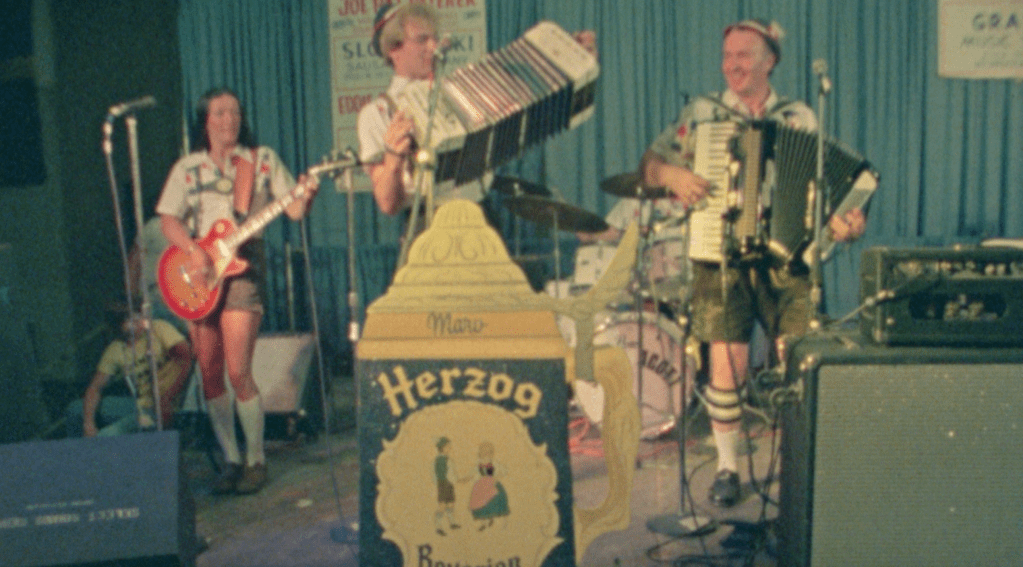
I don’t think I’m capable of willingly listening to polka music for more than a few minutes, but after watching In Heaven There is No Beer? I know that I’m capable of enjoying a short documentary about it. Blank, with the help of editor Maureen Gosling, isn’t trying to convert so much as capture the joy and sense of community the devotées it homes in on find going to polka-related events — the history that informs its importance to those who continue to loyally convene around it. I finished feeling the way I have with so many of Blank’s other movies: with a new appreciation of something about which I’d barely thought twice.
Salome’s Last Dance (1988), dir. Ken Russell
Russell’s “adaptation” of Oscar Wilde’s 1891 play Salome is, characteristically for him, deliciously vulgar in a visual sense. But its framing device — having Wilde be one of the characters in the movie, played by Nickolas Grace, being an overjoyed spectator watching his own play — sets it up to feel stiltedly stagey. It never recovers from its paradox of feeling confined while also being expansive in its wild costuming and general visual ostentatiousness. It at least gets a revelatory performance out of the woman playing the title character: the baby-faced Imogen Millais-Scott, who literally went blind about a month before shooting started, still performed because Russell was adamant she remain in the cast, and then never again appeared in a movie.
The Plastic Dome of Norma Jean (1966), dir. Juleen Compton
I’m glad that Compton made enough money in real estate to completely self-finance and self-distribute this sharp, self-assured, and surreal movie about the corrosiveness of fame — particularly as it relates to women — and sad that she would only direct, more than 20 years later, one more movie.
 Peterson Reviews