

lad in a blushing pink ballgown recalling a certain performance of “Vogue,” Bob the Drag Queen warmed up the crowd at the Madonna show he was emceeing at the Kia Forum the other night by asking when we first fell in love with her. For me it was sometime in early 2015, the year I graduated from high school, after watching her notionally vérité 1991 documentary Truth or Dare on a whim. I didn’t press play really knowing the music or the persona. Then I suddenly needed to know everything about this performer whose attention-gobbling charisma was so overpowering that the movie’s almost neverending array of unflattering moments had a strange way of consistently, which is not to say always, endearing her more to you than putting you off. In an era flush with Truth or Dare-influenced pop star-centric documentaries sanded down to remain harmonious with a brand — the accidentally unsettling Justin Bieber: Never Say Never (2011) and the press release-y Katy Perry: Part of Me (2012) among them — it was thrilling to watch someone successful in the pop firmament confident that providing access even to the worst sides of herself would probably help rather than hurt her. But, then again, “the movie’s not completely me,” Madonna said in a 1991 Vanity Fair cover story. “You could watch it and say, ‘I still don’t know Madonna,’ and good. Because you will never know the real me. Ever.”
The Kia Forum performance I went to was the 57th show of the 80-concert-long Celebration tour, which was supposed to start earlier last year until a major health scare postponed its kickoff to October. The tour is the obvious outlier in Madonna’s four decades of performing: not tethered to any one specific album; more open to musically reminiscing in a greatest-hits sense; the closest to revealing that elusive “real me.” Each of her tours has so faithfully built on the foundation of the latest album that the occasional invocation of something “old” was likely to be thoroughly repurposed aesthetically so as to better suit the latest sonic world Madonna, ever the chameleon, was stubborn about rigidly inhabiting. The practice either was just fine or a major pain depending on how much you liked the album she was this time promoting. On the Celebration tour, she relents, letting the songs mostly remain the way we best know them.
I saw Madonna on the third night she was playing at the Forum. I could not say for sure whether this was a performance from someone particularly happy to be dwelling on the decades of music preceding her, even if I didn’t not believe her when she said to the audience toward the end of the show that “it’s important to never forget where you come from; your past informs your future.” (I also can’t imagine it being easy trying to find a new, persuasive emotional urgency while revisiting the likes of, say, “Holiday” or “Open Your Heart” or “Burning Up,” perfect pop songs played to death because they are perfect pop songs long before the tour even started.)
The performance was, much of the time, blighted by a feeling of obligation. There was no denying the frequent curatorial shrewdness for which Madonna has long been revered: pairing “Human Nature” with “Crazy for You” to repurpose the latter from a song about tunnel-visioned romantic passion to self-love; bringing out the latent melancholy of “Holiday” by climactically, and maybe a little on-the-nosely, segueing to memorializations of friends prematurely lost to AIDS as the bedrock for a performance of “Live to Tell.”
Clunkiness still emerged. A confusing, way-too-long interlude with some incomprehensible storytelling features a ring of fire and nightmarish visuals recalling the woozy sights seen in the Jennifer Lopez-starring serial-killer thriller The Cell (2000). Images of Civil Rights icons bemusingly took up the screens during songs for which Madonna cosplays different ethnicities (“La Isla Bonita” and “Don’t Cry for Me Argentina”). “Open Your Heart” was bombarded with images onscreen of what appeared to be AI search results for “man 1940s.” Rather than actually perform “Like a Virgin,” the song was confined to a transition where it was mashed up with Michael Jackson’s “Billie Jean.” The pair’s silhouettes danced on one screen in a way that recalled, as the friend I went with mused, the figures you boogie alongside in the “Just Dance” video game. (Screens were elsewhere taken up with a telling repetition of the very few pictures of Madonna and Jackson that exist — nearly all of them snapped by paparazzi — that only make it stark that the pair were not, as Jackson has said in so many words, friends.) Obviously pandering fan service is not something Madonna excels at; it tracks that she’d leave out hits like “Express Yourself,” “Material Girl,” and “Music” in favor of lesser songs like “Bedtime Story” or “Die Another Day” if she couldn’t even stomach singing “Virgin.”
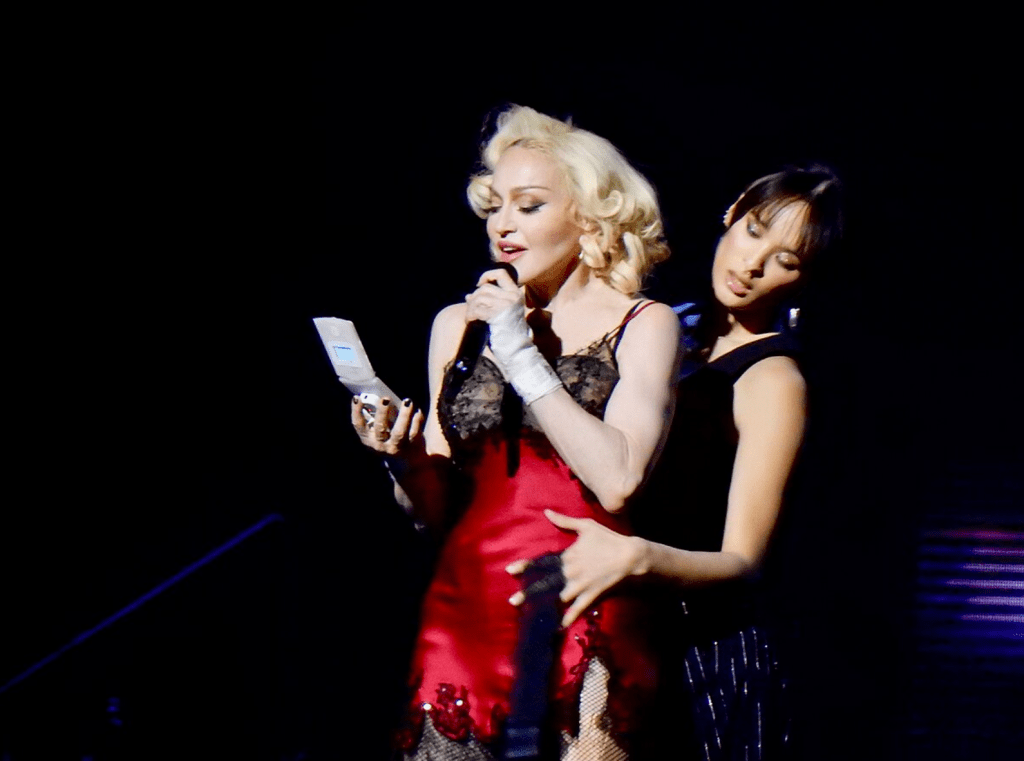
Madonna during the Erotica segment of a London show. All imagery courtesy of Wikimedia Commons.
It is, of course, probably hard in general to be straightforwardly celebratory of the past not just when you’ve lived most of your career straddling the artistic cutting edge, but also when it’s so marked with death. Madonna lamented during the show the heaviness of being a kind of sole-survivor figure, still standing while peers like Prince and Jackson met premature ends. There’s true poignance in that, though its darkness, paired with the number of songs she seemed not that interested in performing, made it hard to be in the mood for which the tour is named. You were better able to feel Madonna’s enthusiasm during the songs that, for her, have yet to truly be exhausted by the public: the power-is-lonely ballad “Bad Girl” during the Erotica (1992) segment (which probably is the show’s most inspired); the propulsive and abrasive “Bitch, I’m Madonna,” which closed the show and saw Madonna capering around with a phalanx of dancers dressed up in classic old looks. I was particularly glad to see the heaving white furs and gold-rhinestoned cowboy hat from the “Music” visual and the ‘40s-style baseball uniform she wore in 1992’s A League of Their Own.
The concert was as tightly constructed as one has grown accustomed to expecting from Madonna; even if performances were sometimes half-heartedly approached or vocally pitchy, you otherwise couldn’t catch anything out of place. But it was at its best when she was most off the cuff — the most willing to let go of just a little control. The “Vogue” segment, steadily the most talked-about moment in the show, was a bird sanctuary-colorful delight. Resplendent in slouchy leather, the comedian Ali Wong gamely guest-starred to help Madonna “judge” different voguers — one of whom included Madonna’s daughter Esther — as they twirled and shimmied and death-dropped. Her on-stage banter, though naturally imbued sometimes with the elegiac, was characteristically sharp and funny (“I am trying to destroy my ego, but it helps when you respond to what I say”), only inadvertently the latter when she noted that it was Tuesday, not Thursday, toward the top of the show and didn’t miss a beat.
The undoubted highlight was when Madonna brought out her Australian analog, Kylie Minogue, to assist with an acoustic cover of Gloria Gaynor’s “I Will Survive.” There’s a late-in-the-show segment looking back on Madonna’s career that ends with the famous quote that “the most controversial thing I’ve ever done is stick around,” yet I found that it wasn’t as much the show’s setlist most effectively reinforcing that sense of longevity as it was the appearance of Minogue. She, too, continues to weather the unfairly inevitable challenge of being publicly written off on account of age, getting the last laugh recently with the surprise smash single “Padam Padam.” There is strength in numbers.
The concert might have been uneven, but it was still a rousing testament to the impressive endurance of a cultural monument with a surplus of great music and indelible iconography. Even on this tour based around looking backward, it’s still blazing a trail for the pop stars to follow in Madonna’s wake, showing what’s possible when you’re more than halfway through your 60s, not able to move or sing with the tireless energy that you used to but still able to enrapture a crowd. (It does not seem likely that she will embark on a tour of this size and scope again.) Even still, I’m hard pressed to think of a current pop star who is not Beyoncé primed for the staying power Madonna has embodied, with her freaky canniness for convincing musical 180s and spinning controversies into boons for cultural dominance. As always, the concert made you curious about what she’d do next.
 Peterson Reviews