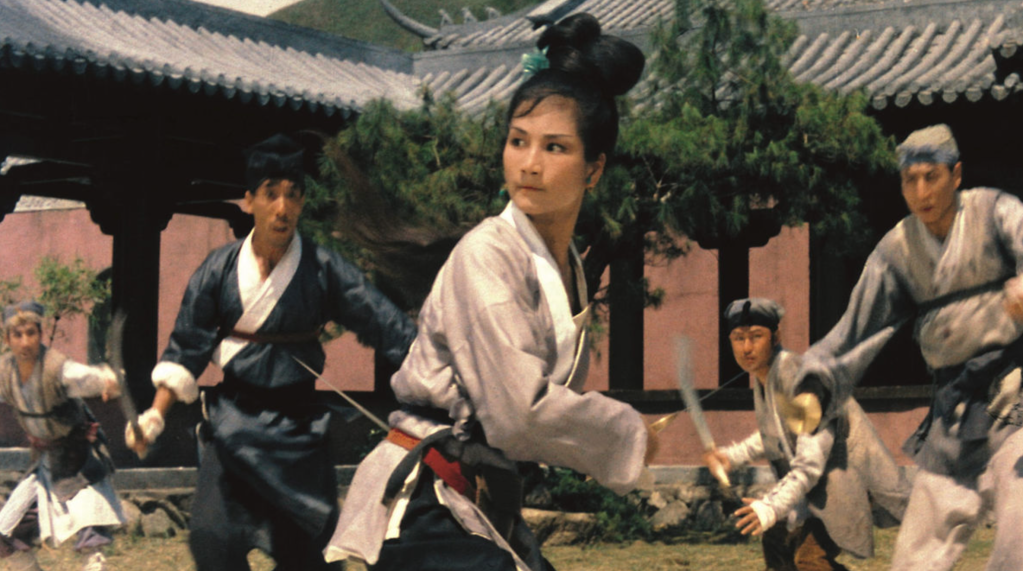
A woman disguised as a man named Golden Swallow (Cheng Pei-pei) sits at a bar, orders tiger bone wine, and proceeds not to have what might have otherwise been a moment of relaxation. The majority of the other men here — minions of a fey bandit known as Jade-Faced Tiger (Chan Hung-lit) — know the mysterious woman poses a threat to them and ambush her. But they prove to be no match for the skilled swordswoman, who nimbly flings her drink into the eyes of her first attacker before almost placidly turning her would-be predators into mince meat.
A truce forms. It’s only temporary, though; it doesn’t change the fact that people on both sides have what the other wants. Jade-Faced Tiger has kidnapped the governor’s son (Wong Chung) in retaliation for the government’s imprisonment of his master. Golden Swallow — who is also the governor’s daughter — wants her brother back.
Though it throws in a B plot via Drunken Cat (Yueh Hua), a goofy incognito Shaolin master who can split boulders in half revealed to have a connection to Jade-Faced Tiger’s milieu, Come Drink with Me’s (1966) story doesn’t get more complicated than that. It doesn’t need to. The film’s director, King Hu, approaches it with such exciting visual verve, and with such a firm hold on the stakes he co-wrote with Ting Shan-hsi, that it has a way of feeling more substantive — more epic — than it seems like it would be on paper. (Its sense of scope feels so sweeping that it’s surprising that it’s only 91 minutes long.) In his 2016 essay “A Touch of Zen: Prowling, Scheming, Flying,” writer David Bordwell noted that Hu was such a meticulous visualist that, while on the set of his movies, he was wont to deliver photocopies of every shot to the cast and crew ahead of time, and that, since he was not particularly interested in anything related to kung fu and Shaolin tales, he looked to Beijing opera as inspiration for his fight scenes, which he preferred to see as dances.

Cheng Pei-pei in Come Drink with Me.
Come Drink with Me was only Hu’s second movie. You wouldn’t guess it was the work of a filmmaker who’d only sat at the head of a project one other time. It’s warranted to call all its assiduously crafted set pieces spectacular — particularly the final showdown between Drunken Cat and his corrupted old enemy — and its period design immersive, the care toward the hair and costuming, plus the detailed set design from Johnson Tsao, palpable. Hu’s commitment to precision makes sense for a director who would go on to have a profound impact on wuxia filmmaking over the next decade.
Wuxia films — which, to put it simply, orbited around the exploits of martial artists living in ancient China — were not new when Come Drink with Me came out. But it was pivotal in ushering a new era expanding on what the subgenre could be. That new era, funnily enough, was formally announced by the film’s backers. In a piece of 1965 publicity, the Shaw Brothers production company explicitly shared their intentions to usurp old-fashioned staginess for realism in their wuxia films, the Bordwell piece says.
Come Drink with Me was also crucial not just in launching the career of 20-year-old Cheng — who’s astounding as a young woman of preternatural strength, poise, and quick instinct — but also the very idea of the woman action star. (Golden Swallow is widely considered cinema’s first action heroine, the kind of role that still, to many, is regarded more like a specialty than a natural part of the action genre.) The movie’s importance is manifold, but its historical weightiness can’t be felt. It’s a milestone that feels light on its feet — ready for the next adventure.
 Peterson Reviews