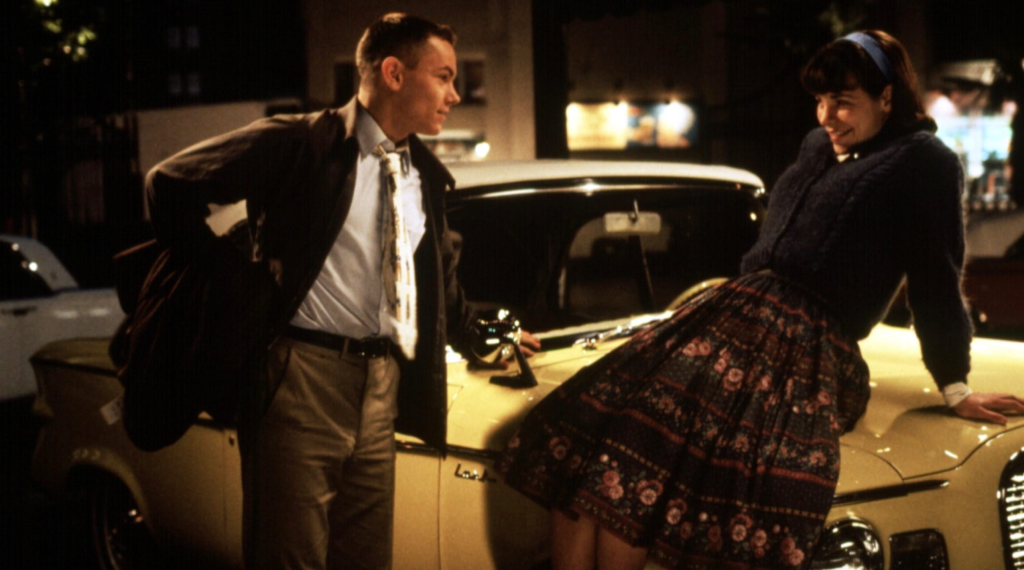
It’s something of a miracle that Eddie and Rose (River Phoenix and Lili Taylor), the teenage couple we will come to root for in Nancy Savoca’s moving Dogfight (1991), are able to move past the cruelty on which their burgeoning relationship was formed. It’s 1963, and Eddie and some fellow Marines are in San Francisco for a 24-hour leave before shipping off to Japan. To amuse each other, the boys are planning what they call a dogfight party — an unfathomably cruel gathering where each brings the “ugliest” girl they can find on short notice and have them obliviously “compete” for the top title. Eddie comes upon Rose, a waitress who gives the cozy diner where she works its namesake, and decides that she’s his best bet even though she’s quite lovely — just a little shy and unconfident about her makeup and hair.
Rose will inevitably find out what’s really going on (a sex worker hired to be the “ugliest” — a title she’s garnered simply because she has false teeth — fills her in), and really let Eddie have it. “You’re just a worthless excuse for a human being,” goes one of her rightfully apoplectic insults. She storms home, and he, both feeling guilty and now able to admit to himself that he and Rose had had a connection even under false pretenses, follows her. He braves the family guard dogs to stick a sign outside her bedroom offering an apology and a nice dinner. She surprisingly agrees, and the movie becomes a touching walking-and-talking-style romance that recalls Richard Linklater’s Before Sunrise (1995), a high point of the subgenre.
The pair in Before Sunrise had to part ways because of practical circumstances — one person lives in Paris, the other in America — and in Dogfight there looms the reality of Eddie’s military responsibilities. (Also hanging over the film is the fact that, the day after the movie starts, word will come that the president has been shot, though the characters do not, of course, know that.) The movie maybe doesn’t have Eddie atone enough for the callous circumstances that brought Rose to his attention, but it’s still hard not to pull for a pair where each person appreciates the characteristics everybody else overlooks: Rose the thoughtfulness and sensitivity Eddie has learned to quell when around his blow-hard friends, Eddie the soulfulness and creativity of an introverted girl considering anti-war activism and yearning to someday be a Joan Baez-like figure, helping heal the world through song. (Rose, who can play the guitar and piano, still only plays covers and looks longingly at the collage of folk singers papered above her bed; she says she’ll start performing live once her hair is a little longer and she’s started writing her own stuff.)
Phoenix and Taylor both give remarkable performances as lost young people who still have some of their optimism left in a cruel world that will inevitably dull it. Taylor is, in particular, so lovable that you often want to give her a hug. She’s the kind of person for whom kindness is never a conscious act, and Taylor conveys it so well that she practically glows.
Dogfight has an unnecessary, but not unwelcome, coda set three years into the future, where both characters are a little more hardened and have managed to find each other again. Bob Comfort, who wrote the film, doesn’t dwell very long on their reunion — see if this romance could end up working out beyond a one-night fling that was, to say the least, memorable — in order to give the movie a happy-enough ending. The same effect could have been achieved had the film concluded with the pair’s goodbyes in the 1963 section of the movie; the later redux feels like the belaboring of a point. But I also can’t say I was unhappy to see Eddie and Rose in each other’s arms again. You hope that this won’t be a chance meeting but the start of a new chapter — a sign that the movie has done its job.
 Peterson Reviews