
he three leads of Steve Kloves’ The Fabulous Baker Boys (1989) are the kind of people one might say were born a few decades too late. The brothers of the title, Frank and Jack (Beau and Jeff Bridges), have been doing a throwback dueling-piano nightclub act for the last 15 years, taking whatever gigs they can get around the greater Seattle area. The singer they hire to accompany them at the beginning of the film, Susie Diamond (Michelle Pfeiffer), is like the red-lipsticked spawn of the kinds of alluring lounge-singer types Lauren Bacall or Marlene Dietrich might have played at the height of the Hollywood Golden Age.
Defeat brings the three together. There’s never been a time when the Bakers’ shtick was particularly in vogue, but their ability to cobble together a decent living has been harder lately. More and more of the bars that used to be regular clients are opting for simpler, cheaper entertainment. That’s not so bad for Jack, who lives mostly for his beloved black lab, regular one-night stands, and the bottle. But it’s grave for Frank, who has a wife and kids to support. (His anxieties about everything falling apart most manifest in his perfectionism, which finds him dwelling on a song in the setlist starting a little unevenly or one of a song’s verses being improperly sung twice.) So the pair decides to hold auditions for a singer to incorporate into their act. All are duds — the winning loser is a Lina Lamont-voiced waitress with a yen for Sammy Davis Jr.’s “Candyman” amiably played by a cameoing Jennifer Tilly — that are promptly forgotten about as soon as Susie appears.
Susie shows up an hour and a half late, literally tripping in through the door with her lipstick smudged and hair mussed and tinselled. But she makes the wait worth it with a take on “More Than You Know” so hypnotic that you only realize what a spell you’ve been put under when she plops her saliva-hardened wad of bubblegum back in her mouth and acts like nothing’s happened. She doesn’t have any musical experience, and has never really had musical aspirations, either, but she’s been an escort for a while and is tired of how empty the work makes her feel.

Michelle Pfeiffer in The Fabulous Baker Boys.
The Bakers don’t tend to be badly received. But as soon as Susie first performs with them, it’s startling how much she transforms their act from pleasant background noise into something for which people are willing to stop dinner conversations. You feel the same way the trio’s audience does watching Pfeiffer. Her unflashy but lovely voice is perfect for the knowing, world-weary standards she’s asked to sing; it was not, as was common practice for the torch singer-playing actresses of a few generations earlier, dubbed. Pfeiffer so assuredly embodies Susie’s hard-edged sensuousness that her stage persona doesn’t feel performative but like a natural extension of the character. It’s a means to poeticize the jaundiced charisma radiating off her whenever she speaks.
Kloves’ dialogue has an almost rhythmic quality at its most inspired. It feels overheard from people who joke and self-deprecate through life to deflect potential hurt and cover up the pain we can tell is there anyway. (“You’re not going to start dreaming about me and waking up all sweaty and looking at me like I’m some sort of princess when I burp?” Susie self-protectively wonders when it seems like Jack might have a thing for her.) You really believe that Susie and the Bakers are at the end of their ropes when we first meet them — that they’re always waiting for the shoe to drop even when it finally seems like their early-film lucklessness has at last turned around. (Jack will still celebrate his hard-won financial security by fixing his dog’s teeth.) That persuasiveness saves the movie’s characters from feeling too much like the familiar types they unambiguously are, though one has to especially credit Pfeiffer for the lived-in texture she brings to the sex-worker-with-a-heart-of-gold trope. She makes you feel like you’ve never met this kind of character before.

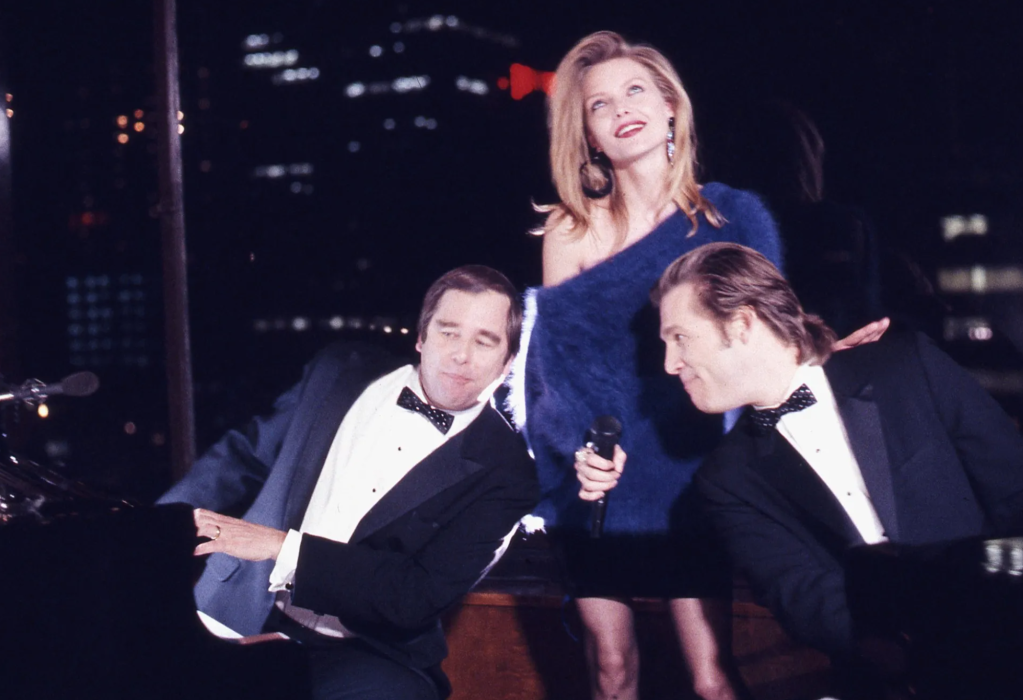
Jeff Bridges, Michelle Pfeiffer, and Beau Bridges in a promotional photograph for The Fabulous Baker Boys.
It’s a feat that when she performs the movie’s most famous number — “Makin’ Whoopee,” during which she writhes atop Jack’s closed-shut grand piano in a clinging red-velvet dress — she, to paraphrase Pauline Kael in her review of the movie, matches, rather than displaces, someone like Rita Hayworth. (The “Makin’ Whoopee” number seems modeled after Hayworth’s black-satinned performance of “Put the Blame on Mame” in 1946’s Gilda.) The latter performance was used to taunt a man in Gilda. In The Fabulous Baker Boys, “Makin’ Whoopee” becomes foreplay for a hookup Jack and Susie have been restraining themselves from having all film long. They worry (accurately) that it will likely ruin the dynamic of a group just barely holding on as is. Pfeiffer and Bridges’ chemistry pulses with will-they-or-won’t-they tension; they make Jack and Susie’s apprehension feel almost touchable — like a presence hovering in and around their adjoining hotel rooms.
Pfeiffer is today seen as properly “breaking through” as a movie star following her immediately indelible work in The Fabulous Baker Boys, even though the film was bigger with critics than at the box office. She’s so much the finest thing about the movie that we don’t realize how much she has come to define it until the last act, when she spends some time away from the siblings and we’re left only with them. The place where they find themselves — washed up while only being never-weres at most, the glow of their dreams dimmed by the stressful practicalities of paychecks — is poignant. But the mind wanders as they finally get to the inexorable part of the film where the long-simmering tension between them comes to blows. What is Susie up to?
The Fabulous Baker Boys was mostly shot in Los Angeles. You gather that the moments conspicuously shot in Seattle — Jack shivering while walking past an Ivar’s, the cameras taking in a misty view of Union Station before gliding into his apartment’s stuffy living room — were probably all taken care of in a few days. But the movie always feels saturated with the melancholy that hovers in the city particularly when the skies are clear and sunny but the air is cold. It’s weather that suggests, rather than insists on, hopefulness. Kloves was only 29 when the film was released; he takes pains to avoid the soft and the sentimental. Even when Jack tells Frank that he loves him onstage, we can’t tell whether Jack actually means it; it’s another inscrutable moment from a character so reserved that it’s hard to detect how emotional he truly feels about anything. It’s a testament to Kloves’ restraint that the film doesn’t end happily, but happily enough. It’s for the best.
 Peterson Reviews