

n a train bound for Zurich, veteran actress Maria’s past and future collide. Shortly after she asks her assistant, Valentine (Kristen Stewart), to dispel rumors that she’s starring in the next installment of the X-Men franchise she’s recently sold out to, Maria learns that the director she’s traveling to Zurich for — the guy responsible for writing her breakthrough role about 20 years ago — has died. Then word gets out that a hotshot theater director, Klaus (Lars Eidinger), wants to revive the play, Maloja Snake, that had given Maria that breakthrough on both stage and screen via its subsequent film adaptation. Only this time, she isn’t to play Sigrid, a self-serving young woman who drives her older lover, Helena, to suicide. The theater director thinks it would be an interesting twist to have Maria play Helena.
Valentine thinks the proposition is worth seriously considering; she calls Klaus “probably the best of his generation,” “a sick director.” Maria isn’t so sure. She is, for one thing, going through a stressful divorce. The role is, for another, scary — too vulnerable. Sigrid had been exciting to play, her mercenary confidence in sync with a young Maria’s hungry ambition. But Helena requires Maria to simulate an emotional sincerity and openness — both things she doesn’t indulge much in a profession requiring a strong backbone — that will ultimately be destructively betrayed.
Exquisitely played by Juliette Binoche, Maria is, like the woman portraying her, an actress of international renown — at the place she is in part because of the care with which she’s cultivated her image and her shrewd selectiveness with roles. Going back to Maloja Snake is difficult to square. It requires her to look back on a career built on unyielding forward motion; it could potentially supplant how people think about her in relation to the play and movie. But also, Valentine reminds her boss, professional options don’t have the far reach and numerousness they once had. There are movies like the X-Men franchise, expensively ersatz green-screen operas that mine Maria’s living-legend reputation to bolster their legitimacy. There are also, as rattled off from Valentine’s well-worn iPad one evening, beneath-Maria offers like Latin-American eyeglass commercials and Spanish horror movies where she’s playing a Mother Superior battling bloodthirsty lycanthropes.
Clouds of Sils Maria (2014), written and directed by Olivier Assayas (who also co-wrote the movie, 1985’s Rendez-vous, that gave Binoche her first leading role of note), perceptively ruminates on how, for actresses, a cache of experience and iconic roles is often not enough to maintain autonomy over one’s image in an industry that historically fetishizes youth and systematically relegates those who’ve aged to the margins. When offers start to dwindle, does one take roles that once might have been seen as lesser because there isn’t anything else available? Or does one risk being forgotten about by being choosier, sanding down a work schedule into something more sporadic not because the passion for the work has diminished but because preserving a legacy, whose loftiness can’t even be promised, is worthier?
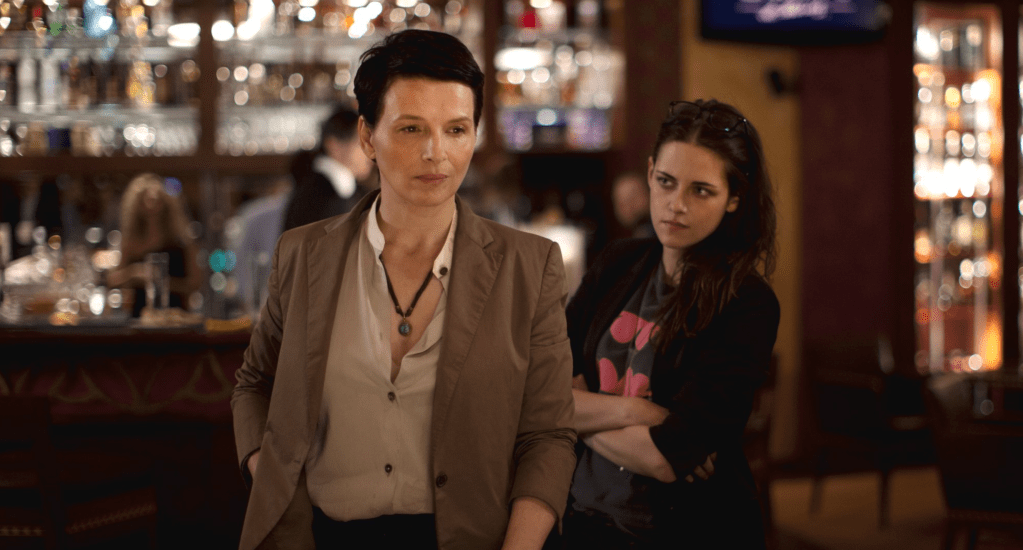
Juliette Binoche and Kristen Stewart in Clouds of Sils Maria.
Clouds of Sils Maria and Maloja Snake are named after a phenomenon specific to the Maloja Pass. When the conditions are just right, a haze of clouds slithers through the valley before giving way to a maelstrom that makes you wish you were somewhere covered and warm. It’s like an elemental embodiment of how rarely, and how elusively, opportunities come as a performer where a part concurrently broadens one’s notoriety and plays to one’s strengths. Despite the respect her name is synonymous with, it’s a chase Maria is ever-familiar with. It becomes even more near-Sisphyean when navigating a career where movies-as-content are greenlit far more frequently than the kinds of films that actually feel artistically rewarding — a problem that only keeps worsening the more franchise and IP movies continue to dominate.
Maria is fearful of what returning to Maloja Snake might stir inside her. Much of the film’s virtuosically maintained tension comes from her internal tussle. Clouds of Sils Maria is infectiously fascinated with how art informs life and vice versa, something most extensively explored in how the relationship between Maria and Valentine both mirrors and diverges from Sigrid and Helena’s. It never steps into the romantic, but you see parallels in the shifting emotional power dynamics — how mother-slash-mentor-figure dominance isn’t limited to the older person in the dyad simply because of age.
Lines are blurriest when, once Maria does hesitantly take the part in Maloja Snake, she and Valentine retreat to a secluded Alpine cabin to prepare. Most of their time is spent doing line readings. Those moments are presented by Assayas with an initial slantedness that at first makes it difficult to parse whether it’s indeed Maria and Valentine speaking. Then, once we’ve gotten our bearings, it’s easy to wonder how much of the vitriol in Sigrid and Helena’s language bespeak what Valentine and Maria privately think of each other but are, on account of their professional relationship and what appears to be a genuine friendship, without much incentive to get off their chest.

Kristen Stewart in Clouds of Sils Maria.
That question is most tantalizing as it relates to Valentine, whose inner life is always obscured. (Stewart, whose performance won her the French equivalent of the Oscar, is hypnotically shifty, impressively standing toe to toe with a towering figure like Binoche; she’s commanding in a role that requires she be more verbose and articulate than in the movies that catapulted her to the A list when she was still a teenager.) The most we get of Valentine’s subjectivity is her opinion on what Maria should do career-wise and her interpretation of Maloja Snake’s themes. Her youthfulness also makes her more naïvely open-minded, most prominently displayed when, in a delightful scene, she waxes rhapsodic about the emotional power seemingly silly franchise movies (like the ones in which Maria stars but hates) can have. Binoche keeps laughing so hard, spitting out attempted sips of beer along the way, that the moment has an improvisational joyfulness.
It’s a cheeky way for Assayas to have Stewart, who’d only just finished her time as the lead in the juggernaut Twilight series, obliquely making the case for why less “serious” movies can still have the kind of emotional appeal worth surrendering to — that one shouldn’t write off as a byproduct of a “guilty pleasure” one should be embarrassed about. (Stewart’s appearance in a movie like the tricksy Clouds complements the overarching idea of, as an actress, wanting to distance yourself as much as possible from the past, especially the early movies for which you’re most known.) It’s also a stark reminder to Maria of what a large contingent of the generation beneath her might want from films they consume and the performers they gravitate toward.
This instance of youthful intuition is a lot less hard to receive than when, later in Clouds of Sils Maria, the new Sigrid, played with masterful cockiness by Chloë Grace Moretz, impudently brushes off some acting guidance from Maria with some startling who-gives-a-fuck-about-Helena dismissiveness. Clearly molded after Lindsay Lohan in her tabloid-baiting heyday (the character is rumored to have shown up at the house of the ex-boyfriend who scorned her with a loaded gun), the Moretz character is additionally representative of how the entertainment industry is far likelier to give its fresher faces, even when they’re this fuckup-prone, second chances than someone at Maria’s age.
Clouds of Sils Maria is never so declarative. Its thoughtfulness is stealthy and subtle; layers aren’t insistent about immediately emerging. It’s a movie you want to keep thinking about. It relishes ambiguity when it can, most memorably with the Valentine character. When she abruptly departs, her unexplained, unremarked-upon disappearance invites questions of whether she was real or the opposing side of an internal dialogue made into a stubborn mirage. There being no fantastical element is likelier. But Assayas’ summoning of prismatic ideas while being somewhat evasive about them makes the mind wander.

Kristen Stewart in Personal Shopper.
In Clouds of Sils Maria, Stewart’s character reminds you of a spirit, floating through spaces in which she would not otherwise be without someone to attach herself to. (Characters that strike you like specters are not uncommon in Assayas’ body of work; as the critic A.O. Scott has smartly observed, the filmmaker is recurrently preoccupied with “figures in perpetual transit: actors, corporate executives, terrorists. Their identities have been dissolved by perpetual displacement.”) Stewart’s next project with Assayas, Personal Shopper (2016) — which he wrote immediately after working with her on Clouds — heightens that ghostly feeling. A part of that is easy to pinpoint. The character Stewart plays, Maureen, may or may not be being “followed” by the ghost of her late brother, and the film is set during a chilly, orange leave-crusted autumn that automatically makes you think of a haunted house (inside which many scenes of the film will turn out to be set). But it’s also buoyed by Maureen herself and the situation she’s living.
It’s a transitional one. She’s in France trying to make paranormal contact with said brother, Lewis, who’d been living in the countryside with his wife (Sigrid Bouaziz) at the time of his sudden death. Both born with a heart defect that could kill them at any time, Maureen and Lewis made a pact that whoever died first would show a sign to the other from the other side. To make ends meet, Maureen works by day in Paris as the personal shopper for a “a real fucking pain in the ass” socialite (Nora Waldstätten) whose societal contributions are appearing at the kinds of exclusive fashion events where Karl Lagerfeld might slink around and serving as the face of a gorilla-rescue organization about whose optics she’s more concerned than the actual impact she’s having on the species.
Maureen doesn’t seem to have any friends, not in France and not stateside either. She has a boyfriend fulfilling a work assignment in Oman she only ever talks to on Skype. (She’s never excited to answer his calls; she winces when he asks her to visit, which she almost never does.) Maureen’s social interactions are almost chiefly transactional. Her communication with those most important to her is usually facilitated by a screen or, obviously, through the supernatural, a mysterious force that can muddy whether the supposed spirit you’re talking to is the one you’re trying to contact or something sneakier, possibly malevolent.

Kristen Stewart in Personal Shopper.
Like in Clouds of Sils Maria, fact and fiction never feel completely separate in Personal Shopper, only in its case “fiction” is not couched in movies or theater but, potentially, Maureen’s imagination. We do see what seems to be a ghost at a few points, but is it really there, or is Maureen’s grief and desperation for closure making her see things? She later starts receiving teasing, enigmatic texts from an unknown number that introduces itself with, “I know you and you know me.” Maureen more than considers ideas of it being Lewis; something more sinister could also be at play, but Assayas dodges anything conclusive. Personal Shopper is one of few movies that manages to turn the act of texting into something emotionally gripping to watch; observing Maureen mull over what she’s going to say next, you feel the way you might when you yourself are absorbed in a conversation on iMessage, so anxious for what your conversation partner is going to say next that it becomes a challenge to act like you’re thinking about anything else when you put your phone down.
The text relationship becomes particularly risky when Maureen, nudged by this presence who is or isn’t Lewis, starts trying on the clothes for which she signs eye-poppingly large blank checks for her boss. At first she modestly twirls around in them in front of mirrors; then she’s falling asleep drunkenly in them in her boss’ bed. It’s like Maureen is haunting the apartment in these scenes, yearning to slip inside the form of another. She can’t help but be overtaken by the allure of this uppercrust world she also logically knows she despises for its shallow surfaces.
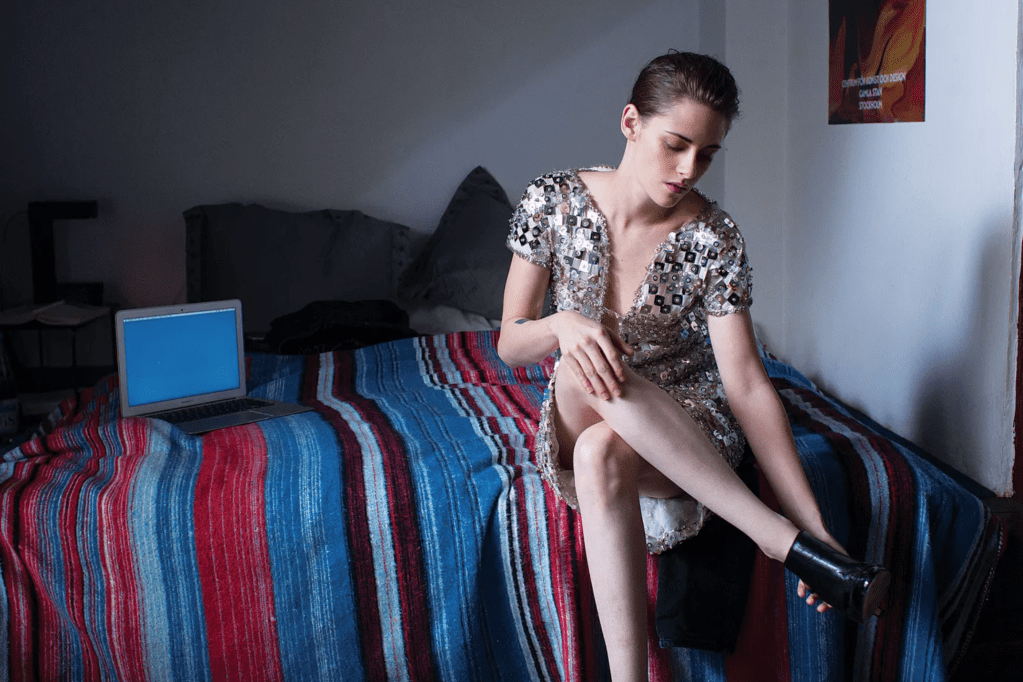
Kristen Stewart in Personal Shopper.
It’s hard not to think of Stewart’s public persona when immersed in these scenes. The actress has always seemed, even when she’s been at the forefront of high-profile movies, somewhat ambivalent about the more superficial aspects of her job, radiating a sense of detachment if not active discomfort. Her love for her art, and increasingly the self-expression clothing can bring during promotional appearances, is what keeps her coming back to a glittery world she doesn’t fully fit into.
Stewart’s stylish outsiderness makes her, whether she means to or not, emit a sense of cool that’s only continued building the older she’s gotten. Cool so often seems to be rooted in how well, and how aspirationally, you perform knowing yourself. Stewart and Maureen share an estimable inability to truly fake when they don’t believe in something, even if Maureen isn’t always so sure what she wants or where she wants to go. They both have a way of revealing, as the critic Sarah Nicole Prickett has said when describing Stewart, more than they mean to. Maureen also marks, I think, the time Stewart has looked coolest in a movie, ambling around in leather jackets and ‘90s-slacker sweaters and getting around town on a motorbike. You can almost smell the cigarette smoke waft off her.
The years since Twilight have largely seen Stewart devote herself to projects tipped toward the “one for me” side of the “one for them, one for me” dichotomy actors of her stature have the financial and artistic security to seriously contemplate. When Maureen frustratedly says at one point that part of the reason she dislikes her job so much is that it takes away from what she’d much rather be doing, I couldn’t help but hear it like Stewart, still at a point in her career where her celebrity was tending to eclipse the substance of her work, indirectly voicing her dislike of the hullabaloo she’s obligated to field whenever she embarks on a new project. Like Maureen, Stewart was in 2016 in a period of adjustment, at the beginning of carving out a career more comprehensively on her own terms. I wonder how she thinks of that time now.
 Peterson Reviews