
Bound (1996), Lana and Lilly Wachowski’s debut feature, is so good that it makes you wish they would have gone on to make more movies like it — bare-bones genre exercises taut as a drum and with style to spare. (They would, instead, come to specialize in expansive, sci-fi-leaning epics — still with style to spare — starting with 1999’s groundbreaking The Matrix.) It stars Jennifer Tilly and Gina Gershon, arguably never better, as Violet and Corky. Corky is an ex-con betrayed by her last lover just released from a more than five-year prison sentence; she’s gotten a handyman job at the apartment where Violet lives with her volatile boyfriend Caesar (Joe Pantoliano), who works as a money launderer for the mob.
When the women first catch eyes in the building’s elevator, it’s lust at first sight, their attraction to each other confirmed when Violet calls the maintenance line a little while later so that the favorite earring she’s dropped into the kitchen sink’s drain can be retrieved. (“I’m trying to seduce you,” Violet coos after Corky wonders why, moments later, she’s teasing the rose tattoo stamped on her left breast.) Violet had already been contemplating leaving Caesar before Corky enters the picture; she doesn’t think she can stomach pretending like she isn’t living with the kind of person who’d cut off a man’s fingers in their bathroom anymore. (They’ve been together five years.) Once she learns more about Corky’s background, Violet gets an idea. What if the two not merely ran away together, but also intercepted the briefcase stuffed with $2 million in embezzled mob money Caesar is going to have sitting ready for delivery to his superiors in the apartment?
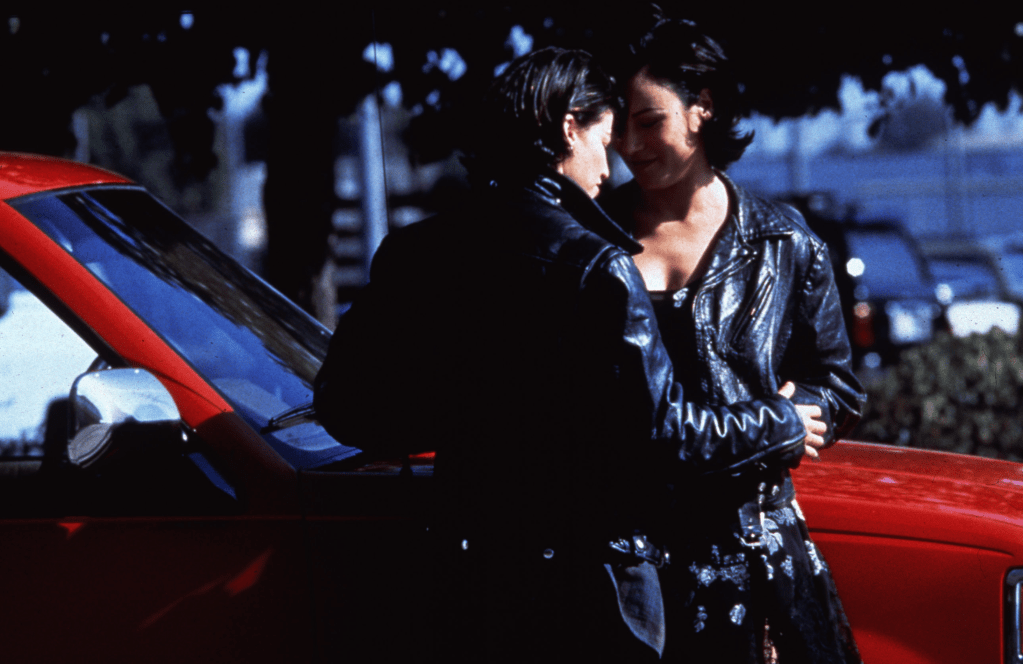
Gina Gershon and Jennifer Tilly in Bound.
One could worry Violet is a Phyllis Dietrichson-style femme fatale, using her surfeit of smooth charisma and sex appeal to manipulate Corky into doing her bidding before double-crossing her. But the Wachowskis and their actresses put you at ease after Corky agrees to Violet’s initial pitch. It’s usually not hard to sense when the femme fatale types seen in the films noirs Bound is paying homage to are up to no good. You can, in contrast, tell that these women, already anomalous in a genre where heterosexuality is a default identity, really are in love, the tricky task at hand only a promise of their newfound romantic commitment.
This is also, it’s clear from the jump, the kind of movie that wants to pull off another thing rarely seen in film noir: women characters duping misogynistic men who underestimate not just who they are, but what they’re capable of. Corky’s and Violet’s sexualities are not ornamental; they’re taken seriously, love scenes steamily reinforcing the sense of power they instill in each other.
There was some bewilderment at the time of the film’s release, and for a few years afterward, how straight male filmmakers could ground a movie in the perspectives of lesbian women (Violet characterizes sleeping with men as “work”) without objectifying them — depict their desires through the fantasy-forward lens of the straight male gaze. Now that both the Wachowskis are out as trans women, it makes more sense, and also makes it hard not to see the film and the struggle it depicts as a kind of allegory about longing to escape into a life where you can be yourself rather than continue existing in a prison of expectation.

Gina Gershon and Jennifer Tilly in Bound.
That escape will, of course, not be easy; the tension inherent in Bound from the moment it starts only keeps building. Violet and Corky’s plan — a true beaut — won’t unfold like it’s supposed to. They can blame Caesar, the sort of impulsive person whose next action you truly can never predict, for that. The Wachowskis’ dialogue is rhythmic and tough, sometimes very funny, but none of these characters’ humanity gets undermined by the stylishness not just of the dialogue but the presentation. The movie claustrophobically spends nearly all of its running time in two apartment units, but it never feels stagebound because of the Wachowskis’ visual acuity. I’m still thinking about how one scene starts by zooming out from the bowels of a pistol barrel, the visual of an apartment covered with so much blood-stained money that it looks like a particularly fucked-up sliver of a community garden.
Pantoliano gives a live-wire performance, his character so much a collection of snap judgments that his decision-making can make you physically flinch. But Bound is as electric as it is because of Tilly and Gershon, whose chemistry crackles. In so many movie romances, you can feel how much those experiencing it soften. There’s some of that here, but when I think of Corky and Violet together I think of how much they fortify the other’s confidence and power — swagger. Corky in particular has the latter in spades even before she’s become one half of a couple; Gershon beautifully deploys her cat-like smile — a trademark, to my eye — in a way that physiognomically points to the character’s con-artist background, a hustle that after enough successful manipulations would certainly give you the I’m-the-shit cockiness she personifies so well. Even in the many moments where they’re undermined, Bound makes you feel like Violet and Corky could do anything. You not only want them to get away with it — you want to see how they’re going to pull it off. Bound locks you in.
 Peterson Reviews