
In Bull Durham (1988), former minor-league infielder turned filmmaker Ron Shelton’s feature-directing debut, the character Susan Sarandon plays, Annie, is such an inextricable part of the milieu created by North Carolina’s Durham Bulls that she’s practically part of the team. Only her value isn’t on the field: when not lecturing at the local community college part time, she is, essentially, the Bulls’ leading groupie. Her approach to her unofficial title is a little more intellectual than the pretty hangers-on we associate with, say, the rock stars of the 1970s and ‘80s, though. Every season, she methodically picks a young player full of potential (but maybe too inexperienced to fully understand how to weaponize it) and, yes, initiates an affair, but also works to “mature” them — one of her favorite avenues is reading them aloud Walt Whitman passages before they go to bed — to the point that they’re instilled with enough seriousness and focus to graduate into the majors.
It’s a little out there. But Annie is played so appealingly by Sarandon — she has the street-smart elegance and good-humored nature that put me in mind of the women Barbara Stanwyck played in comedies like The Lady Eve and Ball of Fire, both 1941 — that we don’t think of her mission that way for very long. And besides: her methods have ostensibly been working for years now.
Like Stanwyck in those movies, Sarandon is the best thing about Bull Durham, a movie arguably less interested in sports specifically than the pains and pleasures of passion in general. It’s based on Shelton’s own experiences as a minor leaguer, and plants Annie in the middle of a love triangle that’s only sort of a love triangle. One of the guys in it is a skirt-chasing young pitcher people call Nuke (Tim Robbins) who has an arm with a thunderbolt’s power but who is said by lovers to aim about as well as he fucks: he’s all over the place. (He’s an obvious candidate to be the man Annie goes after at the start of the season Bull Durham begins in tandem with.) The other is Crash (Kevin Costner), a veteran with a brief taste of major-league glory brought in to not only serve as the new catcher of this team currently on a losing streak, but also a quasi-mentor to the unfocused Nuke.
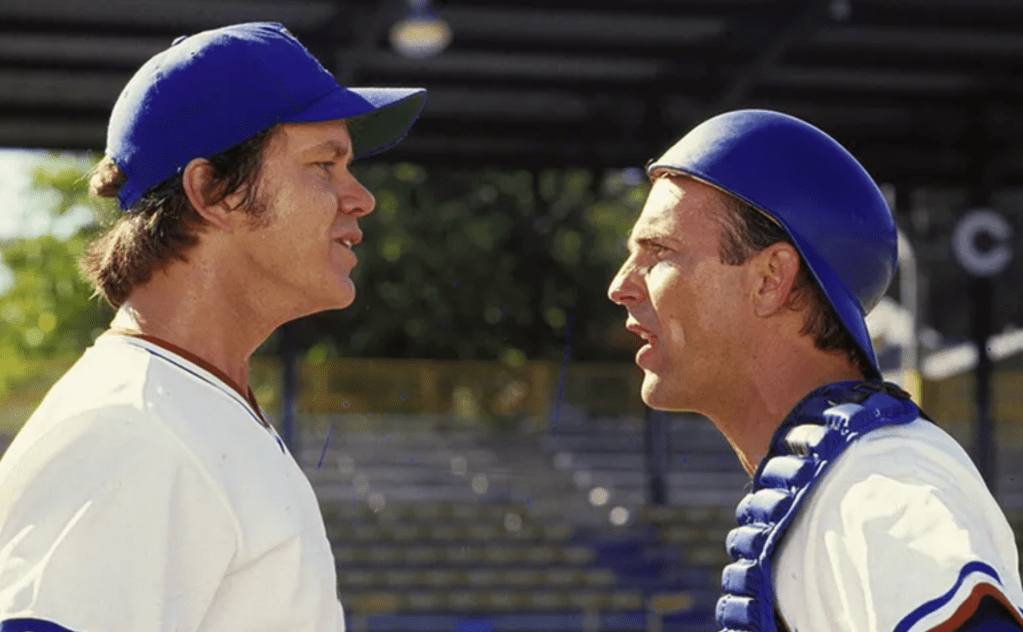
Tim Robbins and Kevin Costner in Bull Durham.
Crash doesn’t think he particularly likes Annie — he doesn’t understand how she could want to spend time with someone as dumb and vulgar as he finds Nuke. But the more he gets to know her, with her crackling wit and the artful seriousness with which she takes her carnal mission, he’s almost defenseless. You root for them as a couple in part because you can sense that they’ll ground the other: Annie will give Crash some new purpose in a life that’s mostly been a series of you’re-good-but-not-good-enough disappointments, and Crash will intellectually complement Annie in a way she’s not used to.
It’s a goofy premise for a romantic comedy. Bull Durham’s idiosyncrasy, paired with the jauntiness of the dialogue, takes you back to the rom-coms of the 1940s and ‘50s, where the writing felt a little heightened (á la Preston Sturges, who is often invoked when people talk about Bull Durham, or writing partners Betty Comden and Adolph Green) and where the first thing you notice about the woman lead is her self-assuredness. (Stanwyck is the most obvious parallel for Sarandon here, though you could picture Annie, in another era, being played by the likes of Katharine Hepburn or Claudette Colbert.)
I didn’t quite believe in Bull Durham as much as I did on this viewing compared to previous ones. Some of the screenplay is unbearably overcooked, lines pleasing to the ear but deflated by their nobody-talks-like-that unnaturalness. But I still find the chemistry between Sarandon and the cynical Costner sizzling, and I like how it’s a sports movie where sports are almost beside the point. We watch games and practices, the long trips to and from away dates. But you’re seldom thinking about how the team is doing over the course of the season. The movie doesn’t end with a make-or-break game that will harmonize well with whatever the romantic outcome turns out to be, either. Maybe it’s because Shelton knows the world the movie is set in so well, but what’s suggested is that, so often, what’s most compelling about a game isn’t always what goes on on the field, but what happens off it.
 Peterson Reviews