
Catherine Breillat has spent the majority of her nearly 50 years of directing making movies fascinated with female sexuality that unflinchingly go to places from which most might prefer to turn away. Last Summer (2023), her first movie since 2014’s semi-autobiographical Abuse of Weakness, is characteristically canny and unsettling — another provocative, perceptive exploration of how unreliably desire surrenders to reason, of a woman aware of but unwilling to repress the destructiveness of her lust.
The film’s protagonist is Anne (Léa Drucker), a stylish blonde lawyer who’s made a name for herself defending women and girls whose lives have been upended by sexual misconduct. She lives in a beautiful mansion neighboring a river with her businessman husband (Olivier Rabourdin) and their two adopted young daughters (Serena Hu and Angela Chen). The only things that seem to lack in her life are her dearth of friends (she would consider her sister, played by Clotilde Courau, the closest thing she has to one) and her tetchy relationship with her 17-year-old stepson, Théo (Samuel Kircher).
Shaggy-haired Théo gloomily arrives at the house early on in Last Summer after he’s expelled for physically assaulting an instructor. He’s immediately hostile to everybody except his stepsisters, toward whom he’s unhesitantly loving. Théo is resentful of his father and the cold shoulder the latter gave to his mother, and he barely gives Anne the time of day. His iciness only somewhat dethaws after Anne essentially blackmails him into behaving upon her discovery of something he could get in big trouble with his dad over.

Léa Drucker in Last Summer. All Last Summer imagery courtesy of SBS Productions.
That dethawing unexpectedly will escalate into flirtation, something that announces itself during a picturesque day on the water. Théo is, throughout the film, more aggressive about initiating and prolonging the inappropriate affair, but Anne barely puts up a fight. Breillat keeps opaque what’s going on in Anne’s head: how she’s rationalizing what she’s doing; how she can eventually speak about Théo, when their secret is inevitably unearthed, the same way she hears the gross self-justifying predators in court she is known for putting behind bars. (Breillat is more inclined to honor Anne’s warped gaze than the whirrs of her mind; a pivotal sex scene, for example, doesn’t look at either person’s body, instead keeping the camera tight on Théo’s face close to how Anne might see it.) Anne’s inscrutability, paired with the quiet, self-preserving savagery Drucker gradually introduces into her performance, only makes her more nauseously hypnotic, and also encapsulates the masterful restraint from Breillat and co-writer Pascal Bonitzer.
Movies with a similar premise — such as the 2019 Danish film I haven’t seen that the film is based on — might be more unreserved in their villainization. Last Summer’s more humanistic approach to material that had ostensibly been more morally clear-cut prevents it from cheapening predatory evils with dramatic spectacle, with unduly feeding into lurid interest and the salacious thrills it might subsequently evoke. Last Summer’s mutedness is consonant with a woman whose motivations and rationale she apparently can’t explain even to herself, and how effectively a bourgeois home’s structure can practically nonchalantly muffle the harms done to those less powerful living inside. Théo is eager to slake his newfound sexual curiosities, but he isn’t prepared for how instantaneously any semblance of power in this particular dynamic can be overturned by someone with the social and financial upper hand, strengthened by the authoritatively unbalanced roles a household prescribes.

Samuel Kircher and Léa Drucker in Last Summer.
Last Summer trails inflammatory, immediately infamous comments Breillat made about the #MeToo movement (and its French counterpart #BalanceTonPorc) and one of its more outspoken figureheads, the since-disgraced actress Asia Argento. In a 2018 podcast appearance, Breillat myopically decried how the lives of alleged abusers could seemingly be destroyed with a hashtag rather than through a long judicial process. She also aggressively disbelieved Argento’s claims of sexual assault by movie mogul Harvey Weinstein simply because she found, while working with the actress on 2007’s The Last Mistress, that she was “quite servile,” someone “who’s not timid about sex, who does it a lot, and has lots and lots of desire for both men and women.”
Breillat has since backtracked much of her vitriol while still remaining steadfast in her short-sightedness about, say, the purpose behind intimacy coordinators. She qualified to Screen Slate recently, for instance, that she saw the abuse evinced by the #MeToo movement as an ultimately positive thing, but that she also worried about “people in the cultural landscape after MeToo, especially of a kind of radical feminist imposition on the world of cinema.”
Breillat’s ideological slipperiness can make her seem, in some ways, like something of an inverse of her protagonist. Anne recognizes the nuances of predation, and has made a tangibly positive impact on the lives of people who have been harmed by it, yet perpetrates it herself. Breillat outwardly seems limited in her willingness to recognize predation’s nuances yet can make discerning art about its insidiousness and how those professedly against it are not precluded from themselves inflicting it. She pokes and prods rather than answers. Last Summer, like so many of her other movies, is striking for where it goes, what it asks, and what it does and doesn’t say.
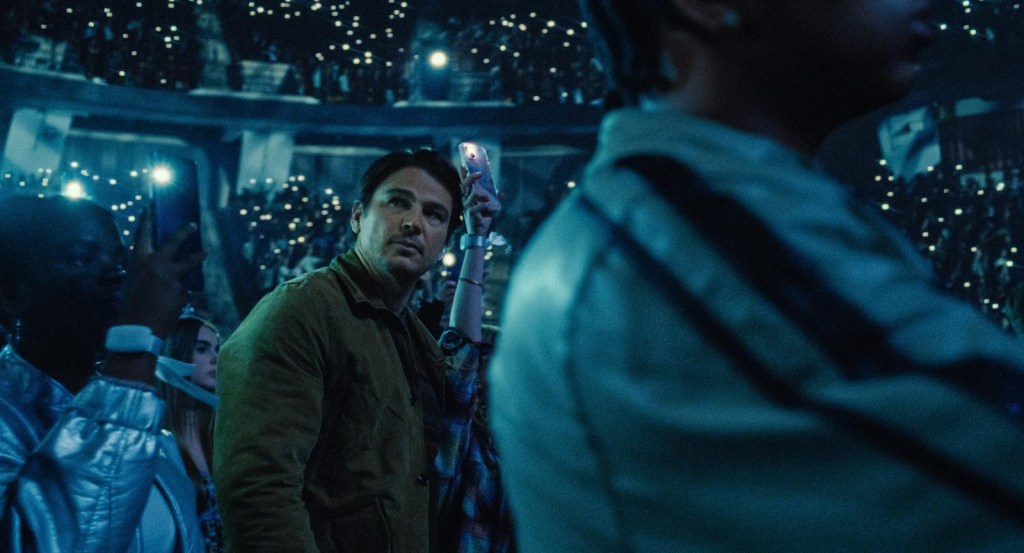
Josh Hartnett in Trap. Courtesy of Warner Bros. Pictures.
Trap, M. Night Shyamalan’s follow-up to last year’s risible Knock at the Cabin, is formed on a preposterous premise — an ambush of a serial killer at a pop star’s afternoon arena concert — hard to accept logically but easy to embrace because of how entertainingly it’s expanded on. Though not averse to indulging the dark comedy the storyline often poses, Shyamalan’s evocatively closeup-generous filmmaking is interminably tense. And Josh Hartnett, as a wildcat-eyed murderer known to the teenage daughter he’s going to the show with (Ariel Donoghue) as Cooper but to the public as the 12-diced-up-victims-and-counting Butcher, is excellent as a man struggling to worm his way into freedom while keeping up the appearances he has ostensibly been able to carefully keep separate for years. Suspense is as much culled by how-is-he-going-to-get-out-of-this-one uncertainty as a lack of confidence that Cooper’s homicidal instincts won’t get the better of him. He can’t pass up to opportunity to, for instance, injuriously nudge a girl who happens to be falling down drunk at the top of a flight of stairs, or set up a grease-trap trap that will inevitably gravely harm an innocent worker as a sick pleasure-instructed means of distraction.
Is Trap a mechanism Shyamalan is subconsciously using to work through some gnawing parental guilt? He’s cast his aspiring pop star daughter, Saleka, as the established pop star scores of teenage girls are clamoring to see; in common between Shyamalan and his otherwise worlds-away protagonist is a love for their daughters that cannot transcend the troubles their very association will engender. Riley will soon be best known publicly as a killer’s progeny. Butter-voiced Saleka has the advantage of a dad who can bring her art and evident talent to a wider audience with the disadvantage of her, even if she wasn’t in Trap, reasonably judged with nepotistic and meritocratic skepticism. Her entirely self-written music, for what it’s worth, is actually pretty good, just slightly dated in how it echoes early-2010s Tinashe. (Which makes it unconvincing that it would resonate with squealing teenagers more than anybody else.) But the music is beside the point in a movie that is, above all, an enjoyably constructed game of cat and mouse that marks Shyamalan’s most unabashedly fun movie in years.
 Peterson Reviews