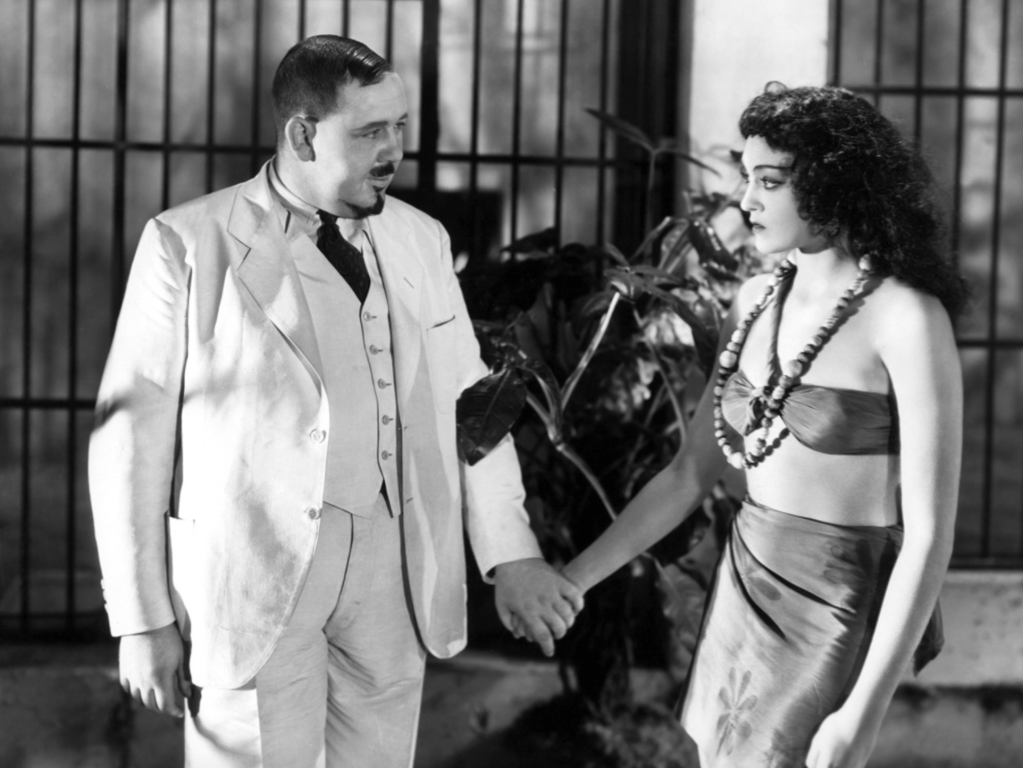
On a private island deep in the South Seas, Dr. Moreau is basically God. Played by a deliciously fey Charles Laughton, whose upper lip is shadowed by a crowbar-shaped mustache and his chin by a goatee shaped like a witch’s hat, the scientist discovered a little more than a decade ago that he could make various flora and greenery grow into their centuries-advanced forms with a little biological tinkering. His creations — including a fuzzy, many-feet-tall asparagus — now define the landscaping of his waterlocked abode.
Seduced by the knowledge that he can alter the natural world in ways few could dream of, Moreau has transformed, since his innocent-enough discovery, from a garden-variety scientist to a classically mad one. At the island, where he’s accompanied by a former professor, Montgomery (Arthur Hohl), who was exiled after some vaguely alluded to misconduct with a student, Moreau performs the unthinkable: changing the genetic structure of animals to transform them into humans, or something close enough. He reasons that as they evolve, animals are already moving in a direction close enough to humanity anyway. He’s just speeding things up.
That reveal is kept secret for a while in Island of Lost Souls (1932), Waldemar Young and Philip Wylie’s loose, still-creepy adaptation of H.G. Wells’ The Island of Dr. Moreau (1896). Our vessel into the story is a shipwrecked traveler, Edward (Richard Arlen), who ends up on the island thanks to the drunken stubbornness of a freight captain initially poised to rescue him. Edward is quick to appreciate the hospitality of Moreau, if a little bemused by the assortment of always-lurking, decisively strange “natives.” Then he slowly gets hip to what’s going on, his alarm bells starting with Moreau’s disconcerting determination to make a sexual connection happen between the affianced Edward and an ostensibly Polynesian woman Moreau keeps around (Kathleen Burke, in egregious yellowface).
Laughton’s performance as an odious man described by someone, in what will come to feel like an understatement, as a “black-handed, grave-robbing ghoul” gives the film a campy charge. (A particularly funny choice in his performance memorably comes from him rattling off some patently evil philosophies while demurely reclining on an operating table, practically sucking his thumb.) But it’s difficult not to be frightened even amid the instances of black comedy by the film’s macabre — and devastatingly sad — premise, and the malevolent shadows wrought by cinematographer Karl Struss. He gives the movie a nightmarishly groggy look more broadly. You always feel like you’re in a haze, trapped in a funhouse-mirrored universe where up is down and backward is forward.
It’s hard not to admire the movie’s bold, easy-to-notice suggestion that God, stood in for by Moreau, is maybe not quite the vision of moral clarity that he’s often viewed as by those who worship him. Is someone ultimately worth revering if those they have power over are practically treated like playthings, expected to behave nicely in a life they never asked for to ensure a salvation they can’t even be sure is coming? (Many of Moreau’s creatures — including a werewolf-like man who speaks with booming eloquence by Béla Lugosi — don’t seem to think so.) The questions Island of Lost Souls raises, and the images it conjures, stay with you.
 Peterson Reviews