From Fatal Attraction (1987) to Basic Instinct (1992) — perhaps the most totemic examples of the genre — erotic thrillers “tend to function as fearful reactions to the cultural aversion of expressive female sexuality,” the writer Jourdain Searles wrote in 2019. The narratives featured in movies now firmly classified as part of the genre weren’t homogenous, but they traditionally saw a man’s life jeopardized by a bold woman who disrupts the stability of his life after he sleeps with her. Women transgressors were likely to be climactically punished while men were allowed their old, if not unscathed, lives back, though not before the films could satisfactorily relish in the sexy dangerousness of giving in to what you know you shouldn’t.
In the Cut (2003), New Zealand filmmaker Jane Campion’s polarizing first movie of the aughts, flips the script on a genre whose tentpole works were almost always filtered through the straight male gaze — that often made you wonder, in their readiness to villainize women, whether that villainy could be trusted or if we were just seeing them as delusionally as sexually anxious male characters were.
Though In the Cut is too frequently heightened visually to completely resemble real life, it potently evokes the not-confined-to-fiction feeling that to exist in the world as a woman is to feel hunted, to paraphrase the writer Doreen St. Félix in a recent revisiting of the movie. Its protagonist, an introverted writer and college lecturer named Frannie (Meg Ryan), will embark on a potentially-sleeping-with-danger arc similar to many male erotic-thriller main characters. But while Frannie will get some thrill out of it, Campion never loses sight of a woman-specific sense of fear largely not given the time of day in the erotic thriller writ large. (Frannie isn’t without genre forebearers, though: I can see some of her in Jagged Edge’s Teddy Barnes, a lawyer who sleeps with a client accused of murder, and also, as pointed out by St. Félix, proto-erotic thriller Klute’s Bree Daniels, a sex worker with whom Frannie shares a bang-forward haircut and taste for long skirts, dalliance with a cop, and increasing paranoia about maybe being next in a serial killer’s spree.)

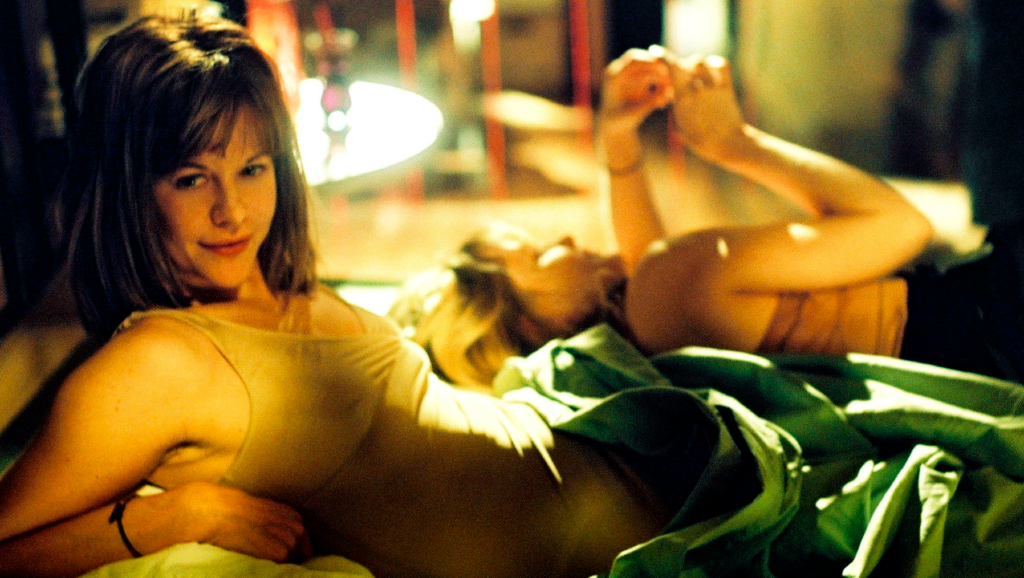
Meg Ryan and Jennifer Jason Leigh in In the Cut.
Evidence of the latter shows up in Frannie’s backyard early in In the Cut. An unknown suspect has been moving around the pocket of New York City where she lives, finding seemingly random young women and murdering them so violently that hardly an inch of a crime scene goes unrouged by their blood. Investigators find one of the latest victim’s limbs in the garden behind Frannie’s apartment. Leading the questioning is Giovanni Malloy (Mark Ruffalo), a hirsute detective with working-class roots whose gruffness turns Frannie on. Suggested to have pretty much given up on dating as she nears 40, Frannie has sexual fantasies about him before they get drinks and then begin an affair.
In the Cut’s sex scenes are hot. They’re also invigoratingly unbothered with what Malloy is feeling. The film foregrounds its women characters’ points of view. “I can remember every guy I’ve fucked by how he liked to do it and not how I wanted to do it,” Frannie’s sister Pauline (Jennifer Jason Leigh), who is currently fielding a restraining order from a married doctor she had an affair with, nonchalantly says. It’s intimated that part of why Frannie’s relationship with Malloy so consumes her is because it so excitingly finds a rare middle ground within Pauline’s complaints.
In the Cut’s aesthetic makes Fannie’s delirium, a mixture of fear and titillation, feel almost tangible. The heated-up cinematography, by Dion Beebe, is all rich reds, nauseous greens. Shots are regularly blurry, uncomfortably close up. Everything feels at once hyperreal and slightly fantastical. The latter is underlined by silent movie-style flashbacks to Frannie’s parents’ courtship, which she romanticizes, and moments on the subway where Frannie swears she could see poems on the walls speaking exactly to how she’s feeling at a given moment. (That element is one of the movie’s few touches I didn’t totally buy, though I like critic Hunter Harris’ recent observation that Frannie’s tendency to search for meaning in poetry and literature, and then write down words and phrases she likes, feels as if “she’s piecing together evidence of what she feels but can’t express.”)
Beebe underscores the sense that you’re watching something that you shouldn’t, oscillating between what Frannie sees and what those wanting to harm her do. When moving out from her perspective, the cameras uneasily rest in places that mimic a predator’s leering vantage: from behind a tree, beneath an awning, the sidewalk across from where Frannie walks, a car’s rearview mirror.

Mark Ruffalo and Meg Ryan in In the Cut.
There’s no man in In the Cut around whom Frannie can feel entirely at ease. She’s covertly attracted to one of her students (Sharrieff Pugh), but his repeatedly-brought-up theorizing that John Wayne Gacy wasn’t guilty of his crimes (his desire made him do it) is especially disquieting when a serial killer is afoot. Frannie’s ex, a sleazebag whose facial hair matches his pet chihuahua’s ratty fur (Kevin Bacon), is stalking her, at one point waiting for her in her bed when she gets home one evening. Malloy’s abrasive partner (Nick Damici) is noisily sexist and homophobic — something Frannie immediately comments on with an almost audible eye roll — and has been barred from using a gun because he tried to kill his wife with it. (Or simply “scare her,” as Malloy unpersuasively deflects.)
Malloy, whom Frannie will come to be so warily fond of, is the most suspicious. She’s certain she saw one of the soon-to-be victims with a shadow-obscured man with Malloy’s same 3-of-spades wrist tattoo the other night in a bar. Only one of these men is the murderer. Campion, who co-wrote the script with Susanna Moore, the author of the 1995 book the movie is based on, doesn’t imbue the big reveal with too much relief. So much damage will be done by then; ill-intentioned men won’t cease to exist.
In the Cut was originally supposed to star Nicole Kidman, who dropped out amid her divorce from Tom Cruise to spend more time with her kids. (She nonetheless got a producer credit.) Considering how much we’ve come to associate — and thereby be a little more comfortable with — Kidman in difficult roles in provocative movies, this initially feels like a loss. But a playing-against-type Ryan only gets better the more you adjust to her in this searching, unmoored role that only accentuates how limiting her seldom-escaped girl-next-door typecasting was. Like In the Cut was at the time of its release, her out-on-a-limb performance wasn’t particularly well-received. I’d be happier to accept that people have come to see the light more widely years later if it didn’t also come with the truth that, had Ryan’s nerve been more broadly celebrated, her audacious work could have resulted in more than a striking anomaly in her body of work.
 Peterson Reviews