
Irena (Simone Simon), the tragic artist protagonist of Jacques Tourneur’s Cat People (1942), often frequents the Central Park Zoo, where she’s drawn to a black panther that can do nothing but nervously pace. The more we get to know Irena, we gather that she might see some of herself in this big cat: trapped in a life where freedom feels distant and where that freedom, if it ever is to come, is burdened with the promise of pesky consequence.
Some of that is couched in a common experience. Serbian Irena is an immigrant struggling to assimilate into American society, acutely aware that she’ll have to publicly obscure her cultural idiosyncrasies to better fit into the life she longs for. But more is based in what at first sounds like delusion. Owing to a legend in the village where she was raised, Irena is convinced that she will transform into a beast — a big cat not unlike the caged one she visits — if her body ever surges with too much passion. You’re not sure you buy her beastly claims until she walks into a pet store one day, looking to buy a canary, and every animal goes ballistic, their cages suddenly rendered protective rather than prison-like. “Animals are ever so psychic,” the shop’s owner shrugs.
Irena is transparent about her transformational worries to Oliver (Kent Smith), an all-American marine engineer she meets-cute while out sketching before they officially start dating. But whatever trepidations she has are ignored by a man who’s ready to marry her by the second date. (He seems to chalk up her fantastical-sounding concerns to exotic baggage she’ll be able to rend once they’re wed.) Steamrolling ahead predictably doesn’t solve anything; distance is generated instead.
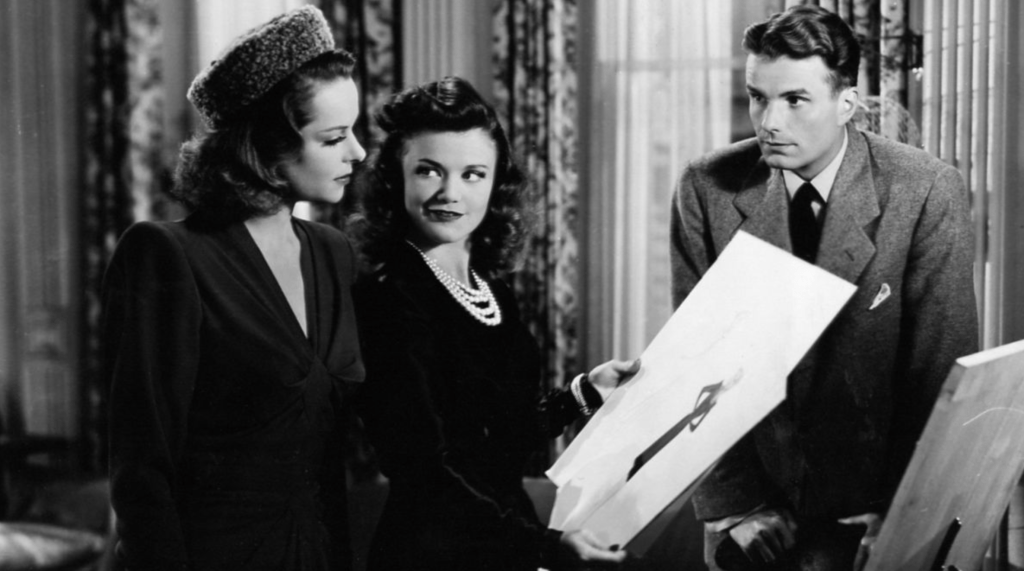
Jane Randolph, Simone Simon, and Kent Smith in Cat People.
In part because of the era’s strict production code, Irena is only implied to be unwilling to try consummating the marriage. Oliver, in the meantime, gets closer to the coworker, Alice (Jane Randolph), he might have already been in love with before getting together with Irena. She more and more seems to have just been a distraction for a man who proves disinclined to meaningfully support her. Smith’s note-perfectly myopic performance conjures every man you’ve ever met who’s never had to sit long with discomfort — be told what he doesn’t want to hear. It’s no shock when he confides to Alice soon into the marriage that he’s “never been unhappy” — a privilege he concludes is reason enough to shirk his marital responsibilities.
Irene gets increasingly jealous of Alice, stalking her down city streets at night and, most indelibly, while she’s alone at an unlit pool hall for an evening swim. These are bravura sequences, forgoing music for the clicking of heels or echoing screams. Legendary cinematographer Nicholas Musuraca ingeniously indulges in chiaroscuro lighting to let our anxious minds see what isn’t there in the shadows. Irena herself is often visually placed “in darkness, cast the silhouettes of other characters on the wall behind her, enclose her with shadows that work like a cage,” Roger Ebert observed in his review of the movie.
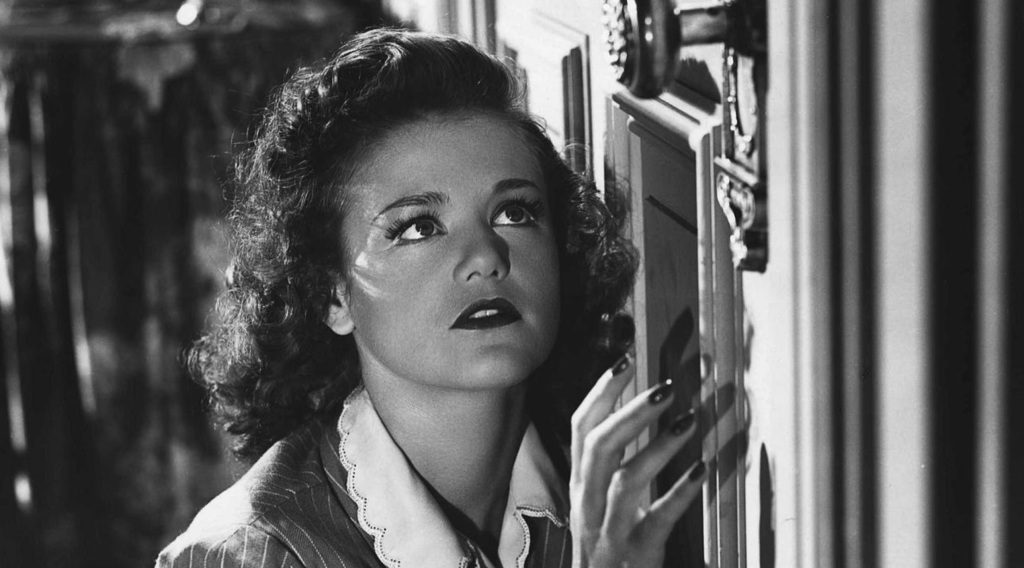
Simone Simon in Cat People.
At face value, Cat People is a story of a cursed woman fruitlessly yearning to leave her past traumas behind. But today it’s difficult not to see the gay subtext in this movie featuring a character repressing her true sexual self and whose envy of another, more conventional woman seems raveled in underlying attraction. She seems at once tortured and a little comforted by the endlessness of her capacious loneliness. “I like the dark,” she admits. “It’s friendly.”
Irena is, from certain angles, Cat People’s villain, but one’s sympathy for her is likely to supersede ill will potentially inspired by the dark path she goes on during the film’s final stretch. We can’t picture her without sadness wilting her eyes. When Irena first meets Oliver, she confesses to not having made friends or found community since immigrating to America. The ribbons she often wears in her hair and the soft, girlish way she speaks suggests someone frozen in childhood. (Her earliest years were defined by formative traumas: her dad died tragically, and her mom was accused of witchcraft and made a pariah in their village.) It’s crushing to see her vulnerability taken for granted by Oliver, whose strain of thoughtlessness will see him on one occasion take Irena on a museum date only to treat her like a third wheel to him and the also-invited Alice. Queer viewers will no doubt recognize the weight of living with the kind of secret you worry will upend your life, the way those closest to you might look at you. Simon’s performance, which you can feel carrying that self-imposed heaviness, is among the genre’s greatest, making vivid the visceral terror of imminent, destructive transformation. She’s one of few horror characters whose torment makes you genuinely sad.
Cat People was the first and arguably best in a series of low-budget horror movies the producer Val Lewton oversaw for RKO Pictures for a brief period in the 1940s. It was common for their effectively told stories to have otherwise taboo real-world resonance beyond what was happening literally; each inventively used shadows to mask the limitations of their $150,000-or-fewer budgets, with set pieces — Cat People included — memorable precisely because of what they insinuated with tantalizing slivers of light and patches of dark. Paul Schrader’s 1982 remake of Cat People, longer and more literal, accidentally argues for the minimalism and ingenuity Lewton and his collaborators mastered. Sometimes less really is more.
 Peterson Reviews