
One of many things to love about the peerless films of Agnès Varda is how extraordinarily curious and caring her gaze is — inclined to recast even the most minor of moments as significant. Her 1976 documentary Daguerréotypes is among her most amiable projects despite being borne, in part, of creativity-limiting claustrophobia. Not long before production began, she gave birth to a son, Mathieu — her first with her fellow filmmaker husband, Jacques Demy — and understandably didn’t want to stray too far from home for a film shoot amid the calls of her chronic artistic restlessness. Unsurprisingly for a filmmaker long reverential of everyday, generally unremarked-upon beauty, it eventually struck Varda to make a movie about the shops on Rue Daguerre.
Named after the photography pioneer Louis-Jacques-Mandé Daguerre, the Parisian street had been Varda’s home since around 1951, and she continued to reside there until her death, at age 90, in 2019. The shoot’s technical equipment was all hooked up to her home — a decision roused both by a guarantee to neighbors that no electric bill would increase but hers and her own maternal commitment to stay close to the nest. The move also ensured she couldn’t wander further than 90 meters away from her front doorstep.
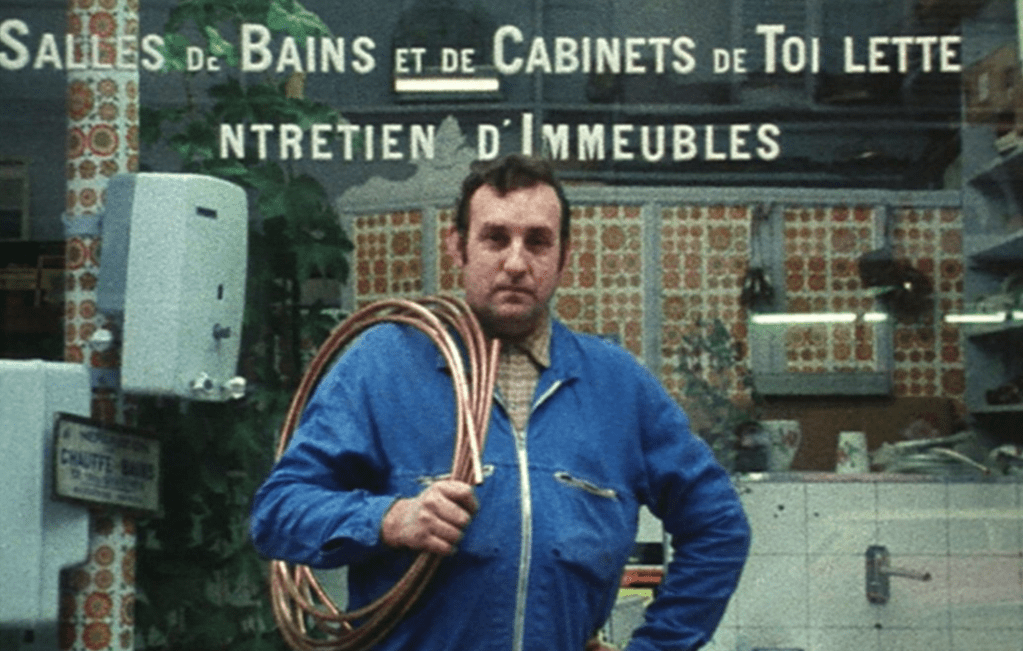
From Daguerréotypes.
Daguerréotypes has the unpretentious affection of a home movie. “It’s a film by their neighbor,” Varda concludes. The opening credits immediately indicate its intimate way of seeing: they roll on top of the reflection of Varda and her tiny crew as they perch in front of one of the featured shops’ window display. Portraits of the businesses and their owners will emerge. Details are divulged, with direct-to-camera eye contact and sometimes eager-to-share grins (the compositions of the camera placement winkingly recall the look of daguerreotype-style portraits), about their decades-spanning romances, passion for the work around which they’ve wrapped their lives, and how they got here. (A through line across many proprietors is that they were born in small villages littered around France, relocating to Paris to capitalize on their trade or entrepreneurial initiative.)
Varda takes her time getting there, though. She spends most of Daguerréotypes’ first act simply visiting the stores and ethnographically capturing the mundane interactions inside. An older woman settles for a cut of meat she didn’t request when the street’s butcher doesn’t have what she wants. A politely frustrated man heaves his handsome clock to a repair place to find out why it mysteriously goes a half-hour askew at the end of every day.
Daguerréotypes unshowily commemorates the small, community-unifying miracles of time-tested craftsmanship. It also plays like a living time capsule, paying tribute to the quotidian rhythms of businesses that, by 1976, already had a rather folksy quality, if not in specialty (one standout is an accordion shop, one of whose instruments is squeezed by a musically inclined little boy Varda shoots in close-up) than their quaint models and presentation. “The pavement has the scent of the countryside,” Varda says in some voiceover narration, which is intermittently heard throughout the movie. Of the street’s old-fashioned quality, she says later, “At the outdoor market at the other end of the street, you find political newspapers, activists, discussions. Here — nothing.”
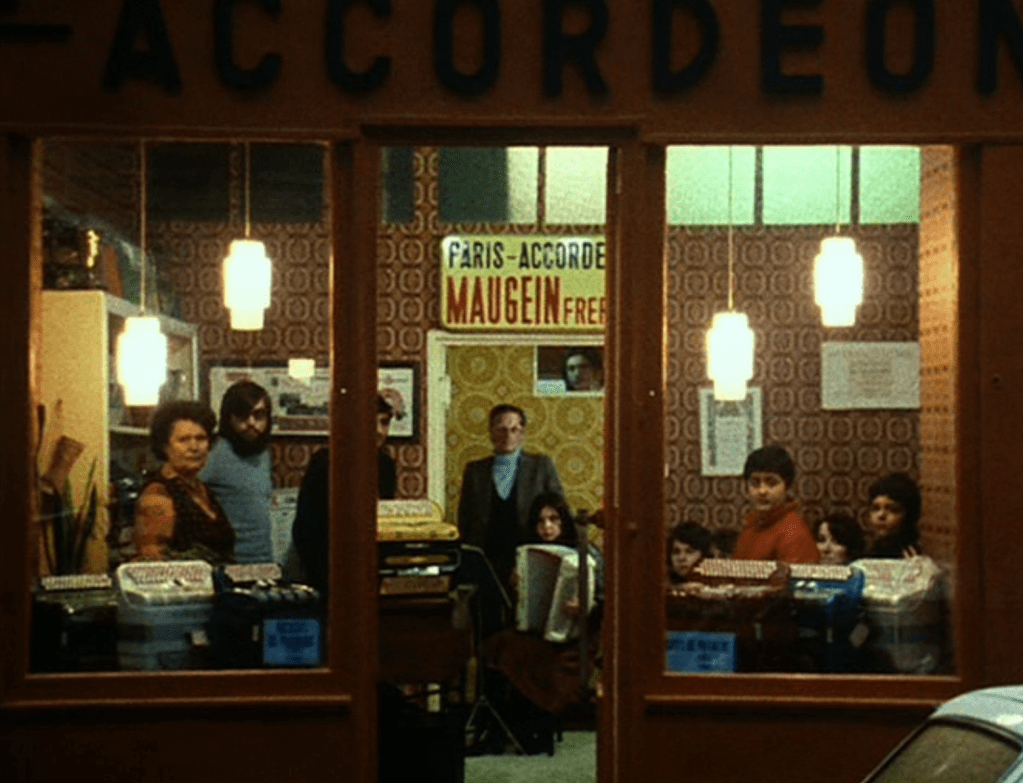
From Daguerréotypes.
Footage of a magic show several of the street’s business owners attend one evening is scattered throughout Daguerréotypes. Its presence, as the critic Brandon Streussnig has observed, stresses what the film elsewhere says more implicitly — that what these shop owners do, connecting their neighbors through indispensable skills polished across decades, is its own kind of magic, hardly as showy as a magician’s entertaining deceptions but unquestionably more valuable.
Shortly into the Daguerréotypes, Varda says she’s fascinated by the slowness and patience a shop owner must endure daily — that she wonders what they do with their downtime, empty moments. This good-naturedly inquisitive point of view is part of what imbues the movie with what, to me, feels like a rather medicinal quality. To see the world through Varda’s eyes, even if for just 80 minutes, is a balm in a predominantly transactional world, her outlook as uninsistently vital as the small-time services she so exalts.
 Peterson Reviews