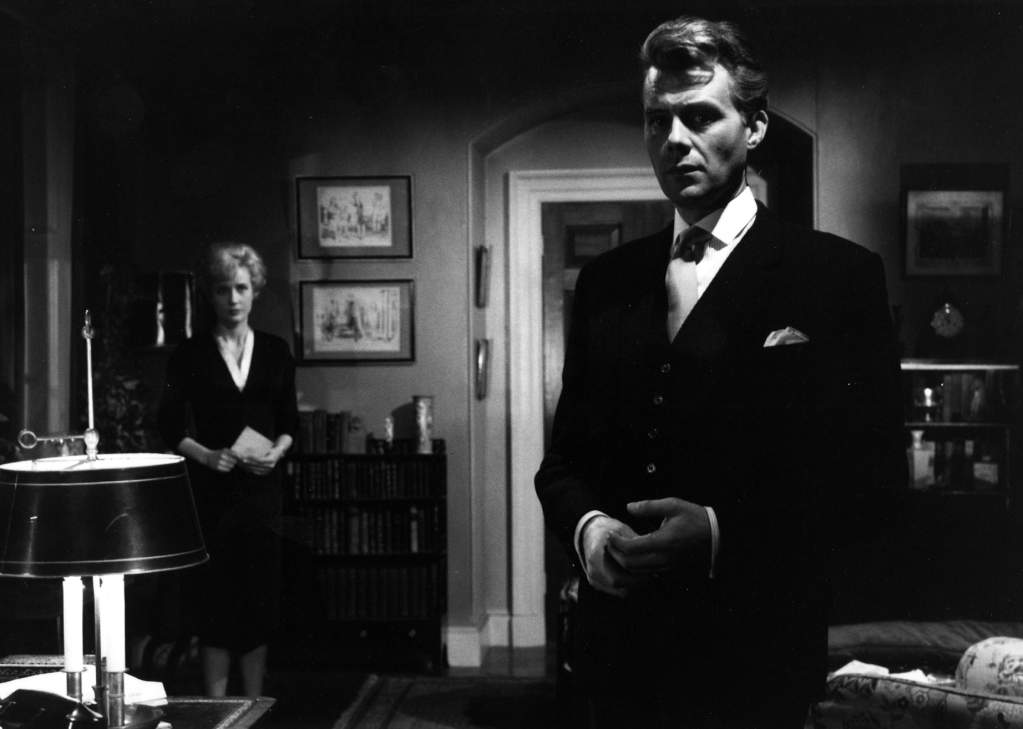
Much like their first collaboration, the police procedural Sapphire (1959), screenwriter Janet Green, producer Michael Relph, and director Basil Dearden’s second film together, Victim (1961), foregrounds a social issue with a clear intention to challenge — and hopefully transform for the better — the ugly attitudes popularly surrounding it. For Sapphire, which revolved around the murder of a white-passing Black woman, it was racism; for Victim, homophobia.
Though Sapphire had some astute observations about white liberalism’s tendency to profess support for equality but balk if an opportunity to effect tangible change unduly threatens social comfort, it was disappointingly too police-centric and soft around the institution’s systemic role in racism’s perpetuation. (Its release year, though, might make one more willing to adopt the line of thinking that there are only so many progressive ideas a mainstream movie of its time could shuttle in — let alone be capable of — to reach a wide audience.)
Made when it was still criminalized in the U.K. for men to partake in any sort of gay sex act, Victim also suffers from a similar unwillingness to very deeply reckon with the police’s role in sustaining a culture of homophobia, even if, by 1961, law enforcement’s persecution of what had been nicknamed “the blackmailer’s charter” had diminished. Similarly to Sapphire, Victim features a good-hearted department leader (here played by John Barrie) positioned as the standard and not the conservative colleagues whose prejudices are treated as to-be-swatted-at annoyances and not serious liabilities.
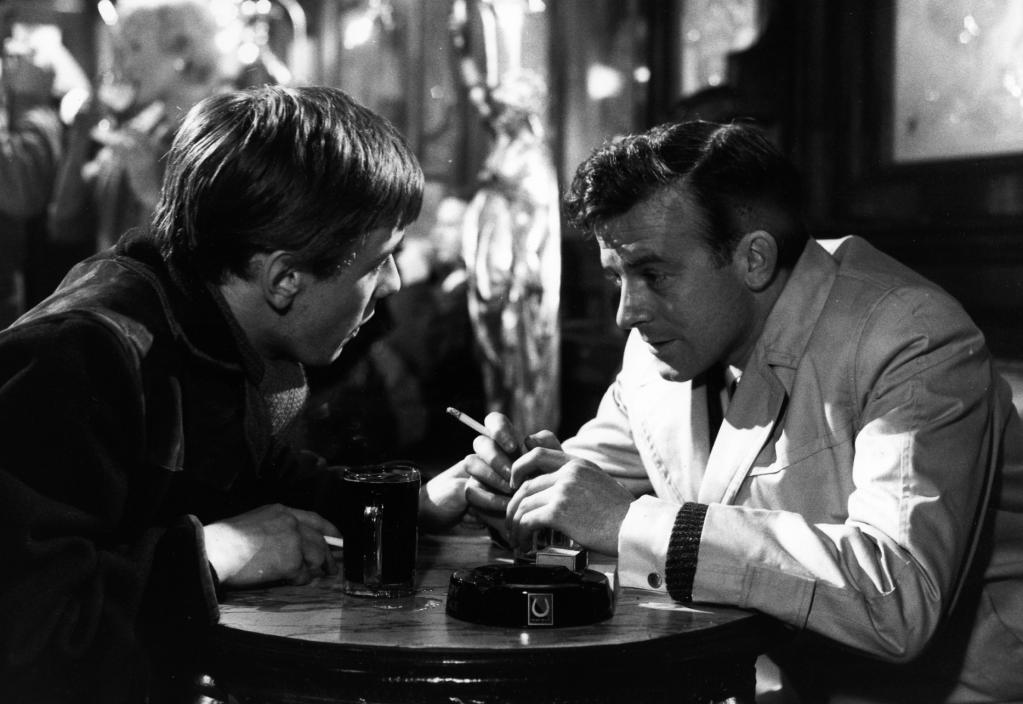
Peter McEnery and Donald Churchill in Victim.
That Victim, unlike Sapphire, mostly keeps the police peripheral is a strength. Instead its protagonist is a closeted gay character whose quest for justice is essentially promised to dovetail, if his efforts are vindicated, with his own ruination. He’s Melville Farr (Dirk Bogarde), a respected barrister expected to soon be appointed a Queen’s Counsel, who finds out that Jack “Boy” Barrett (Peter McEnery), a young man with whom he’d once had an obliquely discussed romantic dalliance, has killed himself.
The suicide is preceded in the film by Barrett frantically asking people — including Farr, who self-protectively never returns Barrett’s kept-vague attempts at contacting him — for financial help. He stole £2,300 from work in an effort to get some outing-minded blackmailers off his back, and needs some extra cash to leave the country. Once the police catch up with him, he can’t bear the thought of the consequences, especially since the photograph he was being blackmailed over had Farr, whom he didn’t want to take down with him, in it.
Investigating on his own in addition to the police, Farr discovers that Barrett is one of scores of gay men around town being anonymously blackmailed. In Farr’s exchanges with some of the ongoing victims, we find some men too squarely middle-class to be able to stave off what they see as their destruction for much longer, like a hairdresser (Charles Lloyd-Pack) with plans to sell his business and abscond to Canada as a means of salvation, and others, like a popular actor (Dennis Price) who values his career, who have the privilege to afford the regular solicitations for cash. Money cannot buy happiness in any of these cases — it can’t preclude nervous over-the-shoulder glimpses, the unbearable weight of repressing oneself — but it can secure a certain degree of freedom.
Green and husband-slash-co-screenwriter John McCormick write Victim’s targets with a level of compassion that still feels meaningful. “I can’t help the way that I am,” the Lloyd-Pack character says, “but the law says I’m a criminal,” adding later that he can’t bear the humiliating thought of being jailed again. Those who help societally conserve these men’s misery, from a casually homophobic barkeep to the slow-to-be-revealed blackmailers themselves, are presented so hideously that it’s hard to imagine a more conservative-leaning viewer unmoved to do some ideological rethinking by the time the movie is over.
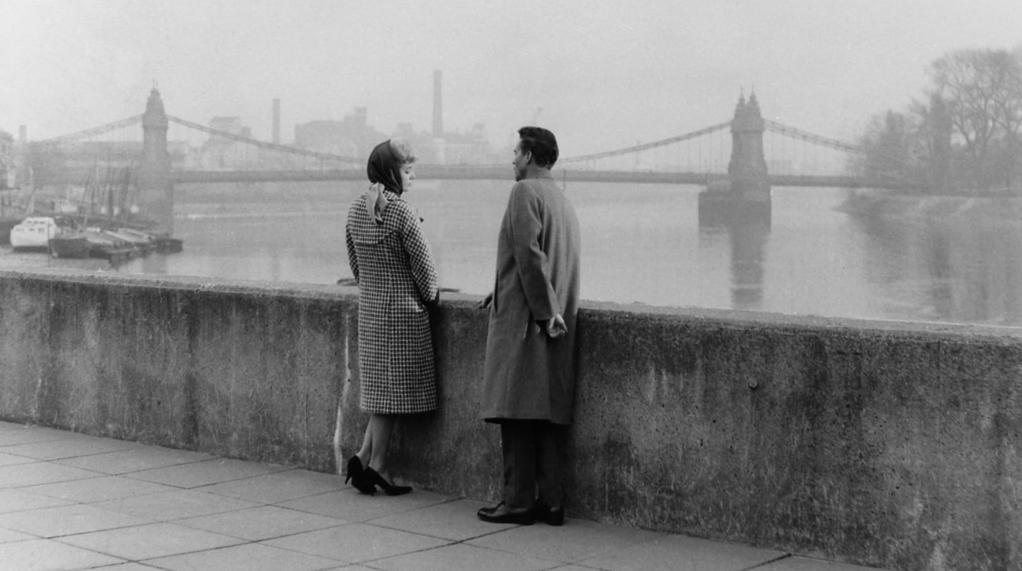
Sylvia Syms and Dirk Bogarde in Victim.
A gay actor who never publicly came out, Bogarde is magnificent in a tricky role that doesn’t so much require his character be ashamed of himself as be acutely, tormentedly, aware of the image that must be maintained to succeed as the type of man he’s trying to be. (The movie too literally confers his weariness by painting some additional wrinkles and lines on 40-year-old Bogarde’s still-boyish face.) Victim doesn’t just see what happens to Barrett in tragic terms. Whether they’ve been literally lost or continue forward, you can feel the movie mourning the lives of gay men who can’t fully be who they are, their harmless human instincts pointlessly relegated to the shadows. Placing a character like Farr — handsome, smart, successful, and played by a respected actor — at Victim’s nucleus is very obviously methodical, underscoring gayness as something that doesn’t exclusively exist in margins and emphasizing the stupidity of a man’s attractions having the power to end his career. The characterizations of Farr and the other gay men he’ll come into contact with remain easy to appreciate for their lack of stereotype.
Farr’s investigation doesn’t only jeopardize his professional standing; it also threatens his marriage to a woman, Laura (a fantastic Sylvia Syms), to whom he’d been transparent about previous — and supposedly done-with — homosexual experiences before their wedding. When the Barrett situation becomes impossible for Farr to continue covering up, Laura is resentful for being made into a social “life belt.” But Victim doesn’t villainize her; it delicately treats her and Farr’s bubbling-up marital complications with the kind of nuance only possible when people really love each other. When a false equivalency is made between Farr and the blackmailers’ different strains of dishonesty, Laura is unreserved in her disgust, her empathy for her husband unmoved even amid the unavoidable hurt he’s caused.
Farr and Laura’s relationship is responsible for some of Victim’s best writing, stewing in the complexities, rather than having Laura simply walk away, of an otherwise strong marriage confronting something it thought it could leave behind. Laura’s anguish adds to the collective possibilities of the title. A person cannot be destroyed without causing some secondhand damage; a society only suffers when the ruination of another is encouraged. Victim’s boldness was ultimately constructive: the criminalization haunting the movie’s storyline would, by the decade’s end, be vanquished. Today lauded for helping push gay acceptance in the U.K. forward, the movie’s norms-changing importance demonstrates art’s transformative potential.
 Peterson Reviews