
This is the eighth edition of Odds & Ends, a capsule-review column collecting brief notes on movies taken throughout the month.
Body Electric (2017), dir. Marcelo Caetano
I confess that I’d generally rather watch a slice of life-style movie where nothing really happens when it revolves around someone gay — in Body Electric’s case, it’s a 23-year-old named Elias (Kelner Macêdo) with a pretty smile and a yen for casual sex who works for an underpaying textile business — than someone not. Even then, sometimes it’s a good thing when a movie has some sort of incident besides the doldrums of quarter-life, is-that-all-there-is routine, though.
Tricia’s Wedding (1971), dir. Milton Myron
Pioneering drag troupe The Cockettes’ short-form spoofing of Tricia Nixon’s wedding isn’t particularly sharp or well-performed; the group’s rehearsal-averse reputation is plenty evident in the relative sloppiness of its funhouse portrayals of Nixon’s star-studded guests of honor and the pageantry they’re part of. But it’s still fun in the way taking the piss out of people in a room into which you’ll never be invited can be.

Devon Aoki, Meagan Good, Michael Clarke Duncan, Sara Foster, and Jill Ritchie in D.E.B.S.
D.E.B.S. (2004), dir. Angela Robinson
In spy-movie spoof D.E.B.S., which takes place in a world where teenage girls are recruited as baby agents of the titular agency if they answer a certain number of SAT questions a certain way, a forbidden romance between prodigy criminal mastermind Lucy (Jordana Brewster) and a goody-two-shoes D.E.B.S. trainee Amy (Sara Foster) comes to have the power to make Lucy rethink the bad-girl plotting that goes on in what is explicitly labeled in the film as her evil lair. (There are even errant bolts of lightning creeping around some of its tech.) The movie was a mammoth flop when it came out — it made less than $100,000 of its $3.5 million budget back — but it’s deservedly become a cult favorite, particularly among lesbians who appreciate its knowingly silly enemies-to-lovers romance and tongue-in-cheek riffing on espionage-movie tropes. That Rolling Stone’s unctuous Peter Travers panned it for being “libido-killing” now feels like a kind of badge of honor, a testament to it successfully paying no mind to the straight male gaze.
Starrbooty (2007), dir. Mike Ruiz
Fans of TV’s long-running competition show RuPaul’s Drag Race might look at the frugally made Starrbooty, which star RuPaul Charles also wrote and produced, as a sort of cinematic forerunner to the acting challenges that have become a staple on the series, which premiered two years later and has helped further mainstream drag with every season. It’s rare for an acting challenge on the show not to feature at least a few queens who prove not to be very cut out for performing in that kind of capacity. Starrbooty is similarly gangly as it riffs on the blaxploitation movies of the ’70s. It doesn’t have quite enough narrative juice to power a feature-length and pads out its already-short runtime with going-nowhere (albeit transgressively entertaining) scenes that might find Charles, playing the eponymous, undercover-as-a-sex-worker spy heroine, stomping on a man’s balls or demurely eating out a proudly unhygienic-down-there Lady Bunny, who can only react by villainously cackling.
Pink Narcissus (1971), dir. James Bidgood
James Bidgood’s short, shot in mostly 8mm over a seven-year period in his apartment and finally released without his explicit consent, is a hypnotic haze of surreal, evocative gay imagery, elevating the sort of sexual fantasy that was not then (and still now) given much cinematic consideration.
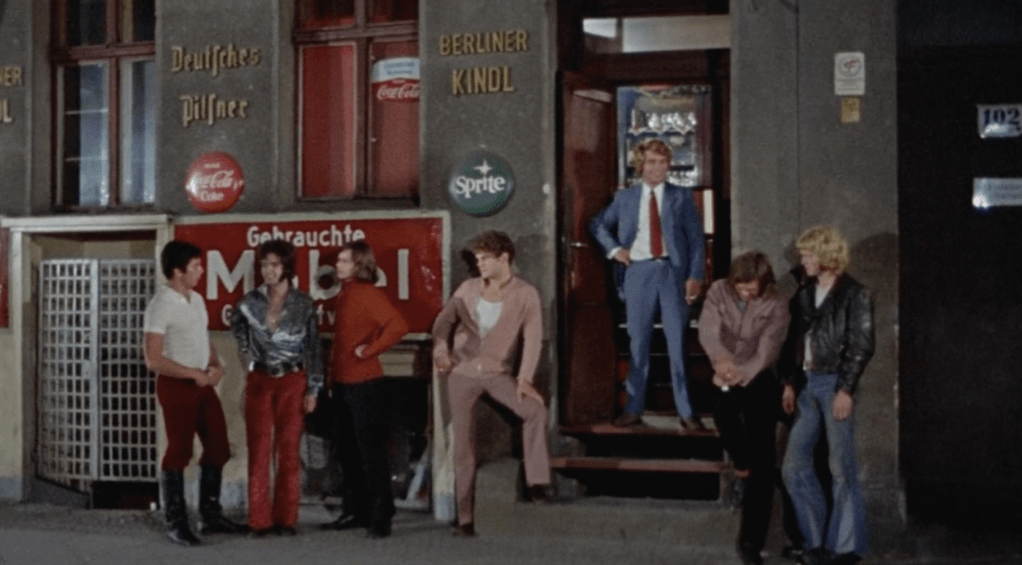
From It Is Not the Homosexual Who Is Perverse, But the Society in Which He Lives.
It Is Not the Homosexual Who Is Perverse, But the Society in Which He Lives (1971), dir. Rosa von Praunheim
The form of Rosa von Praunheim’s landmark, unforgettably titled visual essay It Is Not the Homosexual Who Is Perverse, But the Society in Which He Lives cuttingly and reclamatorily satirizes the look and feel of fear-mongering propaganda documentaries to make fun of certain desires and forms of presentation common among gay men. Then it climactically makes a moving case for the importance of collectively pushing for more mainstream gay acceptance rather than continuing to strengthen the boxes gay men might be hegemonically pushed into. Aside from its dated conclusions about transgender people, It is Not still feels germane.
T Blockers (2023), dir. Alice Maio Mackay
In the preternaturally wise-beyond-her-years 18-year-old filmmaker Alice Maio Mackay’s T Blockers, a literal parasite is targeting young men and turning them into right-wing zealots. The movie disappointingly never becomes the sort of full-fledged zombie movie the conceit suggests it might, but I can’t say I had a problem with it preferring to simply watch its young, newly out trans main character, Sophie (Lauren Last), try to figure out her life and budding career as a director amid her Australian homeland’s escalating rightward shift. Her voice already smart and distinct in her teens, Mackay has a promising career ahead of her.
 Peterson Reviews