
What I’d most remembered about Purple Noon (1960), a movie I hadn’t seen in more than a decade, was the beauty of its lead, Alain Delon — his tanned, dewy skin glistening in the Italian summertime sun and his tropics-blue eyes menacingly glinting as his character, the psychopathic Tom Ripley, schemed. The movie, co-written (with Paul Gégauff) and directed by René Clément, is an adaptation of Patricia Highsmith’s indelible crime thriller The Talented Mr. Ripley (1955), and, barring its disappointing, inaccurate-to-the-book crime-doesn’t-pay ending, it’s a great one. But it continues to function best as a visual celebration of the then-24-year-old Delon’s fox-featured good looks. Remaining among cinema history’s most striking, they’re overwhelming enough to make you not mind that the beguiling young actor’s casting as a man Highsmith wrote to be rather off-putting isn’t totally right from the source material’s eye view.
The parasitism of Delon’s lower-class Ripley is obvious from the jump. He’s a hanger-on of Philippe Greenleaf (Maurice Ronet), a guy about his age from money trying to eke out for as long as he can the last days of his no-responsibilities, bottomlessly budgeted carefree youth. The two are together in Rome, alongside Greenleaf’s long-suffering girlfriend, Marge Duval (Marie Laforêt), but not because Greenleaf has invited Ripley.
The latter has been sent by Greenleaf’s father to essentially retrieve his son so that he’ll come home and take over the family business. (If he can pull it off, Ripley will get a not-too-shabby $5,000 reward.) Greenleaf yo-yos from treating Ripley like a pal and like the scum of the Earth — to the point that Duval will express her discomfort about it — and it’s that rotten treatment that helps amp up what it turns out Ripley had already had in mind when coming to Rome in the first place.
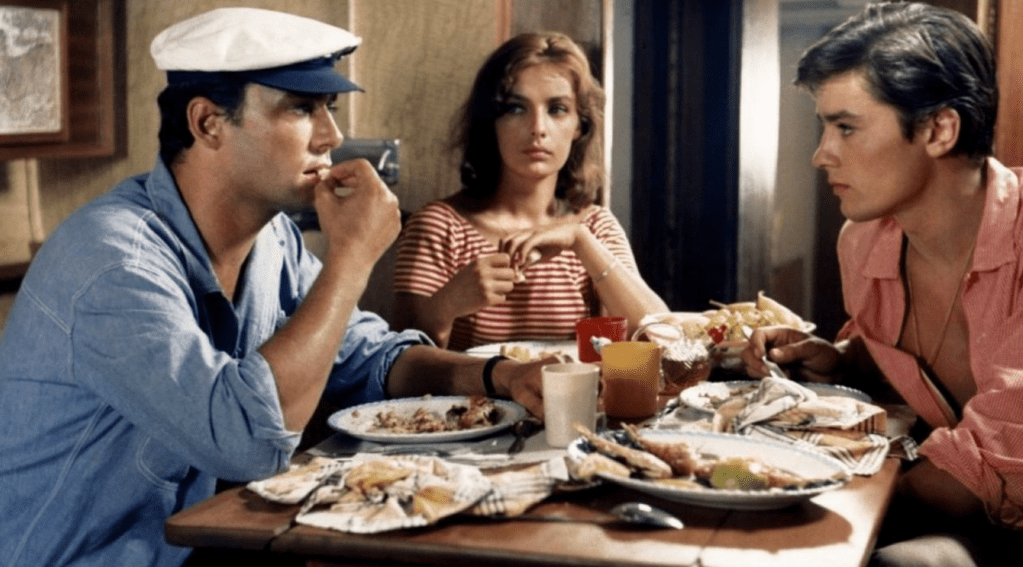
Maurice Ronet, Marie Laforêt, and Alain Delon in Purple Noon.
An opportunist unaverse to killing to get his way, Ripley has designs on murdering Greenleaf, who is adamant about not planning to return home, and stealing his identity, gorging on his finances and upper-class access. In the book and in the better-known 1999 American film adaptation, which starred Matt Damon as Ripley and Jude Law as Greenleaf and was directed by Anthony Minghella, there was far more homoerotic agitation between the men — absorbing the identity of another supplanted the cathartic, easier-on-everybody possibilities of sexual penetration — than there is in Purple Noon. (There’s far more eroticism pulsing between Delon and the camera.) The movie is more preoccupied with how a yearning for what one does not have but desperately wants can practically become a disease, particularly when sociopathy prevents good judgment from stalling the unthinkable.
Ripley’s unsettling amorality is first hinted at with an unforgettable early scene where, thinking he’s alone in Greenleaf’s bedroom, he puts on one of his host’s striped suits, neatly combs his hair, and pretends to be him while gazing at himself in the mirror. He’ll eventually kiss his reflection, playacting what it would be like having a romantic moment with Duval. His sense of self is most defined by imitation. “He can do anything,” Greenleaf naïvely announces early in the movie. “Be a butler, cook, accountant, helicopter pilot — even forge signatures!”

Alain Delon in Purple Noon.
Considering the Ripley lore’s entrenchment in both literature and the movies, it’s not much of a spoiler to say that he’ll comply with his mercenary instincts, and that killing Greenleaf will not be a one-off as long as his homicidally sped-up upward mobility is threatened. Highsmith’s Ripley feels more cunning than Clement and Gégauff’s: theirs acts more on immediate gut instinct. Unbelievable luckiness again and again helps assuage consequences. It’s a wonder that Ripley can dispose of a conspicuously area rug-wrapped dead body, which he lugs down several flights of stairs and down a block, and not get thwarted. Delon can make that credulity-stretching feel more plausible. When you’re this preternaturally beautiful, it feels like a given that consequences could be more easily skirted than they would be for the more physiognomically ordinary.
Delon’s beauty also helps make you actively want Ripley to get away with his misbehavior. He makes dirty deeds look appealing, glamorous. Cinematographer Henri Decaë’s stunning shooting of the film’s postcard-pretty locales helps you better understand why Ripley so covets a world he has no easy way into. Your uncertainty whether his risky decision-making will continue going uninterrupted gives the movie a lasting tension, which is itself heightened by Clément’s decision to mostly avoid music as a means to underline what we’re supposed to be feeling. (The barking of dogs in the background is the closest we’ll get during one of the film’s most keyed-up sequences.)
Purple Noon was integral in launching Delon’s career, during which his handsomeness would naturally continue to be accentuated. So would his capacity for playing slippery men. I immediately think of him in Le Samouraï (1967), Le Cercle Rouge (1970), and Mr. Klein (1977), movies where his sculptural perfection is not an indication of his morality but an effective tool for obfuscating it. There’s a certain symmetry, with hindsight, in Delon’s onscreen image largely being of a man whose exterior allure didn’t match what was going on internally. His name in headlines was long associated with violence, right-wing hostility, homophobia, and racism. Purple Noon encapsulates the overall feeling of what it feels like to enjoy Delon’s talents: It’s a caveat-littered pleasure.
 Peterson Reviews