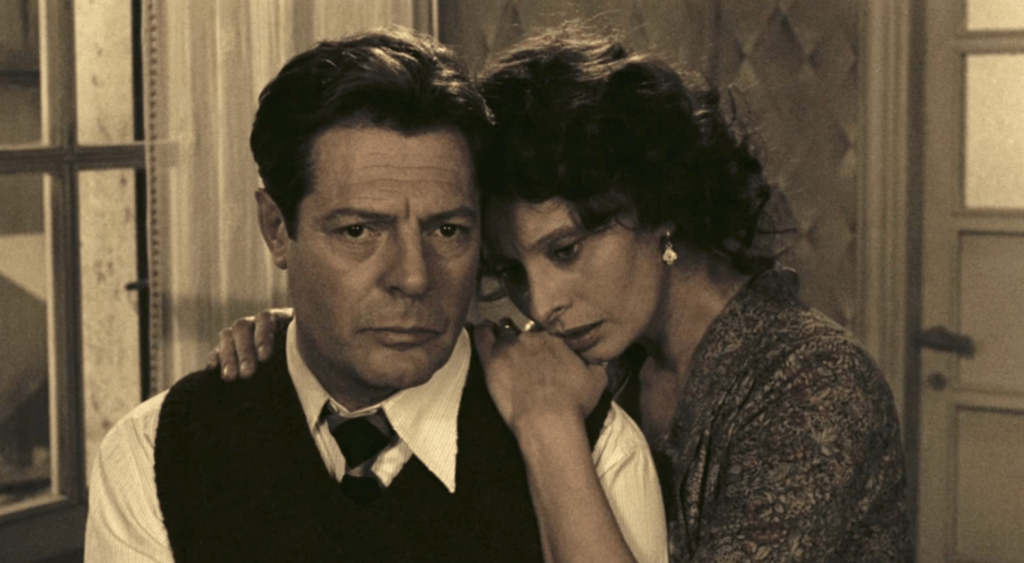
Ettore Scola’s A Special Day (1977) takes place on May 4, 1938. In Benito Mussolini-led Italy, the consequential date marked Adolf Hitler’s arrival in Rome to visit the prime minister. The occasion was publicly marked by a parade and other streetside tributes and celebrations, which the film first depicts through archival propaganda footage before fading into the background with intermittently turned-up radio play-by-plays. The occasion also gives the movie’s principal characters — Antoinetta (Sophia Loren), a relentlessly bossed-around housewife, and Gabriele (Marcello Mastroianni), a radio journalist fired by his National Fascist Party-affiliated bosses after they discover that he’s gay — a reason to connect.
Festooned with Nazi flags, the pair’s apartment building has emptied out, its residents so eager to gawk that one young man who’s running late to the revelry trips and falls while hastily scurrying from his family’s dime-a-dozen unit. Antoinetta and Gabriele stay behind, their only other company a sometimes-intruding, nastily conservative concierge who has a sizable, hair-sprouting mole on her face the movie’s cameras suggest might be symptomatic of her soul. A disappointed Antoinetta has been tasked with keeping house by her government-employed husband. The understandably sulking, suicidally lonely Gabriele — who’s nervously awaiting his deportation to a Sardinian internment camp — has no interest in taking part in the jamboree of a Party he sees as “anti-me.” “Today’s a very particular day for me,” he says. “It’s like a dream where you want to scream, but nothing comes out.”

Sophia Loren in A Special Day.
The recent strangers meet when Antoinetta’s pet bird (and maybe only friend) escapes and frantically flutters over near Gabriele’s apartment window. Their introductory small talk is, at first, threaded with unspoken tension. Worried about the optics, Antoinetta doesn’t want to wait out the rest of the afternoon in another man’s apartment. An at-the-end-of-his-rope Gabriele is so desperately lonesome that he’d like the company of just about anybody — even someone as conservative as Antoinetta. A Special Day sees the two mostly at odds for most of its length, with the Party-sympathizing Antoinetta finding herself conflicted when she learns of Gabriele’s apparent antifascist stance (albeit not enough for her to eventually make clear that her discomfort around him has more to do with a sexual attraction she’s unopposed to exploring despite his sexual preferences).
Though the latter admission results in a frustrated explosion from the persecuted Gabriele, it functionally breaks the ice for the two to arrive at a place close to mutual understanding. When Gabriele points out Antoinetta’s hypocrisy — her finding it morally unconscionable for him to be gay and antifascist while herself being willing to cheat, which is the only actually unethical characteristic of the three — it doesn’t lead her to mope with humiliation but stand with a clearer head.
Gabriele’s anguish over his situation helps her realize that his oppression is not dissimilar from her own — that she does not actually believe, as she’ll initially claim, things like Mussolini’s sentiment that “genius is incompatible with the physiology and psyche of the female and is always strictly masculine.” Fascism has authorized her husband, who cheats, and their whopping six kids, who barely see her as a person, to, as she describes it, regularly humiliate her with domestic humiliation — treat her like a nobody. She’s acutely aware that her lack of education feeds their continued disrespect, too.
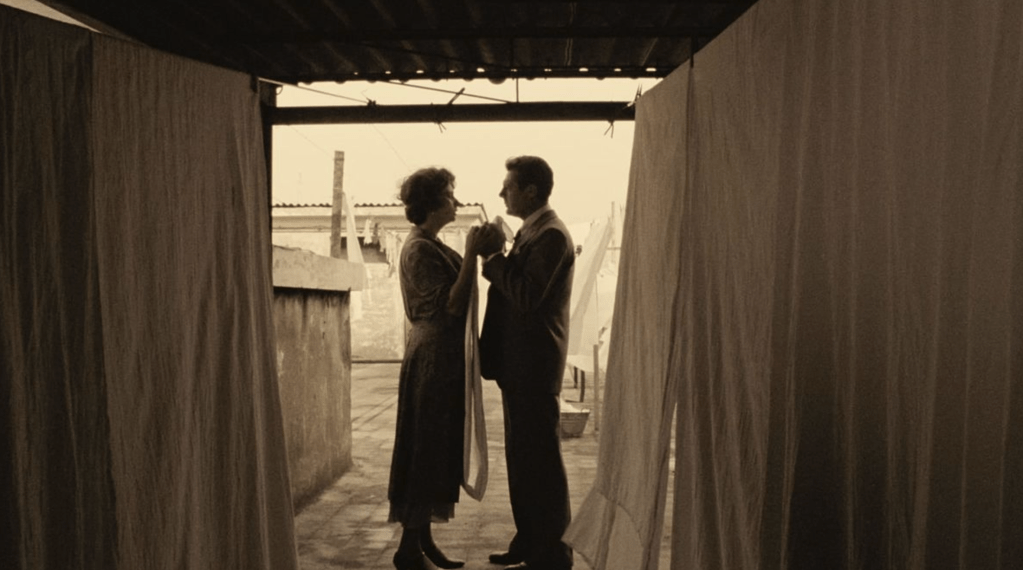
Sophia Loren and Marcello Mastroianni in A Special Day.
Antoinetta and Gabriele’s ability to cathartically confide in each other is a bright spot that we also understand registers as hardly more than an immediate flicker in the broader context of Fascist Italy. Cinematographer Pasqualino De Santis shoots the movie with hyperdesaturated color to impart the cold cruelty with which the ideology, when it has enough mainstream influence, infects everything it touches. Gabriele’s own imminent ruination hangs over the air. But afternoons like Antoinetta and Gabriele’s, even if fleeting, incarnate the power of resistance and empathy, things that, when they’ve popularly accrued enough, can ultimately make possible things like the toppling of Mussolini’s regime less than a decade later.
A Special Day might have felt more facile if it did not have Loren, styled as older than her 42 years, and Mastroianni, actors who, in toto, starred in 14 movies together. It could be said that they disappear into their roles. It also could be said that their evident comfort with each other as performers is what makes the connection between Antoinetta and Gabriele have its staggering level of moving, plaintive soul-deepness. A Special Day underlines the importance, whether more internal or external, of opposition to right-wing oppression, and these actors’ generational greatness.
 Peterson Reviews