
Unusually for a detective film, the mystery at the core of The Big Sleep could be said to be the least interesting thing about it. Like the 1939 Raymond Chandler novel it’s adapting, the 1946 movie’s narrative is complex to the point of being completely unfollowable — something with which Chandler, who assembled the legendarily confusing book by melding and then adjusting two previously published short stories, has himself concurred. I’ve never been able to watch the film’s opening sequence, where a decent portion of things are laid out for us to get our bearings, and finish it feeling like I have a very solid hold on anything, except for that its slightly built, bullshit-dispelling private-detective main character, Philip Marlowe, walks out the door on the lookout for a blackmailer.
Incomprehensibility poses an impossible-to-get-over problem for most movies. But The Big Sleep, written by William Faulkner, Leigh Brackett, and Jules Furthman and directed by the chameleonic Howard Hawks, has enough otherwise going for it that the goodwill from everything else makes me inclined to romanticize how I look at its tortuous plotting. Maybe “baffling” isn’t the right word to describe it. Maybe, instead, it’s simply not that dissimilar from what it might be like for a PI to investigate a case. The question marks that dot a detective’s workload can multiply to make a going-in-all-directions web. It can take a lot of false leads, and the reveals of sometimes helpful and sometimes useless secrets, for there to surface anything like a clear picture.
However much credit one might like to give its mystifying storytelling, The Big Sleep wasn’t, while it was being made, trying to subvert the genre it’s part of by pointedly taking a more realistic, less narratively satisfying approach. But what it does well makes it hard not to engage with it in good, perhaps generous, faith. It was the second time real-life spouses Humphrey Bogart (who plays Marlowe with a just-right dose of world-weariness) and Lauren Bacall (who plays Vivian, the slinky daughter of the elderly general who hires Marlowe to figure out his blackmailing problem) had starred in a movie together, and the film rather spectacularly emphasizes the crackling chemistry that made them a joint box-office attraction. The Big Sleep capitalized less on being another Marlowe movie — it was preceded by Murder, My Sweet (1944) — and more on being another chance to see the heat Bacall and Bogart had memorably conjured in probably the most personally consequential movie either of them ever made: the 1944 Ernest Hemingway adaptation To Have and Have Not, which Hawks also directed and which was soon followed by their wedding.
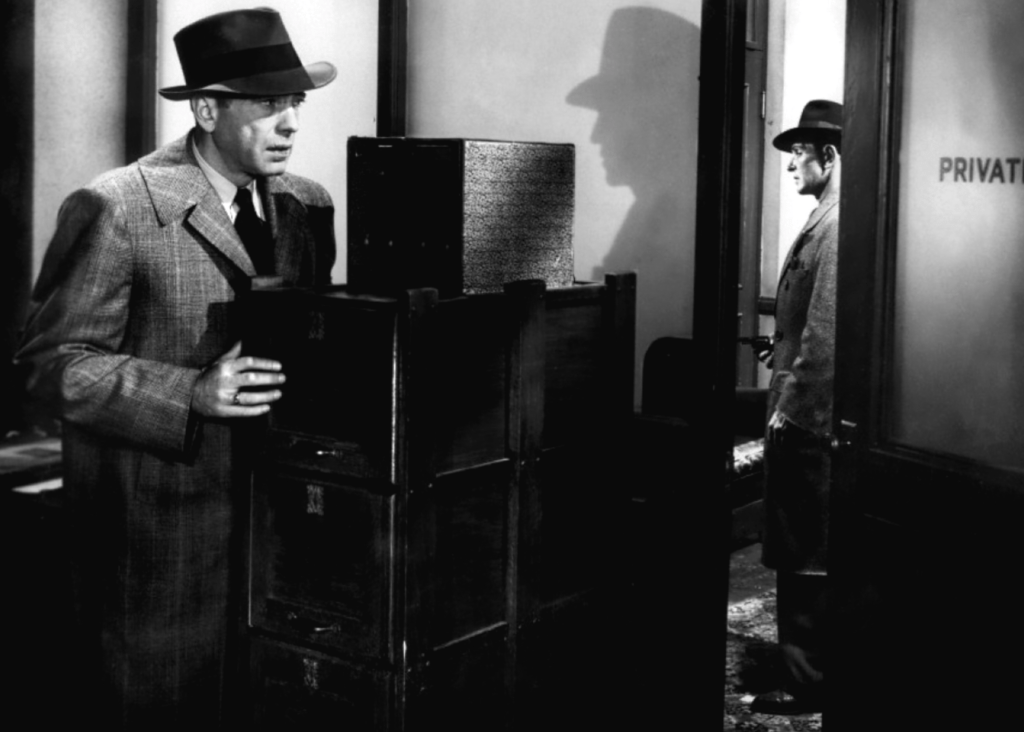
Humphrey Bogart and Bob Steele in The Big Sleep.
The pair’s romantic interludes in The Big Sleep are consistently threatened either by actual danger or the coming-and-going antagonism between them. (It’s not unusual for the witty but hot-tempered Vivian to throw some ice on a flirty exchange by snapping at one of Marlowe’s seemingly endless wise-guy lines.) Some scenes carried by the two — a joint prank phone call made in Marlowe’s office; an evening out where the conversation consists of little besides Hays Code-safe double entendres that mostly just confirm their mutual sexual interest — do nothing for the overarching movie except tacitly argue that the two are dynamite together.
Bogart and Bacall’s connection seems as much intellectual as romantic; they play their scenes with, Richard Brody has observed, barely suppressed grins. Warner Bros.’ instinct to give the recently married duo as much screen time together as possible — even at the expense of the movie’s forward motion or clarity — continues to still feel like a correct instinct. You don’t mind, for instance, that there’s what amounts to a musical number, centered by the throatily voiced Bacall, for no reason besides an excuse to show off her hold over a room, and how she responds when Bogart joins the onscreen onlookers.
Heightened by Sidney Hickox’s saturnine, almost sexy cinematography, The Big Sleep’s milieu is menacingly enticing. The shadowed, trouble-posing streets are nearly always wet with rain or fog. The quiet of clearer nights is drowned out by the chirps of cicadas, which hit the ear like warning cries. (When you think about The Big Sleep after you’ve watched it, you’re unlikely to remember anything happening in sun-brightened daylight.) And the dialogue — which probably deserves some blame for why things are so hard to follow — dances in a way that’s both reverential of Chandler’s own descriptive, snappy writing style and is what makes The Big Sleep so enjoyable to purely listen to.
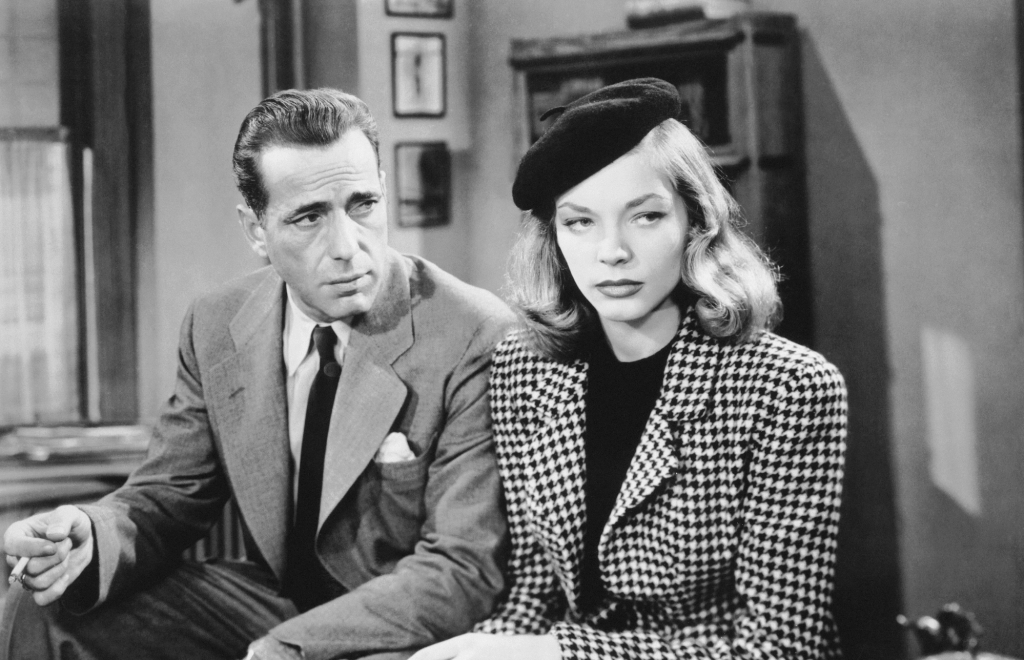
Humphrey Bogart and Lauren Bacall in The Big Sleep.
The latter helps make the gaggle of both incidental and important-to-the-investigation characters all interesting beyond what they provide Marlowe’s sleuthing. That’s especially true of its women characters: Dorothy Malone, who in an indelible one-scener plays a bookstore employee who flirts with Marlowe and gamely assists a mid-afternoon stakeout, and Sonia Darrin as a froggy-voiced moll in whom you can see vulnerability beneath her hard-edged exterior. Vivian wonders if the blunt Marlowe thinks he can handle everyone as if they were a trained seal; what’s meant to be an insult ultimately speaks to the detective’s skill for coaxing out what he needs from even the stubbornest, least submissive of subjects.
The Big Sleep sidesteps conventional greatness for something that can be preferable: making you want to live inside it — explore its world longer than what the runtime and plot constraints allow. That it comes together so beguilingly could reasonably be called a fluke. There exist two versions: the original cut, which some see as slightly clearer and, for the sake of not upstaging Bacall, cuts down the in any case wonderful performance of Martha Vickers, who plays Vivian’s sexy-baby sister; and the theatrical cut, which through reshoots mostly added some more Bogart-Bacall scenes.
I’ve seen the original cut and liked it. But the theatrical version is — surprisingly, because it rarely turns out that way — the better one. What works best about either variant is what its two leads achieve in them. The second attempt allows them to do even more, their onscreen spark feeding into how well we receive them individually. In detective fiction, style and presence can create a heady, immersive mixture; The Big Sleep dispenses both with such proficiency that it practically doesn’t need anything else.
 Peterson Reviews