Uncle Boonmee Who Can Recall His Past Lives (2011) exudes a sense of tranquility powerful enough to make your heart rate slow down — an unexpected trait for a movie that so directly looks at death right in the eye. Its title character, a farmer and military veteran (Thanapat Saisaymar), lives miles into the Isan forests and expects to die any day now. He’s still mobile and cognitively sharp, but his kidneys are failing, and he can’t be convinced, even though the assistant who performs dialysis treatments on him feigns optimism, that there’s a chance of miraculous recovery. Boonmee figures that his fairly premature demise is a result of karma: he had, after all, killed many men during his time in the military, and he continues to kill. Drowsily pesky bugs, it’s worth mentioning, have been his sole victims in his post-service years, but Boonmee doesn’t think their quick-and-easy disposability makes their deaths that much less grave.
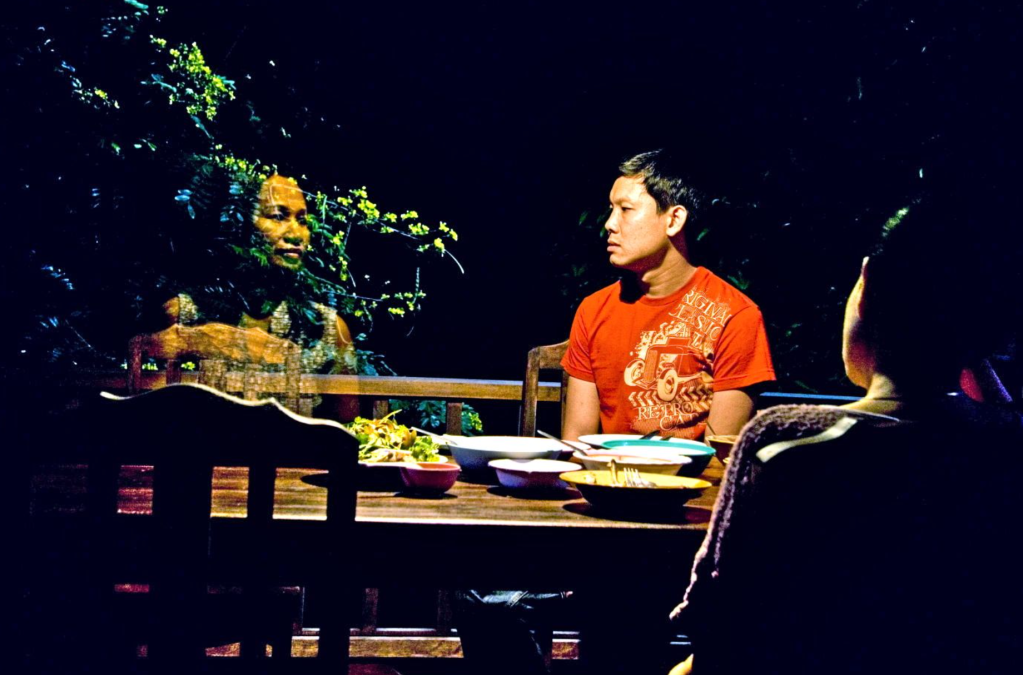
Written and directed by Apichatpong Weerasethakul, Past Lives is punctuated by paranormal visitations that might feel more goofily whimsical if its atmosphere weren’t so serene, infectiously certain about the idea that nothing and no one ever truly dies. (Maybe there’s been some soulful transference to the stir-crazy water buffalo who liberates himself from the tree he’s been tied to at the start of the film.) One night over dinner, Boonmee, who has over his sister-in-law Jen (Jenjira Pongpas) and nephew (Sakda Kaewbuadee), is visited by the placid ghost of his wife, Huay (Natthakarn Aphaiwong), who died nearly 20 years ago. She is, by the looks of it, eternally 42 years old. Soon they’re also joined by Boonsong (Jeerasak Kulhong), Boonmee and Huay’s assumed-dead son who now, to everyone’s shock, looks more like a gorilla than a man, his eyes startlingly transmogrified into glowing red ones.
I won’t get into the reasons for the transformation. Its fantastical qualities are in line with a later-to-come scene that initially feels like a non-sequitur. In it, a looks-conscious princess requests, while visiting a forested pond, that a magical-powered catfish swimming inside makes her look more like the woman she sees in her watery reflection. The cinematography, by Sayombhu Mukdeeprom, Yukontorn Mingmongkon, and Charin Pengpanich, is predominantly silvery, mostly staying surveillance-camera static; the trio underpins an ambience where everything feels at once hyperreal — scenes feel more lived than scripted, regardless of any supernatural intrusion — and not quite. Everything in Past Lives seems to take place at an intersection between life and death, where time and history become as pliable as putty.
Past Lives’ indifference to orthodox narrative beckons repeat viewings. One’s first might be too clouded by the anticipatory, shaped by too many years of movies where the imperatives demanded by storytelling drive nearly everything. It most excels at harnessing a death-haunted feeling, which might simultaneously hit you as foreign yet also evocative of something that’s always been there but easier to recognize than describe.
“Peaceful” is often used to describe Past Lives. Though not necessarily inaccurate, what’s continued to stay with me most is not its quietude but an indelible flash of anxiety that fascinatingly challenges some of the film’s loveliness. When Huay opines that heaven is “overrated,” and matter-of-factly shares that ghosts mostly exist to keep up with their flesh-and-blood attachments, Boonmee, with nervous uncertainty, wonders: Will he and his wife so easily find — or, at minimum, be drawn to — each other after he’s died? Soon he’ll know, and we won’t — at least not yet.
 Peterson Reviews