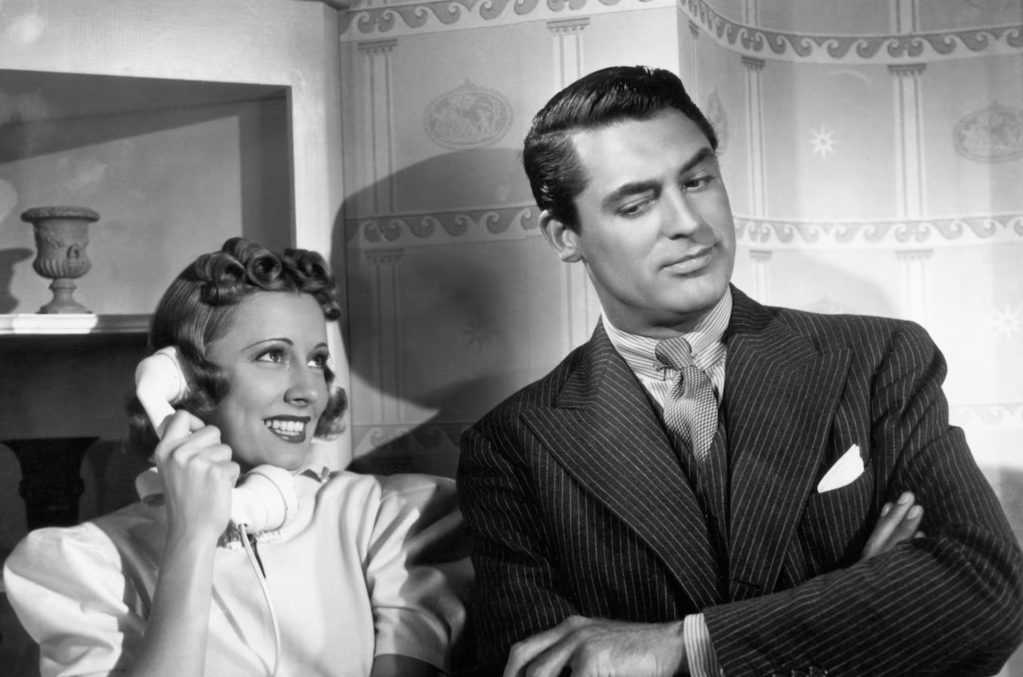
Cary Grant was so uncomfortable with director Leo McCarey’s improvisation-forward style on the set of 1937’s The Awful Truth that he famously threatened to quit the movie in the middle of its production. You’d never be able to detect that unease in the final product, though. With his unending rolodex of Silly Putty facial expressions and ease with language delivered at hummingbird speed, Grant gives a performance so winning that the movie deservedly launched him into a new stratosphere of stardom after several years of giving good but not movie-star-making performances.
In The Awful Truth, Grant is one half of a couple locked in a playful battle of wills. Grant’s Jerry is married to Lucy (a transcendent Irene Dunne), and their happy marriage hits a snag during the movie’s opening. Both catch each other in what appears to be a lie, and after Lucy concludes that “if you’ve lost [faith], then you’ve lost everything,” they decide, with no real attempts at a resolution-seeking conversation, to get a divorce. That refusal to admit any wrongdoing is, we’ll learn, key to understanding the duo. They’re both so cartoonishly stubborn that it makes sense that people with such similar ways of moving around in the world would end up together, then, over something apparently inconsequential, apart.
Jerry and Lucy will spend The Awful Truth taking turns attempting to sabotage each other’s attempts at rebound-style romances. Lucy takes up with a restlessness-inducing square from Oklahoma (Ralph Bellamy, bafflingly nominated for an Oscar while Grant wasn’t) and Jerry with an appearance-fixated socialite (Molly Lamont) with whom he goes out on a series of action-packed dates: boat races, sports games, derbies where Jerry predictably makes bad bets.
Most of that sabotaging is done through the giddy perpetuation of reputation-blemishing rumors about the other. Whether the gossip is made up on the spot by the actors or laid out by the film’s credited screenwriter, Viña Delmar, everything is stretched out for maximum comedic effect. Funniest of all is what might be The Awful Truth’s centerpiece scene: Lucy showing up to a meeting with Jerry’s snooty new beau’s family pretending to be her soon-to-be ex’s sister, all ugly clothes and jaw-slackening insinuations that Jerry is actually trying to dart away from his in-the-gutter upbringing. She makes her voice all nasally because she might as well make herself, and Jerry by proxy, look as unappealing as possible.
The Awful Truth’s vindictively motivated storyline could easily have been unpleasant — too mean-spirited to inspire much besides contempt for its almost competitively emotionally immature characters. But Dunne and Grant’s exuberant, flexibly tongued and limbed performances — not to mention the film’s overarchingly frothy tone — make the movie stealthily romantic in a way that’s surprisingly touching. They make the mutual antagonism seem fun; it’s like a foreplay-like prelude to their inevitable reconciliation. (When Jerry makes a loud and klutzy scene at an important performance amateur singer Lucy gives, she thinks it’s charming rather than another reason to distance herself from her husband.) Sure this couple’s consonant bull-headedness results in a lot of unnecessarily wasted energy — a trademark of the 1930s-specific screwball comedy of which it’s become a defining part over the last near-century. But for each person to go to all this effort to potentially get back a future together in place of a far more effective apology might make even the most contented romantically cuffed viewer think, I hope my significant other would go to all this effort for me!
 Peterson Reviews