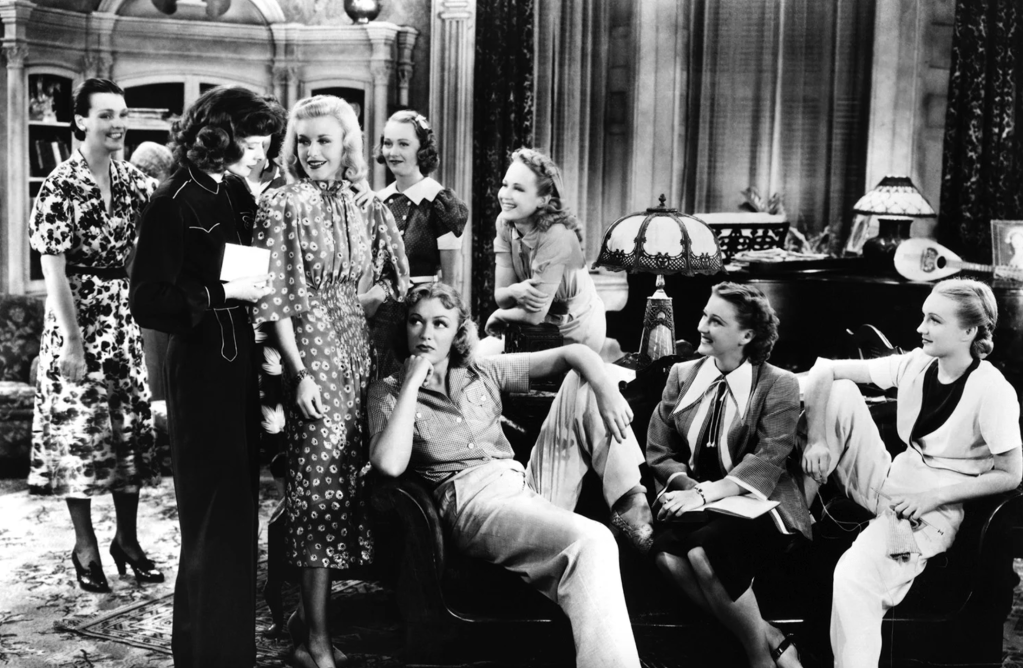
Few movies released in the 1930s were quite as lavish with jokes and wisecracks as Gregory La Cava’s Stage Door (1937), yet calling it a comedy somehow feels like a trivialization of what it achieves. It’s a cynical, clear-eyed drama that pulls off one of the finest cinematic translations of what it means when someone uses humor to cover up their pain. “After you wait around for a job for a year,” puts one character, “you won’t take anything seriously either.”
That hurt is almost a cast member in itself in the infamously unfaithful adaptation of the same-named Edna Ferber and George S. Kaufman play. It belongs to the menagerie of aspiring young actresses rooming together in a New York City boarding house called the Footlights Club, which has both facilitated the careers of breakout successes and seen dreams depressingly calcify. One den mother-like woman there (Constance Collier) is nearing 60 and pacifies the anguish over her long-gone promise by keeping decades-old positive notices for her work in a Twelfth Night (1602) revival at the top of her handbag.
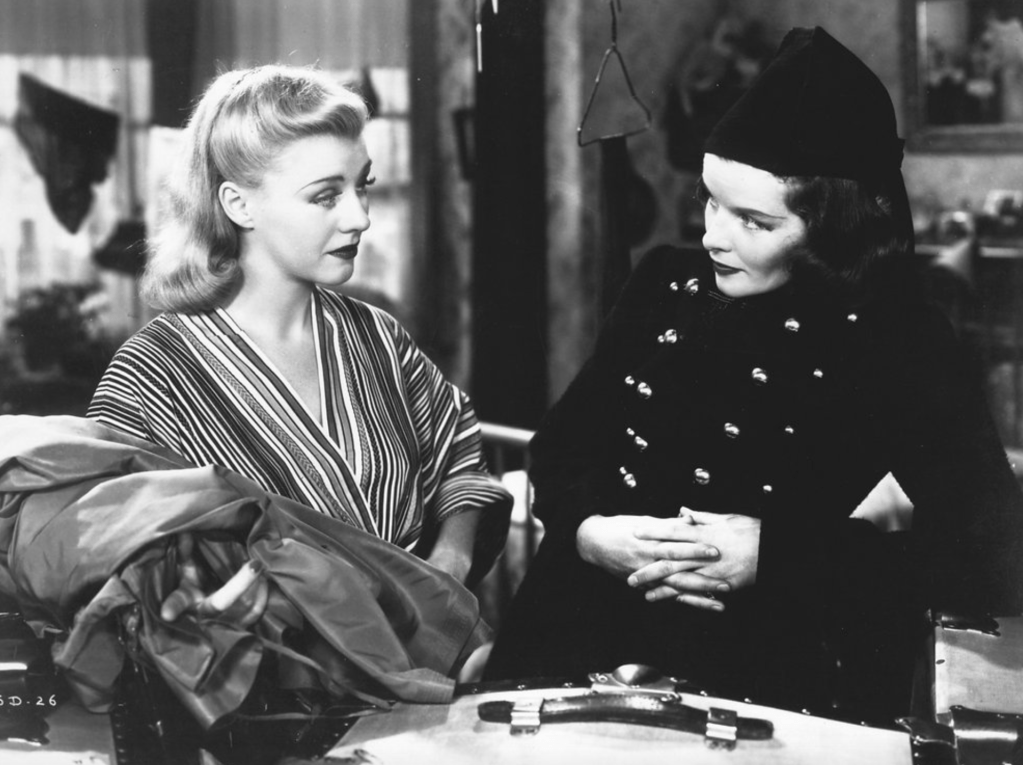
Ginger Rogers and Katharine Hepburn in Stage Door.
Everyone at the Footlights Club is so used to having their hopes dashed, of counting spotting a manager from afar but not actually talking to him as a success, that the building has a higher reserve of gallows humor than decent food, which comes included with the $15-a-week rent. One choice dish includes some soup someone cracks would have made for fine water had it been a little thicker. The breathtakingly clever insult is one of hundreds of dagger-sharp digs studding Morrie Ryskind and Anthony Veiller’s terrific screenplay, which helps solidify Stage Door as one of the great Great Depression-era movies about working women fighting to get what they want.
Many of the Footlights Club’s inhabitants are played by appropriately up-and-coming actresses who’d eventually find much bigger success; Lucille Ball, Ann Miller, and Eve Arden — who spends nearly all of Stage Door wearing a sleepy white cat like a mink stole — are among them. There’s such a lack of pretense between everybody that they’re like a bunch of cells moving around a brain. The film’s lead characters, in contrast, are portrayed by more established talents (Katharine Hepburn and Ginger Rogers) in a move perhaps designed to make you think about all the just-as-gifted women who never made it. Jean (a thrillingly bellicose Rogers) is already a Footlights Club mainstay when the movie begins, with as much star-like quality as an acid tongue demonstrating how accustomed she’s gotten to the industry’s fickle bullshit. Terry (Hepburn) arrives a little later, is assigned to be Jean’s roommate, and drives everybody a little nuts. Her delusion would make you worry more if Hepburn didn’t inject into the character the quality that one also associates with Hepburn herself: the sense that her self-assurance could actually move mountains if it had to.
Terry is inordinately confident in her largely untested acting ability mostly because she grew up preternaturally wealthy and is neither used to being disappointed nor plagued by fears of failure. Her dad (Samuel S. Hinds) declares that he won’t financially help her chase her foolish dream but that he’ll happily support her again if she bellyflops — something he tries to engineer by nudging a powerful producer, Powell (Adolphe Menjou), into giving her a much-sought-after part.
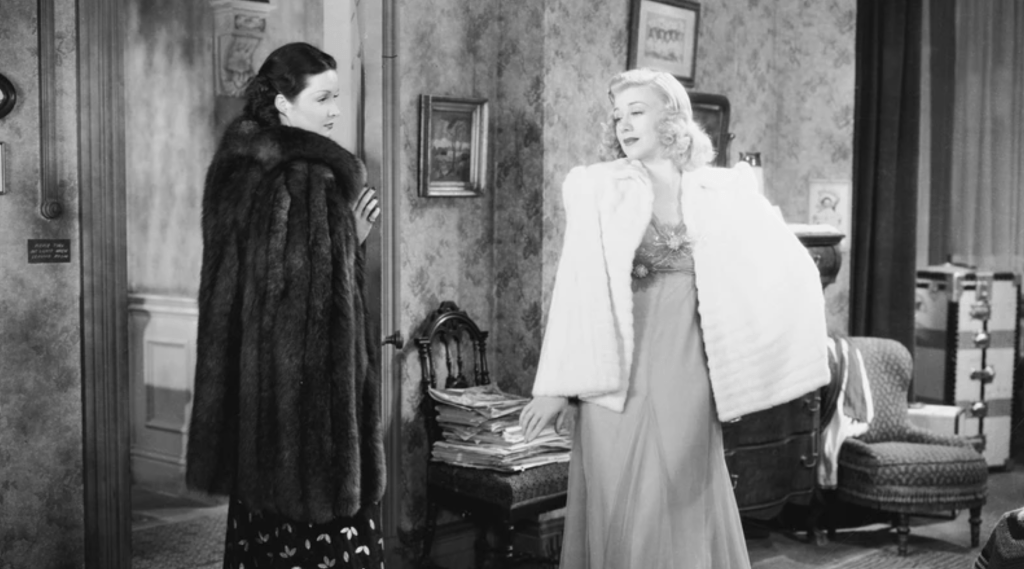
Gail Patrick and Ginger Rogers in Stage Door.
Stage Door’s savage read on the industry is probably best encapsulated by where the latter narrative thread goes. Terry turns out to be a bad actress, so wooden that it’s like she was taken over by one of Jack Finney’s body snatchers the moment she needs to recite memorized lines. It’s amusing, but mostly all you can think about is the actress from whom you could say she’s stolen the part: a genuine talent named Kay (Andrea Leeds) who too lives in the Footlights Club and is one of its most peer-revered residents. She got rave reviews for a performance she gave a year ago but hasn’t gotten any meaningful work since; she’s several weeks behind on rent. The part in Powell’s play had felt to Kay, who can’t hide her wounded-bird torment no matter how much she tries to assure her Footlights Club friends that everything is OK, like a light at the end of a tunnel. Terry’s quasi-robbery is enough to push Kay over the edge.
Stage Door sneaks up on you. You laugh at all of its heartache-soothing jokes, but then something like what Kay goes through — telegraphed hauntingly by a deservedly Oscar-nominated Leeds — gives it almost unbearable sadness. The “this industry will chew you up and spit you out” cliché regularly applied to the entertainment milieu feels almost too facile for Stage Door, a movie that potently and contemptuously dramatizes the life-destroying byproducts of paying to play, unfair favoritism, and all-around bemusing professional politics. One person’s happy ending can be a soul-crushing disappointment for someone else. The film is a still-thrilling celebration of its murderer’s row of now-legendary actresses in their prime; it’s an elegy for the stage and screen’s legions of unrecognized talent, too.
 Peterson Reviews