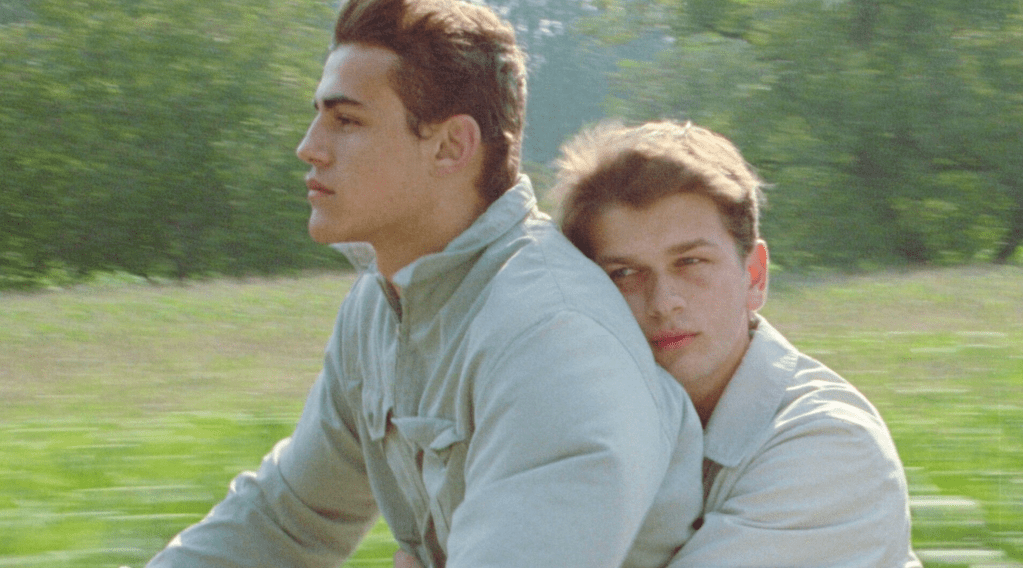
Most of the characters in André Téchiné’s Wild Reeds (1994) are older teenagers arriving at a familiar nexus point: sorting out their lives’ true wants from what they’ve been taught to covet. Set in 1962 — a year stated not explicitly but alluded to with mentions of the Algerian War’s end and sights of movie marquees touting Jacques Demy’s Lola and Ingmar Bergman’s Through a Glass Darkly — the movie unfurls in a pastoral, golden-hued French village called Villeneuve-sur-Lot. François (Gaël Morel), a working-class senior with literary ambitions and sad eyes, is positioned not unlike a nucleus. He’s coming into his sexuality, his gayness affirmed by a sexual dalliance one night with his pouty-lipped classmate, Serge (Stéphane Rideau), in their shared dorm room. François doesn’t seem so much tortured by the epiphany about himself as grudgingly determined to embrace it. “I’m a faggot,” he stoically repeats to himself later while glowering at his reflection in the mirror, the moment presented by Téchiné with “an arythmic jump cut to convey the seismic moments of recognition, assertion, acceptance,” Armond White wrote in 1995.
Though he was the initiator, Serge sees the randy evening as more experimental than concrete evidence of his own identity. (One could say, however, that Wild Reeds, written by Téchiné, Olivier Massart, and Gilles Taurand, subtly leaves open the possibility that he’s still not yet ready — and maybe will never be — to confront what could be compulsory heterosexuality.) François can only reel as a result, seeing things like a subsequent motorcycle ride through the countryside with such heart-eyed fondness that he might as well keep the memory in a locket. Auxiliary to his heartsickness is his proudly politically left best friend, Maïté (Élodie Bouchez). She has feelings for François but mostly keeps them to herself after he comes out and speaks of his unrequited love for Serge, with whom he maintains a friendship. (What she won’t bite her tongue about, though, is how François’ romantic dilemma has irritatingly subsumed any interest he once had in her life.)
Or maybe François’ affections are deeper for Henri (Frédéric Gorny), a death-haunted new student — and now-21-year-old three-time flunk— from Algeria who arrives in town a little after François’ night with Serge. Henri is so angry about the perceived weakness of his originating country that he’s come to have more warped sympathy for its French occupiers. Still figuring out the difference between love and lust, the rather politically indifferent François is smitten less with Henri’s political leanings and more, it seems, the passionate conviction of his contrarianism, as well as their similar taste in authors. (Sitting under a head of perennially perfectly tousled hair, Henri’s good looks don’t hurt, either.) Despite being Henri’s ideological opposite on account of being raised by these three boys’ feminist English teacher (Michèle Moretti), Maïté becomes drawn to him, too.
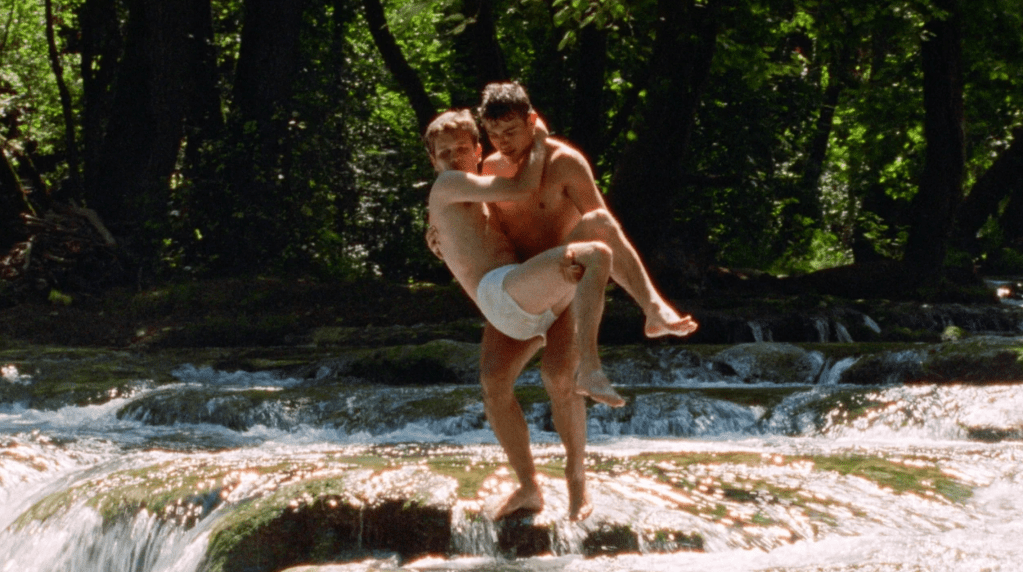
Gaël Morel and Stéphane Rideau in Wild Reeds.
Young and beautiful characters working through their feelings and their worldviews in a gorgeous setting: Wild Reeds sometimes recalls the sunnier movies of Téchiné’s peer, Éric Rohmer. But the articulateness and understated comic tenor associated with the two-decades-older Rohmer aren’t as much replicated by the autobiographically inspired Téchiné and his ensemble. Wild Reeds is readier to latch on to the deeper meanings behind furtive glances — invite doubt around whether its characters, disoriented by the uncertainty marking one’s teenage years, are saying exactly what they believe and feel.
War intensifies things, the characters’ relation to it helping clarify their principles and guide how they see each other. “The unexpected effect of Wild Reeds’ seemingly conventional coming-of-age dressing is the revelation that sex and politics are not just important means of forming one’s identity, but that one’s sexual and political awakening shouldn’t be — and perhaps can’t be — separated,” Chris Cassingham wrote recently.
Wild Reeds treats the emotional disarray of youth with moving seriousness, and some ultimate mournfulness. During the film’s final act, one character concludes that life’s unceasing forward march is worse than the violent consequences of war. Even some of one’s most pivotal moments are vulnerable to being, at best, viewed as less important years later or, at worst, forgotten entirely, the details that once had been life-or-death no more than easily discardable detritus. In this movie where both romantic and platonic feelings are bequeathed a stop-everything urgency difficult to recreate in adulthood, the comparison momentarily seems reasonable.

