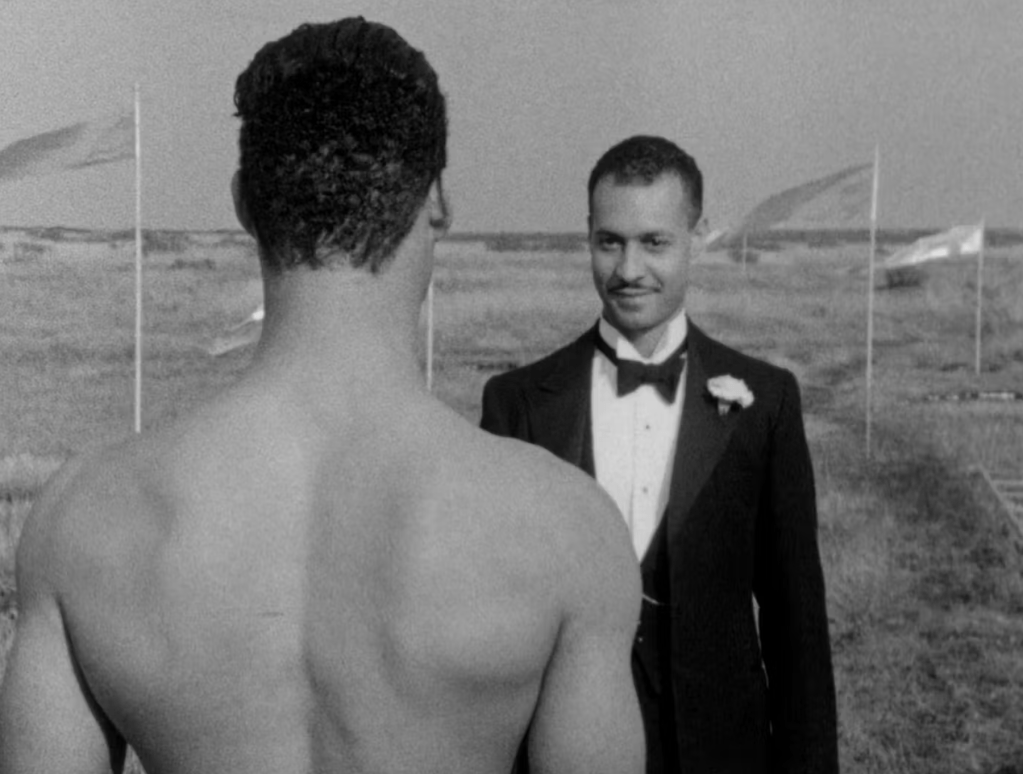
Not long before making Looking for Langston (1989), Isaac Julien hadn’t known much about the Harlem Renaissance. When the Black British filmmaker was studying art history in school, the period, which spanned roughly from the late 1910s to the mid-’30s and engendered an influential boom in African American creativity in its namesake neighborhood, didn’t come up in class — a lack that only became starker the more he learned on his own. “My investigation into the ways in which there were so many absences and erasures in archives led me to view them as a springboard for reinvention,” Julien said in an interview with Frieze a few years ago.
In his late 20s when he made the 45-minute but thematically capacious Looking for Langston, Julien harnessed that hunger for reinterrogation for a film that idiosyncratically plays around with narrative, time, and presentation to both celebrate and eulogize. It’s a heady, dreamy swirl.
It rejects every hallmark of biopic-style filmmaking. The title refers to Langston Hughes, the key Harlem Renaissance figure who’s long been assumed to be gay but never publicly came out before his death in 1967. More through meditative visuals (archival imagery is shown alongside newly shot fictionalized footage) than explicit statement, the movie ponders the stifling toll of outwardly suppressing part of one’s identity while cultivating a career that brought beauty and clarity to the human experience.
Looking for Langston uses its version of Hughes, played by Ben Ellison, to additionally contemplate how the speculated-upon, homophobia-enforced pains of his existence — the destructive weight of the closet, the pressures of assimilation — have mutated, not been vanquished, for future generations of men like him. (The AIDS crisis hovers, wraith-like, over Looking for Langston, particularly during the handful of passages motioning at contemporary times.) Heard through voiceover, Hughes’ poems — along with the words of Essex Hemphill; Bruce Nugent; Hilton Als; and James Baldwin, to whom the film is dedicated — obliquely sharpen (and, usually in the case of archival footage, bring new angles to) Julien’s already-loaded images.
The inclusion of some of Hughes’ work in Looking for Langston kindled some controversy upon release. The writer’s estate bristled against Julien’s uncleared use of it, crying copyright and mandating certain passages go audioless at some official screenings. Julien has noted in recent years that that consternation, about which one is disposed to read between the lines, was anticipated, and only bolstered what he’d sought to do. The successes of an archivist — a role that as embodied by Julien in regard to Looking for Langston prompted productive postulation — often hinge on their ability to destabilize long-held perceptions about a historical figure, loosening up seemingly stiff narratives.
Director of photography Nina Kellgren’s luminous black-and-white cinematography gives Looking for Langston a ghostly mournfulness. It also beautifies the Harlem Renaissance’s early-20th-century stylishness in tandem with the gay male gaze, which is most memorably indulged by how much the cameras love a character named Beauty (Matthew Baidoo), who looks cut from marble and is the fictionalized Hughes’ primary object of affection. Julien’s overarching act of reclamation and -examination works manifold: honoring and empathizing with the probable truths of its eponymous subject; aesthetically and just generally exalting a period that’s not always adequately commemorated in history books. Its achievements are strengthened by its lack of literalism, its fantastical scrutiny of what surfaces can’t always show.

