Years ago, actress Helen Shaver recalled that, when conceiving of how to portray 35-year-old English professor Vivian in Desert Hearts (1985), she imagined a woman who’d spent years living exclusively “from the neck up,” moving around with self-conscious stiffness and usually wearing outfits covering everything but her face and hands. Based on the Jane Rule novel Desert of the Heart (1964), the movie takes place in 1959. How many other tools did women in academia — one employed by Columbia University, to boot — have at the time to ward off the sexist condescension and lecherous gazes of her male peers and pupils besides, essentially, hiding themselves as much as they could?
Desert Hearts, directed by Donna Deitch and written by Natalie Cooper, empathetically documents Vivian’s evolution from a ginger-to-the-touch shell of a person to someone more open and uninhibited. The cause is an unexpected friendship, then romance, with a comparatively wild-at-heart woman 10 years her junior named Cay (a wonderful Patricia Charbonneau). (Our first introduction to Vivian is of her woodenly stepping off a train, flustered by the din around her; Cay, by contrast, is first seen sidling up to the car of a friend on the highway to say hello, riskily choosing to have her black Fairlane 500 death-defyingly zoom in reverse rather than safely move in the same direction.)
Perhaps Vivian wouldn’t be so receptive to this kind of forbidden love were her life not in a state of upheaval. She arrives, at the start of Desert Hearts, in Reno. She’s here for a quickie divorce and plans to stay as long as is required for her signature to be valid. She’d been married to her husband, another scholar who’s never seen onscreen, for 12 years. Their union is suggested to have been sexless, more than anything about unhealthily obsessive appearance-keeping and reputational maintenance. Vivian has, at last, had enough of the charade. She wants to start over; she wants to be “free of who I’ve been.” That doesn’t, at least immediately, extend to the possibility of something more than friendly with Cay, though that proves just a well-trained, deeply internalized response. It’s gratifying to cede an old way of life until you’re hit with the rather frightening realization that much of your hard-to-pinpoint anguish had to do with denial-feeding self-suppression.

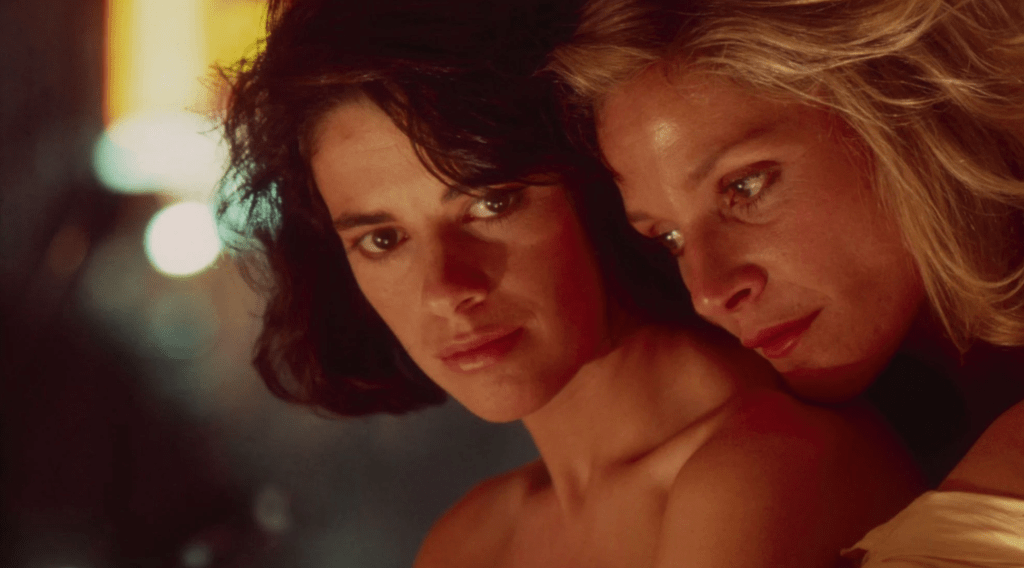
Patricia Charbonneau and Helen Shaver in Desert Hearts.
Desert Hearts’ romance is touching, the pull to be vulnerable with one another magnetizing these outwardly polar-opposite women toward each other. (The scenes depicting Cay and Vivian’s first kiss and their first time in bed are extraordinarily directed and acted, too.) But what makes the movie especially great is its awareness that you cannot really make a film like it as emotionally lucid without getting to know its characters and the milieu they reside in well enough to seem like they could go on existing after there are no more pages left of the screenplay. Made without a distribution deal, the movie didn’t have a big budget — it came to around $1 million — and so Deitch adroitly, if treacherously, decided that the surest way to absorb the viewer in its dusty, open-skied late-’50s setting would be to dwindle her funds on the soundtrack. It encompasses the likes of Patsy Cline, Gene Vincent, Buddy Holly, and others, at once summoning the period and crystallizing the melancholic, slightly woozy feeling preceding Vivian and Cay’s mutual confirmation of their affection.
Cline’s played-to-death “Crazy” in particular sounds brand new in Desert Hearts’ purview. Its Willie Nelson-penned lyrics are rendered compatible with Vivian’s dilemma. Has she lost her mind, or does she really want to live out this taboo? The film’s aesthetic itself sometimes feels like a visualization of its collection of old country and rockabilly songs, gorgeously lensed by cinematographer Robert Elswit: Neon lights flickering against lonely, dark vistas; endless roads barreled down with glassy eyes; the swaying hips of dance partners gently grazing on a dance floor. In Deitch’s romantic presentation of Reno, this small city girded with overwhelmingly vast landscapes becomes “a magical space where anything is possible,” B. Ruby Rich has written.
There’s palpable weight to these characters’ personal histories in the brief allusions made to them — as much a testament to its soulful, albeit sometimes on-the-nose, writing as the across-the-board-excellent performances. Just in Vivian’s hunched gait can you trace the years spent worrying about others’ projections. Though much of that, you can tell, comes from the closet, in which she doesn’t want to admit she’s long been trapped. (As someone who too came out later in life, I still can feel the ghosts of that secret-keeping in my back and shoulders; it had been like I was carrying around a heavy backpack, or something similar to it, at all times.) It could seem more like a cliché that Cay’s free-spiritedness — which partially manifests with her successfully seducing many of her women coworkers who’d previously thought of themselves as straight — is a mere cover for a more delicate nature, but it comes to seem less like one when she clarifies that her seeming to give no fucks is more an authentically rooted way not to let the pressures of conformity win.

Patricia Charbonneau and Helen Shaver in Desert Hearts.
So easily they could: Cay had finally escaped Reno, where she was born and raised, to go to art school not long ago, but she was kicked out when word of her being a lesbian got out. Now she makes a living at a casino where it’s a given to be sexually harassed by sloshed male visitors and guilt-tripped by her boss, with whom she briefly was in a relationship longer than she ought to have because she was “attracted to his attraction.” As vigorously maintained as her sex life is, Cay concurrently looks for “somebody who counts.”
The side characters contain worlds, too. Years of romantic and professional disappointment, plus the gradual slipping away of loved ones, have made the sharp-tongued woman who owns the dude ranch Vivien is staying at, and who herself raised Cay (Audra Lindley), alcohol-dependent and bitterly possessive, the latter trait rearing its ugly head during the film’s last section. An older coworker and erstwhile lover of Cay’s (Andra Akers), who’s getting married to a man she genuinely loves, is believably indifferent to the world’s conservatism, done with giving too much credence to what people might say about her. I love the moment where Cay is over at her house and the two take a bath together, the distance of close friendship kept intact, and they’re interrupted by the Akers character’s unbothered fiancé, who cautiously dodges bubbles to paw off some chilled cocktails. A little mournfully, he good-naturedly expresses his jealousy at how much closer the bonds between women usually are compared to those between men.
Desert Hearts’ slowness and sensitivity continue to feel like a balm, even if the lesbian cinema for which it helped pave the way has gotten far less reliant on the old tropes of someone having to die at the end; the lure of assimilation suffocating blossoming love; or having a lesbian character prey on someone younger, more impressionable, and ostensibly straight. In 1985, though, Desert Hearts was, it probably goes without saying, a breakthrough not just for representation, but also for doing away with tired, harmful narratives underpinning the idea that you couldn’t be in a gay relationship and have it end happily, and of proving that gay directors like Deitch could make viable movies about their community. (With the AIDS epidemic, beyond its devastating mortal consequences, fostering negative public perception about gay people, the critically and commercially successful Desert Hearts additionally functioned as a humanizing rejoinder.) The movie does not, for what it’s worth, conclusively promise anything about its leads. But open-ended possibility is a sufficient-enough beacon of light.

