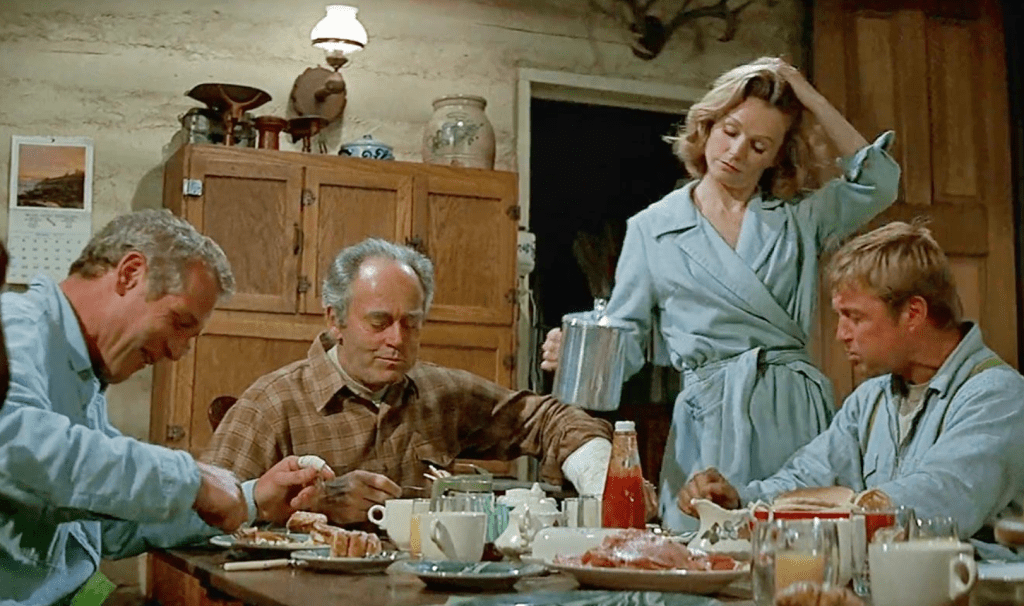
Most families don’t have their own motto, but most families aren’t the Stampers. Led by hobbling, cantankerous patriarch Henry (Henry Fonda), the clan at the center of Paul Newman’s superb Sometimes a Great Notion (1971) so strongly abides by the belief that his kin should “never give an inch” that the saying has been crudely carved into a piece of wood now proudly displayed on the living-room mantel. Long based in the fictional town of Wakonda, Oregon, nearly everyone in the all-grown-up family works for Henry’s independent logging company and stuntedly lives with him in his creaky home, which you can only get to by boat.
The Stampers have always kept to themselves. But lately they’ve become controversial enough public figures that they can expect, every time they come into town, to run into people who either indirectly or quite explicitly threaten them with vengeful violence. The city’s logging union is calling for a strike against the industry giant that profits off their work. Everyone in Wakonda, whose economy lives and dies by the mowing down of timber, is on board. Not the Stampers, though; Henry dismisses the push as commie bullshit. The motto they so tightly cling to turns out not to be just about sticking it to the man but sticking it to anybody challenging their hermetic way of life. It’s chilling when, late-movie, someone ponders why Henry is so uncompromisingly obstinate, and he can reply with no deeper philosophy besides wanting his life to go on, everybody else be damned.
Henry stubbornly holds on to gender norms. He repeatedly decries looking like a sissy, and he considers a man who keeps his hair longer than is conventional probably gay. It’s part of what’s quashed his capacity for empathy, his care for someone else being mistaken for feminine-coded weakness something he’d rather not think about. His style of ornery rigidity has been most inherited by his taciturn eldest, Hank (Newman), who shrugs it off when a particularly at-a-loss union member declares, without hyperbole, that he’ll kill himself if the Stampers continue to abstain from the strike. Joe Ben (Richard Jaeckel), Henry’s nephew, is comparatively sweet, but he also never challenges — that is if he even notices something is off — the be-tough-at-all-costs ethos under which the Stampers live. Hank and Joe Ben’s wives, Viv and Jan (Lee Remick and Linda Lawson), live at the compound, too, but they’re more seen than heard. They’ve learned never to speak their minds in front of the men who see them as little more than caretakers and partners in bed, keeping their heads down to focus instead on cooking meals and doing laundry. When someone at last wonders to Viv what she thinks of the union effort and the men in her family’s baffling refusal to support it, she cops to not having much of a fully formed stance, too used to no one at home asking her opinion to make her think things over for very long.
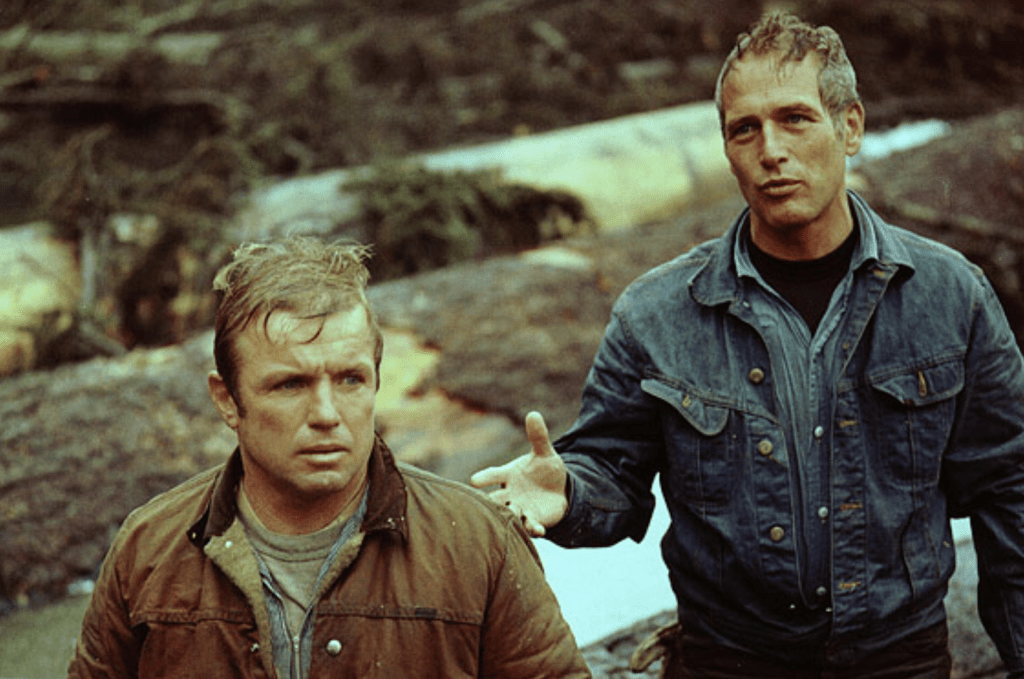
Richard Jaeckel and Paul Newman in Sometimes a Great Notion.
Adapted from Ken Kesey’s 1964 novel of the same name by screenwriter John Gay, Sometimes a Great Notion’s suffocating atmosphere flouts the mesmerizing vastness of its tree- and water-lavish landscape. Newman seizes on both the hard-to-get-out-of comforts of routine and the endless anxiety that’s inevitable when you live like the Stamper men: with constant worry about looking weak, so all-consumingly determined to meet restrictive gendered standards that interpersonal relationships have been sandpapered down to merely filling in roles.
Sometimes a Great Notion’s production was troubled. Newman only took over as director when its originally appointed one was fired. The shoot itself was scourged with conflicts with his agent; studio; wife, Joanne Woodward; and his well-documented alcoholism. But the tumult may actually have been beneficial to the final product, the furor of a contentious day on set perhaps bleeding into the tortured milieu onscreen. Gay doesn’t get much into anyone’s backstory — and I’m not sure, since I haven’t read the Kesey book, whether that’s a matched characteristic or a divergence — aside from a passing late-film mention of childhood sexual abuse at the hands of a never-seen black-sheep family member. Much is explained, though, in the scope of that revelatory sentence. In Sometimes a Great Notion, even the minutest details substantially accrue.
The movie doesn’t need the sort of characterological specificity that would make things easier to diagnose to be potent. The family dynamic feels lived-in, like a tattered sweater barely upholding its original form. No one here, besides the women living in the Stamper abode and a suddenly materializing youngest son, knows what it’s like not to live away from Henry’s chauvinistic despotism and their backbreaking line of work.
Sometimes a Great Notion isn’t unsympathetic to its array of jaded anti-heroes. Affixed to an industry that automatically designates them as replaceable, it’s understandable that they’d be susceptible to trying to exert power and control however they can, especially as age brings them closer to physical obsolescence in a sector as much sustained by natural resources as bodily resilience. Fonda’s uncomfortably barbed performance comes across as the final form of decades of harmful internalization. The augustly shot, seemingly physically onerous logging sequences additionally impart how he could have a bit of a god complex.
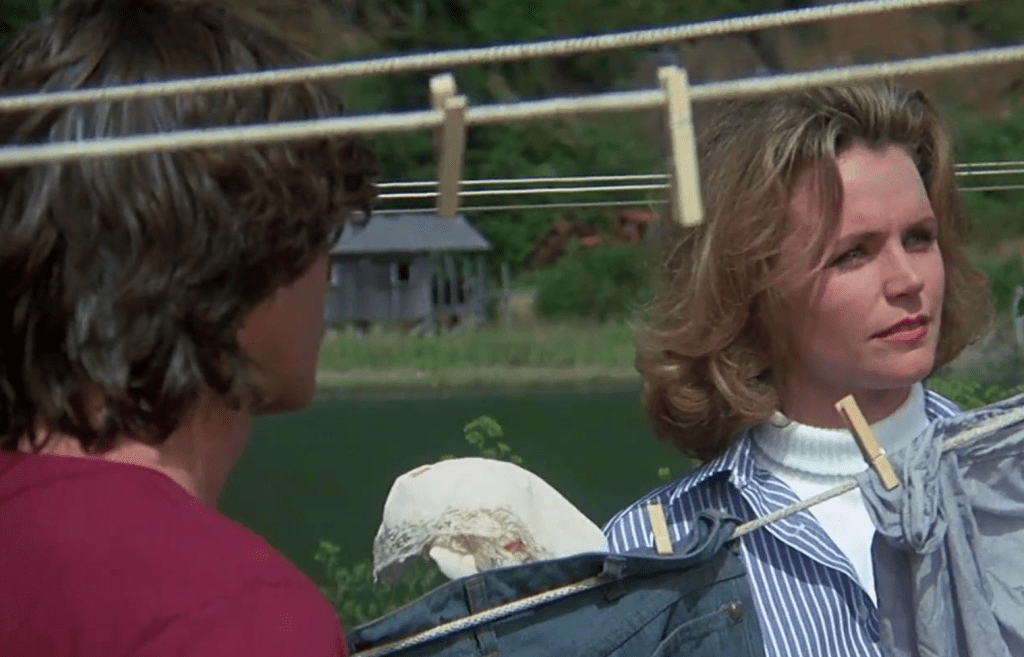
Michael Sarrazin and Lee Remick in Sometimes a Great Notion.
Sometimes a Great Notion’s ending could be seen as triumphal. But the twin tragedies that, spoiler alert, near-immediately precede it — shot and staged by Newman with such awful, naturalistic slowness that they stand among the most mutedly disturbing sequences of their kind I’ve seen — promise that all you really can think about is how little that triumph means in the grand scheme of things. A sharp indictment of the corrosiveness of toxic masculinity not just on the men who are consumed by it but on the women who live with it, the movie persuasively and nondidactically argues that it’s predestined to leave you with nothing. Relationships and, if you’re lucky, a fulfilling job are mostly all we have to make life tolerable. Living while unwilling to open yourself up ensures even the closest of bonds are missing an essential richness.
Sometimes a Great Notion’s best scenes are between Viv and the family’s youngest brother, Leland (Michael Sarrazin). Fresh off a suicide attempt, he returns to the family home after some time away in the city. Born to a different mother than Hank, he’s ostensibly the first person in years to confront his family’s noxious interplay, though he knows it’s too ingrained to attempt something like deprogramming. Still, he’s openly put off by the passivity expected of Viv and Jan (the latter of whom I’m pressed to remember has any dialogue of her own), and is flummoxed by his brother and father’s contempt for the striking workers who fundamentally need their support to survive.
In a movie predominantly attentive to how its male characters steer clear of vulnerability, the handful of moments where Leland and Viv are alone — during which he lends an ear for her to work through what she’s actually thinking and feeling — pack a punch. Only around each other do they feel they can candidly speak to the purgatorial arrested development that defines the Stamper home and how it affects them. Along with Sarrazin’s, Remick’s characteristically lovely performance — which, it should be said, depends heavily on her reputational intelligence as an actor to tell us what her character doesn’t always have opportunities to — is the film’s stifled heartbeat.

