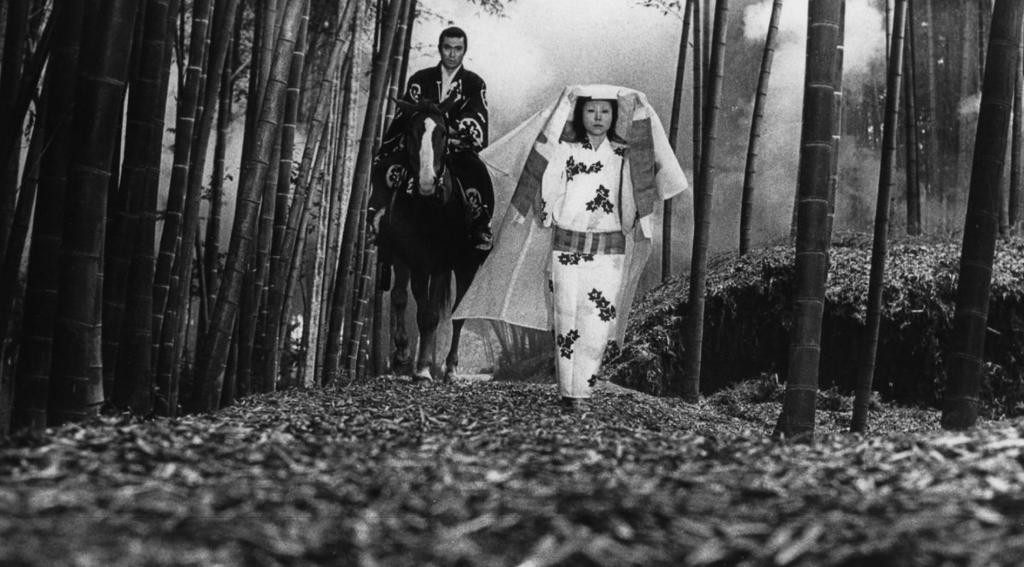
When the ghosts of Kaneto Shindō’s Kuroneko (1968) float through the air, their bodies sometimes acrobatically spinning, their glowing white robes make them look like angelic beta fish. But akin to the creatures they fleetingly resemble, admiring their otherworldly, at times deadly beauty also means witnessing their imprisonment. In life, these ghosts were Yone and Shige (Nobuko Otowa and Kiwako Taichi). They were brought together by Yone’s son, Gintoki (Kichiemon Nakamura), whom Shige married. They’ve been living alone together, in a hut bordering a forest, ever since Gintoki went off to war a few years ago. Set in feudal Japan, Kuroneko begins with the brutal, sudden end of their lives. A phalanx of sweaty, disheveled samurai happen upon their home on a blazing afternoon. After ravaging what little food and water they have around, they gang rape and then murder both women, setting their abode alight to cover their tracks.
Kuroneko’s disturbingly wordless opening heralds a minimalist but searing revenge movie that’s initially satisfyingly cathartic before requisite emotional complications set in. (Shindō, who also wrote the film, is in the meagerly populated class of horror filmmakers to make his undead conflicted and occasionally teary-eyed over their afterlives’ purpose.) Following their deaths, Yone and Shige are reborn as phantoms. Operating under the cover of night, they wait for horse-riding samurai to enter the vicinity of Rajōmon Gate, where Shige offers herself as bait. She feigns fear of walking home alone in the inky darkness and requests an escort home. Until paranoid fear begins to inexorably spread through the area, her luring methods work without fail. She brings her latest patsy into a home for which there can only be a supernatural explanation (Shindō ingeniously often overlays two images on top of one another to blear the separation between lived reality and the paranormal plane). There she will, with support from her mother-in-law, seduce her newest victim before tearing his throat out like a wild cat.
We figure that Yone and Shige’s death-triggered revenge is probably gratifying for them both. Their early acts of bloody justice cyclically play out in a montage made hypnotic by the sounds of undulating drums, images of encroaching fog lighting up tar-black nights, and the mews of black strays, whom the film intimates are soulfully connected to the women. And Kuroneko seems happy to if not quite co-sign then empathize with the agony anchoring Yone and Shige’s crude retribution. Its dialogue pointedly frames its quickly dispatched samurai characters as intensely misogynistic and repellently power-drunk. “It’s a samurai’s world now,” one concludes in between some fits of grotesque laughter, adding, “We can take whatever we want.” Another finds it ridiculous that anyone could want to kill men like him before denouncing all peasants as subhuman.
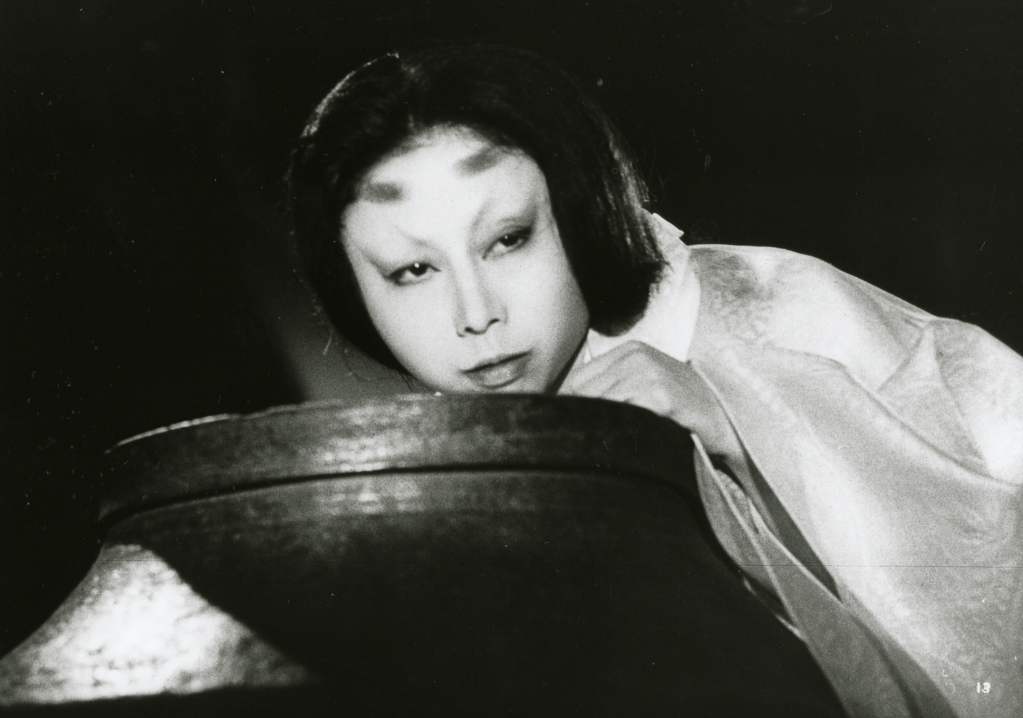
Nobuko Otowa in Kuroneko.
All these men, the film tacitly postulates, are all pretty much the same. The women are doing something like service work by ridding the world of brutes who live for nothing besides sociopathically marking their territory. A self-described socialist who lived to be 100, Shindō has spoken of feeling aligned with “common” characters, not those with enough authority to easily abuse it. Among his earliest projects was, notably, 1952’s Children of the Atom Bomb, which has been credited with being his home country’s first substantial anti-bomb movie.
Kuroneko’s acts of reprisal can only keep a lid on its deep reserves of pain for so long. There’s a sense, after a while, that though Yone and Shige’s murderous facilities are well-oiled in death, what they’re doing resembles slicing off Cerberus heads. Continuing his serrated but not didactic critique of patriarchy and the pernicious behavior it enables, Shindō eventually has Gintoki, now a respected samurai tasked by his piggish commander to get to the bottom of the nightly deaths of his men, return. It puts a wrinkle in Yone and Shige’s homicidal commitment. They’re not killing samurai entirely of their own volition but in cahoots with a never-seen demon who’s promised to keep them out of the underworld, and maintain their fleshly form, as long as they’re consistently giving it samurai sacrifices.
Yone and Shige are doing what they can to stay out of hell while being chronically stuck in a form of it. In waking life they’re destroyed by men who cannot fathom their humanity. And even when they have a morsel of power in what amounts to purgatory, it’s subject to a quasi-contract with no wiggle room. Shige cannot enjoy her reunion with her husband without there being eternally disastrous consequences; there is no slack in her hellaciously arranged vengeance. With its usefully repetitive imagery; spartan score; and, in its trio of lead performances, palpable anguish, Kuroneko is vividly nightmarish without letting its folkloric elements take it too far from reality. It might take place in feudal Japan, but the patriarchal destructiveness it clearly despises continues to lurch forward, reinventing itself as some cultural tides shift and others don’t.

