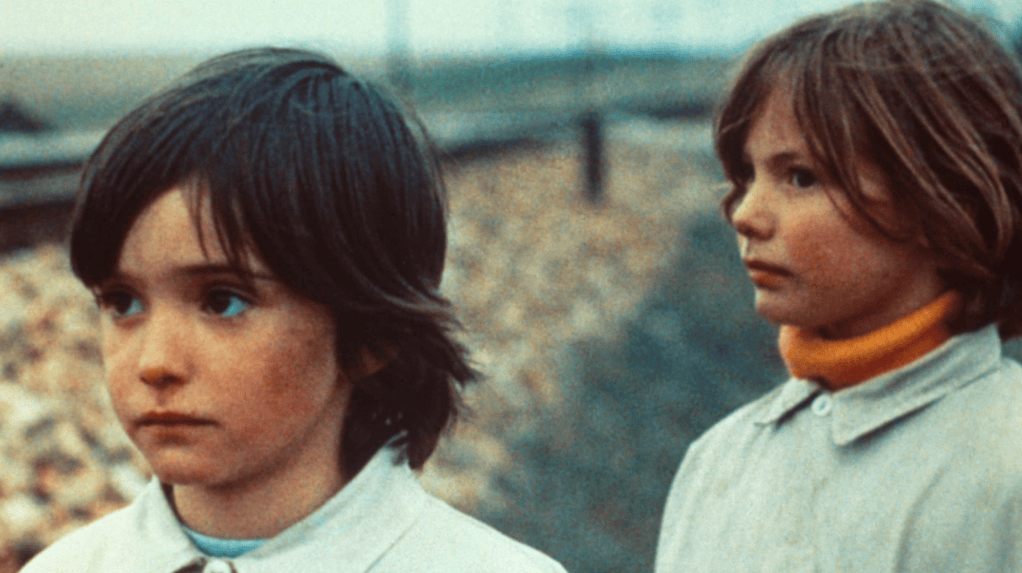
Set at the beginning but released near the end of Francisco Franco’s oppressive Fascist regime, The Spirit of the Beehive (1973) at once specifically evokes its era’s existential suffocation and, more timelessly, the blissfully ignorant cocoon of childhood and its increasing vulnerability to sobering, confrontational realization. The directing debut of Víctor Erice, who’d originally conceptualized the film as a conventional Spanish analog to 1931’s Mary Shelley’s Frankenstein, the divinely shot The Spirit of the Beehive commences in 1940, shortly after the end of the country’s Civil War and, probably not coincidentally, the same year Erice was born. Its setting is an arid, windswept village on the Castilian plateau where there is little to do but attend church or the occasionally set-up movie screening.
Its main characters comprise a family whose mother and father figures — Teresa and her much older husband, Fernando (Teresa Gimpera and Fernando Fernán Gómez) — are too distracted by the depths of their inner worlds to be particularly present. Teresa can’t stop thinking about the well-being of her brother, whom she hasn’t heard from since before the war’s end. She devoutly writes him refugee camp-addressed letters she hasn’t lost hope about him receiving. Fernando spends most of his free time beekeeping, fixated on his winged subjects’ mindless, collective commitment to a cause that pitilessly slows down for no one and over which he has ultimate control. The relationship between these spouses seems fractious, though the film, predominantly maintaining a kid’s-eye view introduced by the opening credits’ succession of scribbly children’s drawings, doesn’t get into the details, favoring hovering silence as a communicator of malaise.
The home is itself somewhat reminiscent of a hive. Its windows have a yellow tint the color of embalming fluid and are patterned with black-outlined hexagons. But it conversely trends awfully quiet for an abode in which two young girls are growing up. Of elementary-school age, Ana and her older sister, Isabel (Ana Torrent and Isabel Tellería), get into the kind of mischief that obliquely seems like unconscious manifestations of the war-enforced darkness they’ve grown accustomed to. (Unintentional morbidity is also, of course, very common in children.) The pair play on train tracks, resting their heads against the metal to feel the vibrations of coming locomotives they try to stay in the path of as long as they’re brave enough to. We see a long-winded game where one of them pretends to be dead and the goal seems to be making the other person at a loss enough to leave the room flummoxed. When Isabel accidentally cuts her lip, she uses the spillage as makeshift lipstick.
Ana — who, with woodland-creature eyes that seem to soak up everything, wispy eyebrows, long eyelashes, and an often blank expression, resembles a haunted doll — is concurrently looked out for by her older sister (we see a sweet example during a math lesson in their shared classroom) and teased in a way that only an admiring, too trusting younger sibling can be. In The Spirit of the Beehive, the chief example of the latter comes after a scantily furnished showing of Frankenstein in the city’s town hall, which the majority of the town’s children attend and mesmerically huddle around each other for. Ana is troubled first by the scene where Boris Karloff’s bolt-necked zombie accidentally kills a little girl, then by the tragic village uprising-spurred finale. Happy to mess with her younger sister for the twisted fun of it, Isabel doesn’t properly explain the plot when Ana asks post-screening. She spins a tale of her own: that she’s seen Frankenstein’s monster in real life, his form existing in the spirit world and therefore able to be conjured whenever one would like to see him.
It gets to a point where Isabel is bringing Ana along to an abandoned, rickety farmhouse a decent trek from home, claiming that it’s where the creature lives. When she later ventures back alone, though, Ana really does stumble across someone of a piece outsider-wise: an injured Republican soldier who’s been hiding out on the property after hurling himself off a passing-by train. What comes afterward doesn’t have the same horror as Frankenstein — Erice’s approach, though climactically marked with death and some magical-realism flourishes, does not seek to frighten 1930s Universal-style — but eerily furthers what the movie initiates for Ana especially: slowly receding innocence; the troubled places the mind can go in times of culturally underpinned insecurity and confusion. (Placidly portraying the internal jumble, 6-year-old Torrent gives one of the best, subtlest youth performances in the history of cinema.) The mysterious, sometimes impenetrable-feeling The Spirit of the Beehive legally couldn’t be openly critical of Franco’s reign: it was released “at a time when Spanish cinema was just starting to reawaken, and to probe, carefully and hesitantly, the buried traumas of the recent past,” A.O. Scott noted of the movie in 2006. But its solitary main setting and the closed-off disposition with which its older characters live their lives powerfully harness what could be felt but not wholly said.

