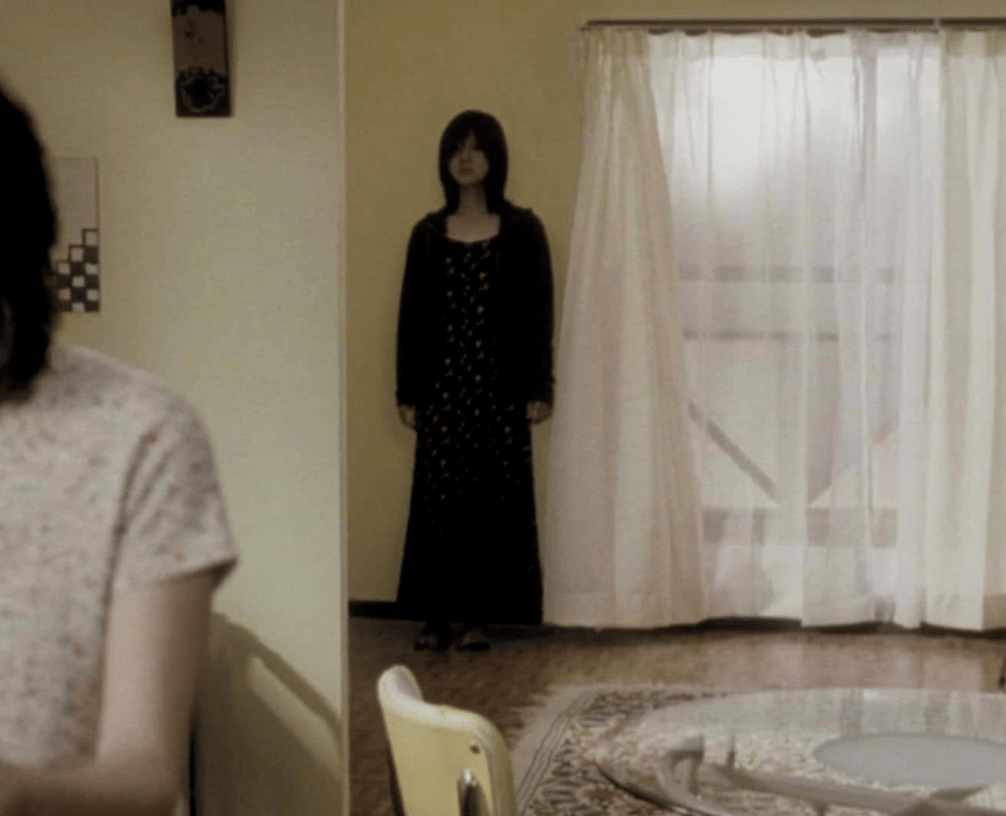
One of the most impressive things about Kiyoshi Kurosawa’s interminably impressive tech-horror movie Pulse (2001) is that it never wilts into silliness. It’s easy to imagine a version of it that does; I haven’t seen it, but I’m probably right to guess it’s the 2005 American remake. Pulse begins shortly after an invasion has occurred under everyone’s noses. Get this: the spirit realm has figured out a way to infiltrate the human world by taking advantage of vulnerable internet channels. (No, Kurosawa doesn’t explain how or why these dissatisfied souls are doing this.) Once an average desktop user in the Pulse universe has made accidental contact with a tech-savvy ghost — usually the wraith pushes an unsubtle “Would you like to meet a ghost?” pop-up button to the front of a target’s home screen — they’re shortly afterward impelled to kill themselves. A victim doesn’t leave behind a corpse. Instead, they evaporate, bequeathing to the wall what looks like a body-shaped smudge of ash as evidence of their unearthly departure.
Silliness is effectively avoided, I think, because Kurosawa is more than anything — even more than telling a comprehensible story — intent on creating an achingly lonely atmosphere that sustains a state of fragility and psychological solitude. In Pulse, views from windows are always concealed by choking fog. The sun is too glum to be relied on to peek through the clouds. Most scenes are set in small, one-bedroom, impersonally decorated apartments, no music playing, no lust for life in them. Shadows lipping dark rooms look like black holes pining to swallow you. The characters struggle to have meaningful relationships with each other even when they’re mutually craving them. The movie’s sound design so perfectly smothers white noise (while bringing ordinarily quiet sounds to a sonic forefront) that you might flinch a little after an extended stretch of silence is adjourned by dialogue.
In Pulse, you’re constantly on edge, waiting for something to erupt. “I don’t know — I just feel like something’s wrong,” a character shrugs at one point. In a movie like this, this scans as understatement. Kurosawa so authoritatively arouses what it feels like to be lonely — an oversensitivity about everything around you; despair blanketing everything; feeling alone even when someone is there with you — that Pulse would be plenty discomfiting even without its ghost business. I’m not sure I would have handled the film very well had I watched it at the height of the COVID lockdown last year, when isolation was compounded to the point of feeling purgatorial. (Later in the movie, we find out that it is itself also a kind of pandemic film.)
Pulse is set in Tokyo; it hinges on two parallel stories that will eventually intersect. One involves plant-shop employees mourning the abrupt suicide of a co-worker (they don’t yet know the supernatural-technological cause); the other follows a tech-allergic economics student (Haruhiko Kato) introduced right around the time he decides to invest in a proper computer setup.
In both narratives, characters are incrementally besieged with disconcerting, popping-up-without-much-warning videos on their computers containing seemingly supernatural images, anonymous phone calls from a phantasmic voice (it sounds like an auto-tuned drum roll) saying “help.” If a character endures enough of either thing, death is basically a promise. It’s a little like how in, say, Ringu (1998), you die a week after getting a weird anonymous call from a person announcing that you’re going to die in seven days. (The ghosts eventually seen in Pulse are as placidly fearsome as the famous one from Ringu — that long-haired phantom girl who hits you with a deadly diabolic stare after she’s finished crawling out of your TV.)
Pulse, objectively too long at almost two hours, isn’t very narratively satisfying. It remains basically an unsolved mystery; it doesn’t have much vested interest in developing any of its characters enough to imbue the drama with a real emotional center. But none of these things do much to diminish what’s good about it. It’s a nauseously efficient exercise in dread, in creatively capitalizing on the fundamental-to-horror fear of the unknown. It’s a nightmare-as-movie, where not much makes sense but where the environment in which everything takes place is so creepily immersive, feels true enough, that even when things get a hair tedious you still haven’t gotten rid of the pit that has formed in your gut.
Pulse isn’t necessarily smarter, even that much more thoughtful, than the majority of other internet-concerned movies trifling with the over-addressed (but never not true) idea that the web alienates us from each other more than it meaningfully connects us. What sets it apart is how artfully Kurosawa realizes visually and sonically paralyzing encroaching doom, how well he understands that, in the horror genre especially, it’s more important to worry about getting under a viewer’s skin than straining for explanations of and rationalizations for one’s fears.
 Peterson Reviews