
The Matrix Resurrections is an unnecessary sequel that never persuades you to rethink its necessity. But it may convince you that this is probably the very-best version of a continuation with this 20-year gap, in this cinematic climate. It has the vitality one looks for in a Matrix movie without ever feeling like it’s overextending itself for it. It’s visually of a piece with its predecessors while developing a distinct look of its own, forgoing the sickly-green overwashes of yore for something sleeker and more shimmery. And it’s in a constant existential tussle, unexpectedly figuring out a way to explicitly commentate on the cynical IP machine dominating the blockbuster field of late that helps enable its very existence. This new Matrix never pacifies, panders. All of this is to say that this is a resurrection done unusually well. Not zombieish, yanked into new life with one hand proverbially clinging to the grave, but full of new verve.
Co-writer and director Lana Wachowski, returning to the franchise sans sister-slash-longtime collaborative partner Lilly, knows there’s a question nagging many a Matrix fan as they’re either hitting play on or buying a ticket to Resurrections. How is it that we’re meeting up again with leather-clad protagonists Neo and Trinity (Keanu Reeves and Carrie-Anne Moss) after their deaths in final-parter The Matrix Revolutions? Arriving with a meta flourish, the answer smartly avoids completely canceling out the work of its cinematic ancestors while also creating a new venue for narrative possibility and indirect self-criticism.
When we enter the world of Resurrections, it’s not quite like the one we’d seen in the earlier movies. Though the main San Francisco setting does look a little too pristine, this universe is seemingly closer to our own lives: everyday people living in it can sit around tables waxing rhapsodic about their love for The Matrix and debating which interpretive framework they think best fits it. (Cryptofascism, trans politics — take your pick.)
Only in this world, The Matrix isn’t a film trilogy but an iconic video game saga that lifted off in 1999. The long-haired developer of it happens to be played by Keanu Reeves and happens to be named, just like the series’ Neo before he became “the chosen one,” Thomas Anderson. When away from his Matrix figurine-littered desk, Anderson admits to imbuing a lot of himself into this supposedly fictional character that looks and sounds exactly like him. Trinity isn’t Trinity. Now she’s a soccer mom named Tiffany that Anderson sometimes sees at a café near his office. (When the two shake hands during an awkward encounter early in the film, there’s an almost phantasmagoric charge when their fingers meet — a ghostly familiarity neither can pinpoint.)
The suggestion, then, is that everything we saw in The Matrix movies was just dramatized gameplay. When moments from those films gauchely interrupt some of the visual flow of the film we’re currently watching, it’s hard to discern whether Anderson, whose reality and fantasies are basically cohabitating indiscriminately these days, is experiencing these flashing images as memories or if these creative effigies are simply so burned in his brain that they feel as vivid as life.
When Resurrections starts, Anderson is facing pressure to make a new sequel. A warning has come that Warner Bros. will proceed with a follow-up whether he’s involved or not. This frustration funnily allows Wachowski, with the assistance of co-writers David Mitchell and Aleksandar Hemon, to channel her personal annoyance around Warner Bros.’ own long pestering for a sequel, and poke fun at the bloviated chatter and commodification of the original series. “Nothing comforts anxiety like a little nostalgia,” one character offers. For a time, Anderson is another exasperated creator, alternately proud of and vexed by the work that’s defined his career, resentful of a climate where artistic direction is guided more than ever by the not-untrue but still-depressing reality that “reboots sell,” as one cynical co-worker reminds him.
This new pressure to revive a tentpole work Anderson wants to confine to the past comes concurrent with his escalating feelings that there’s something a little bit off about his reality. Reflections sometimes don’t look right. Coding glitches sometimes appear to be twitching in the air itself. Anderson soon secretly stops taking the daily blue pill his therapist (a perfectly smarmy Neil Patrick Harris) has prescribed to gauge whether there’s a defogging effect, letting the capsules pile up in the sink until it looks like a decorative white marble living-room bowl.
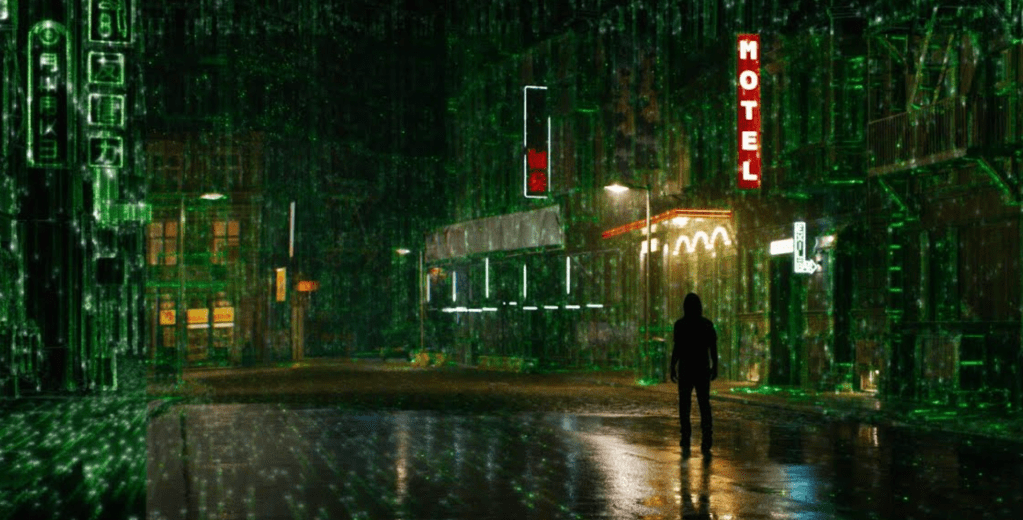
From The Matrix Resurrections.
THOSE ESCALATING FEELINGS WILL EVENTUALLY take us somewhere appropriately Matrix-y. While that fundamental Matrix-iness inevitably presupposes some welcome familiarity — the philosophical headiness, the big-hearted-but-generally-earned sentimentality, the lovable corniness, the dramatic slow-motion-loving action sequences (which don’t have quite the visual inventiveness of its predecessors) — it’s of a refreshingly distorted, never wholly comforting kind. It makes you think about how déjà vu tends to be more unnerving than consoling. That isn’t to say Resurrections is averse to having fun with the throwbacks when it can, though. The entire opening sequence is a funhouse mirror image of the original film’s start, and there’s an amusing visual moment where the new version of Morpheus (Yahya Abdul-Mateen II) stands in front of a projection of the old one.
Given the Matrix’s central premise, with revolutionary freedom always being chased after and with so much progress having been made in the original triumvirate, excitement tends to dovetail even more with despair here, what with how much time has passed with these characters still finding their desires far out of reach but their fears seemingly far closer. But that the endgame remains unity and community, with both still unreservedly believed in, has a moving effect, and instates once again why these movies, playing into fantasies of there indeed being a “something more,” continue resonating. When the movie gets to its soaringly soppy ending, you’ll probably be touched.
The meta sharp-wittedness, and the close-but-not-quite new-movie counterparts to earlier characters, keeps you happy up to a certain point. (Jessica Henwick, Harris, Jonathan Groff, and Abdul-Mateen II are strong enough not to droop under the shadows of their forebears, even if the stylishly dressed latter’s open “I’m Morpheus II” winks can get annoying.) But Wachowski hasn’t made a movie that rides more than anything on its callbacks, shrewdly remixed echoes, self-interrogation. What makes The Matrix Resurrections most worthwhile is the slow-burn-but-worth-the-wait reunification of Neo and Trinity.
The original trilogy managed to concoct a stirring love story between them across three movies. But because the main course of overarching interest was revolutionary thrills, the romance arguably tended to feel a tad supplementary — important but not enough to take up chief focus. But in Resurrections, the placement for a long stretch of the film becomes all-encompassing. That it’s able to give the movie a consistent exigence speaks to the soulful dynamism Reeves and Moss emit whether separate or together, and how much accumulated fondness Neo and Trinity still have working for them some 22 years after their introduction. We didn’t need to meet them again, not like this, but Resurrections makes us glad to have anyway. Hopefully this is the last time, for real. Coming back from the dead even once is a big-enough risk as is.
 Peterson Reviews