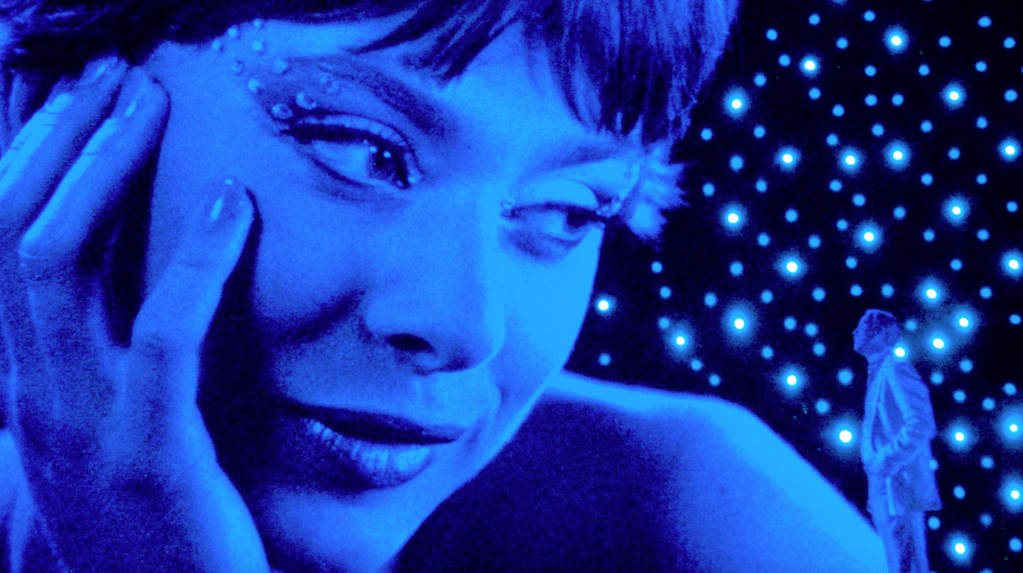
Francis Ford Coppola’s follow-up to Apocalypse Now (1979) is one of the best-looking not-so-good movies I’ve ever seen. Entirely shot on the sound stages of Coppola’s production company, Zoetrope Studios, 1981’s glittering One from the Heart recreates Las Vegas in a way that elicits the pretty plasticity of Hollywood Golden Age studio backlots. They’re lovingly presented by Coppola with an assiduously conceptualized shine and color that makes their artifice in itself beautiful — like inviting postcard idealizations. Depending on their mood, scenes may be bathed in a rich, romantic fuschia, syrupy green, or effulgent gold. At the film’s most melancholy, Coppola especially recalls Edward Hopper.
But One from the Heart is breathtakingly uninteresting when you take away its rapturous look. After a while I started thinking it might have worked better if it were a little more expressionist and discarded its dialogue entirely, the characters communicating only in glances, passionate stares, and embraces while the film’s constantly-interrupting soundtrack — all lovelorn duets between Tom Waits and Crystal Gayle, who together sound like silk caressing cacti — continues to tell us, as it does in the movie, basically exactly what its characters are thinking and feeling.
At One from the Heart’s nucleus is Hank and Frannie (Frederick Forrest and Teri Garr), a Vegas couple celebrating their fifth anniversary. When we first meet them, though, they’re on wavelengths so comically dissonant we can only suspect approaching doom: they get home from work at about the same time but manage not to notice the other person for several minutes, absent-mindedly sleepwalking through their respective after-work routines.
Slights pushing the night on edge arrive once they’ve finally crossed paths. They planned to go out for dinner, but now Hank wants to stay in instead — something he doesn’t say until Frannie has finished gussying herself up for the night. Then Hank reveals that he’s bought the house in which they’re currently living and renting — one Frannie has always thought of as more a fixer-upper on which to do a couple renovations before getting something better — without asking her first, dipping into some of her personal savings in the process. And Hank roundly rejects Frannie’s suggestions they go on a vacation sometime soon. This tourism-agency worker has been dying to go to Bora Bora, and it hurts to have her simple dreams so quickly dashed.
These little wounds carve a path for pettier insults that push this couple into a breakup. One from the Heart becomes a mournful movie about trying to find purpose again after unhitching yourself from something so central in your life for so long. After going their separate ways, Frannie quickly takes up with a suave piano player (Raúl Julia), Hank a gigi-esque family circus performer (Nastassja Kinski). But based on the sadness persisting in Garr’s and Forrest’s eyes, we know it won’t be these reactionary romances that stick. One from the Heart eventually starts casting its gaze on the beauty of re-connection, learning to again appreciate what you’d once had and maybe taken for granted.

Teri Garr in One from the Heart.
This sounds nice. And you can imagine how well its bittersweetness might have come off if Coppola were able to emotionally pull us in accordingly. But it’s hard to care much about Frannie and Hank. We mostly only see their dysfunction before their separation — and this is a dysfunction that seems truly destructive rather than something silly that can be eventually worked out. Their treatment of each other at the beginning (especially Hank of Frannie) of the movie makes us not really want them to get back together. So when that latter possibility proves to be the development Coppola is ultimately going for, we aren’t swept up because it doesn’t really feel right. It doesn’t fit in the swoony, meant-to-knock-you-off-your-feet romanticism his carefully-worked-over visuals otherwise convey.
Set pieces always look terrific but taste flat. A key moment where Garr and Julia traipse into a sunset-colored piano lounge, all alone and dancing dopily in an exciting early moment of their new romance, has no spark. And in another, where a dance sequence spills out into the busy Vegas streets, you’re immediately reminded of that terrible thing that happens when a musical (which One from the Heart sort of is but never fully commits to being) isn’t convincing: songs and dances feel not like valves for locked-up emotion but tacked-on appendages to the main drama.
You get the impression Coppola had a vague idea of the love story he wanted to tell going in but started getting so much more obsessed with the movie’s atmospheric landscape that it became more another decoration than the force grounding the film. I’ve noticed some defenders of One from the Heart look at its romance’s vacuity as sneakily complementary to the movie’s devotion to artifice. But to my eye it should be the other way around. Because One from the Heart’s idealized visuals still work over us despite their fundamental syntheticness, then the romance should work, too, not be boringly airless.
Garr and Julia suit the material; maybe that’s because they’re performers that could fit in easily with other performers of the Hollywood Golden Age period with which Coppola has a kinship here. (Garr especially puts you in mind of Joan Blondell.) And Harry Dean Stanton, rocking a perm, turns in a predictably memorable supporting performance as a friend of Hank’s whom you could imagine Walter Brennan playing a few decades earlier. But Forrest, whose acting style is more earthbound, feels like an odd man out. Kinski doesn’t get to do much of anything besides look beautiful under Coppola’s exacting lighting and star in what’s perhaps the film’s most unfading single image: Kinski writhing around in a giant martini glass all vamp-eyed.
One from the Heart is one of film history’s most infamous commercial failures: it took in a little more than $600,000 after Coppola spent about $26 million on it. It’s a failure of a movie, too, never as momentous as Coppola wants it to be and never making us feel much of anything. But it also looks so good that that alone, I think, makes it worth engaging with. I’d rather watch an interesting failure than a completely uninspired one. And there’s no denying One from the Heart’s aesthetic brilliance.
 Peterson Reviews