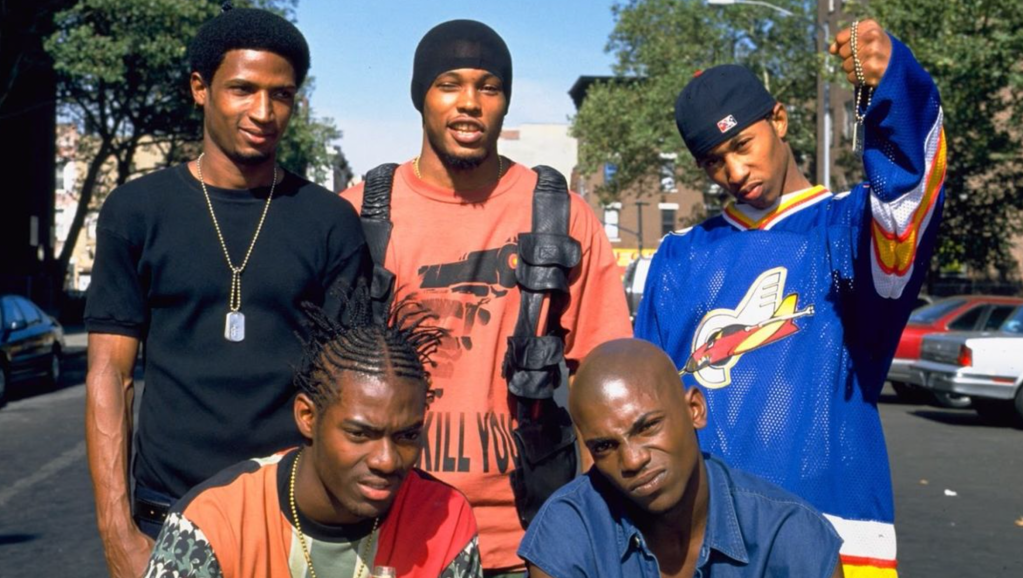
Clockers (1995), Spike Lee’s adaptation of Richard Price’s acclaimed novel, is broadly a murder mystery. But it hardly recalls the works associated with a genre that takes great pleasure in the twisty-turny mechanics of a whodunit plot — especially when it comes time to reveal the murderer’s identity. It’s far more solemn, vividly rendering the Brooklyn-area milieu in which it’s set and why many of the young Black men living in it might turn to the drug dealing that informs much of the narrative to make a living. It’s not as much the murder itself Clockers is most preoccupied with; it’s the context in which it takes place that interests Lee.
The film is put into motion by the gunning down of Darryl Adams (Steve White), an apparently back-stabbing drug dealer among the “clockers” commanded by drug lord Rodney Little (Delroy Lindo). Our prime suspect is Strike (Mekhi Phifer), one of Rodney’s favorite pushers. He was at the scene of the crime shortly before it happened; he also was the one asked by Rodney to do his bidding for this particular task. But Lee cuts away before we can actually see the murder. When Strike’s brother, Victor (Isaiah Washington), confesses to the killing later, that’s meant to be that. But the detective assigned to the case, Rocco Klein (Harvey Keitel), is certain Victor is covering up for his younger brother. Everyone he speaks with for a clearer picture of Victor pretty much uniformly agrees this is out of character for this strait-laced family man.
We’re not as set in our ways as Rocco, but it’s easy to relate to his certainty that this seemingly clear path isn’t necessarily the correct one, however much beckoning it’s doing. A little intentionally but also not, the characters are generally written open-endedly enough to make it hard to get a sure read on them, let alone an idea of their interior lives. That makes it hard to fully engage with the drama — Clockers ultimately is a better milieu movie than it is a character piece — made harder since the movie is prone to jumping around in time and not being very specific (though we make our own assumptions) about when a certain thing is happening.
But even if the script, which Lee co-wrote with the Price, leaves something to be desired characterologically, unimpeded are the roundly strong performances, particularly Keitel as the increasingly obsessive lead detective, Lindo as a figure at once frightening and convincingly father figurely, and Keith David as a cop who professes to care about Strike and his friends even as he’s participating in the “random” police frisks with which they’re regularly humiliated. Clockers ends in relative optimism, but it isn’t of an unearned kind: it’s a kind of scarred salvation.
 Peterson Reviews