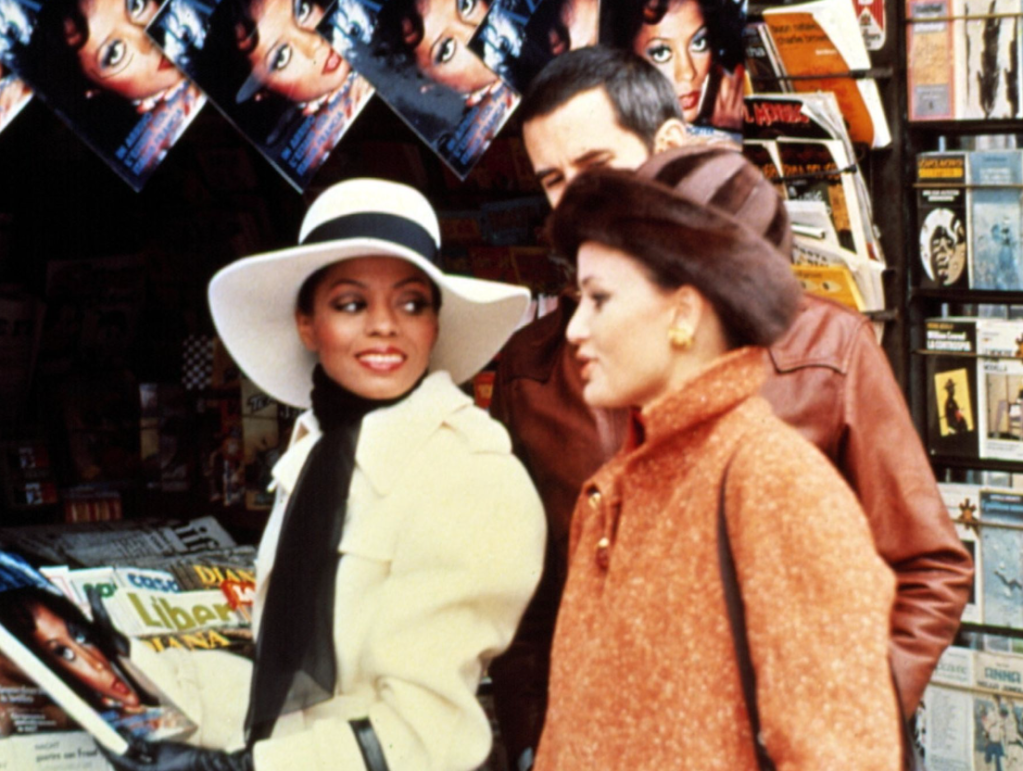
“Success is nothing without someone you love to share it with.” So says Brian (Billy Dee Williams), the primary love interest in Berry Gordy’s Mahogany (1975), sometime around the film’s midpoint. He’s saying so to the title character (Diana Ross), who was born a less glamorous “Tracy,” a little while after she’s moved from the Chicago where they first met to Italy.
Mahogany initially found success in Rome as a supermodel; more recently, she’s rebranded as a big-name fashion designer. It’s a dream come true, but the realities of her seen-through dream aren’t quite as picturesque as she’d imagined them. Pressures and superficial social dynamics evocative of game-playing are getting to her; she’s becoming increasingly brittle and sapped by disillusionment. (When Brian and Tracy first met, she was still in the “aspiring” era of her career — the student who put rhinestones on things even when her instructor was adamant, to her specifically, she not.) The aforementioned line, we hope, portends a happy ending. Even though it’s finally in a sturdy place after years of struggle, another major reason Tracy isn’t having a very good time in her career is that the man she loves isn’t by her side. Once they’re finally together, after some time separately exploring themselves, the stresses of her job won’t get to her with the same destructiveness with a sturdy foundation at home.
But unsurprisingly for a movie that has until this point framed the fashion industry as nothing but a cesspool, and Tracy’s pursuit of a place within it rather silly, the line actually is another inflection of Mahogany‘s undergirding of misogyny. I generally agree with the suggestion that love is more valuable a thing in life than success. But the film approaches it more in the sense of, a man’s success is nothing without a woman putting her separate dreams aside to share it with. A woman’s success being nothing without a man to share with it isn’t even a question. Mahogany, spoiler alert, disappointingly finds Mahogany relinquishing the fashion career she’s always dreamed of so that she simply can be the wife of Brian, who has long been a community activist in their shared Chicago hometown and is now pursuing a career in politics. The script, from Bob Merrill and John Byrum, looks at this as good and natural — the way things are supposed to be and, therefore, more spiritually enriching for everybody.
Mahogany could still have ended this way and been powerful if its scaffolding had been different. The movie could have been a devastating movie about a Black woman becoming the rare person of her race and gender making it big in the fashion industry only to find it too wearying to navigate a space so dominated by white gatekeepers, and having to continue measure her success partly by how profitable it is. It could have been a film about how the intersection of art and commerce ultimately is bad for art.
Mahogany is not incorrectly critical of the materialism and elitism rampant in the industry (and how it can, as exemplified in Mahogany’s increasingly blustery behavior, engender a certain spiritual rot). But because it never takes fashion seriously in general, the film avoids having anything touching it be framed with any nuance. It’s quick to write off Mahogany’s creativity as itself trivial. You sense Mahogany impatient for its heroine to fall in line — to make her realize that her life will be much worthier if she devotes it to her husband and his passions.
Even style, something you’d think the film would have more of considering how closely it works with fashion, is in the kind of short supply that doesn’t rise to the occasion of being anything like a saving grace. Gordy, coming in as a last-minute replacement after the film’s original director, Tony Richardson, was fired from the project, directs competently. But it’s the type of competence suggesting a director trying so hard to keep a ship afloat that he couldn’t care less whether the movie was dramatically sensible or had much visual appeal.
Ross is predictably the most effective part of Mahogany. Even with material this misguided, her superstar charisma is almost impossible to neutralize; she’s radiant even though most of her character’s actions and decision-making can be baffling. The second-most-effective part of the movie, though often derailed by its own quasi-campy exaggeratedness, is the exploitative creative and personal relationship Mahogany enters early on with a fashion photographer played by Anthony Perkins.
In his most famous role, in Alfred Hitchcock’s Psycho (1960), Perkins mastered the art of telegraphing chaotic, compulsive evil. In Mahogany, he gives us an evil comparatively calculated and manipulative, his character molding Tracy into an iconic model though only in his image. When she diverges from it, he only vengefully makes it more difficult for her to try to find success on her own terms in the industry; early on, for instance, he attempts, near successfully, to sabotage her first attempt at selling an original creation at a high-stakes show. It’s a dynamic bespeaking how quickly someone can become a pariah — especially when that someone is a woman of color — in the industry you’d found success in by wandering too far out of the mold in which you’d been created, the lane that has been constructed for you.
Mahogany doesn’t portray this relationship with much interest in realism, though. It’s played so broadly (Perkins’ work, though entertaining, is only a decibel or two below “lunatic”) that it comes across like a parody of a noxious Svengali. Real harms feel flattened, like a font of demented comedy, in the process. Mahogany never feels very serious outside of its moral message. Its dour, one-dimensionally cynical approach nullifies the power of a story whose big potential only gets more and more trampled on the more it unravels, just like its heroine’s.
 Peterson Reviews