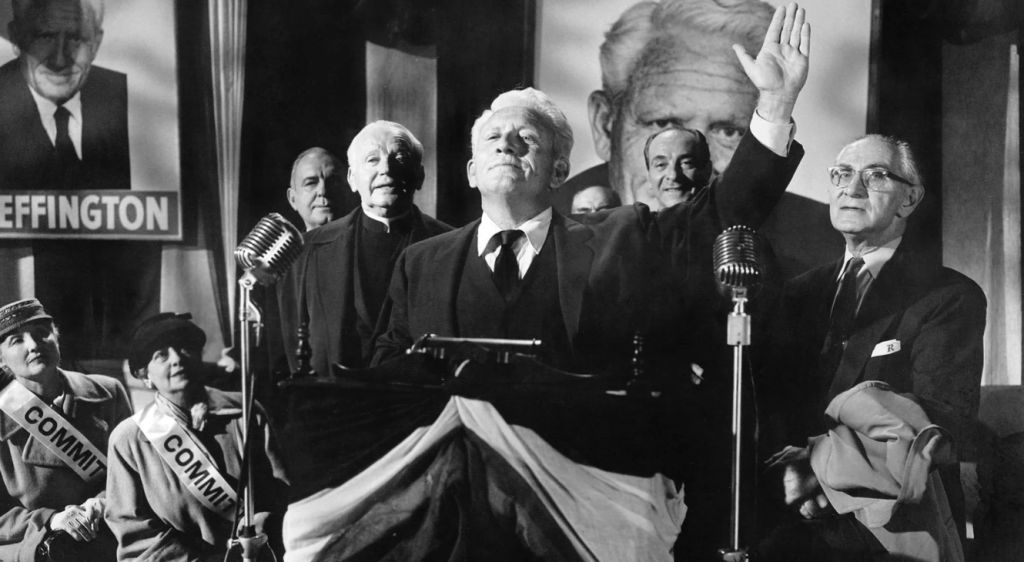
Spencer Tracy was only in his late 50s when he made The Last Hurrah (1958), though the movie, which doesn’t put him in old makeup or, maybe I didn’t notice, specify his age, presents him like he were closer to 90, his days so limited that it could be anyone’s guess whether he’ll be taking his last breath tomorrow. (Tracy himself would be gone in just under a decade, dead of a heart attack in Katharine Hepburn’s house moments after pouring himself a cup of tea.) In The Last Hurrah, Tracy plays Frank Skeffington, the mayor of a pointedly unnamed New England city who decides, at the beginning of the movie, that he is going to run for a fifth term.
It’s not necessarily because there are projects he has in the works he wants to continue with or because there are general issues he fears a successor couldn’t adequately address. It’s because he knows this will be his last campaign. He also knows that these are the last gasps of a politician being able to campaign without worrying about making TV appearances and indulging in other forms of emergently ubiquitous visual media. Despite the conflict of interest, he invites his sports-columnist nephew, Adam (Jeffrey Hunter), to take a front-row journalistic seat for what he figures is a rather historical narrative — not just the last election of a longtime mayor, but also what the political landscape looked like just before it became unfavorable to do things mostly analog.
There are some complications with that. The local paper Adam works for is old-fashioned and very right-wing and declares that it will not so much as publish a photo of Skeffington in any upcoming coverage. (Skeffington thinks much of this has to do with the fact that his mother, who used to work as a maid for the editor-in-chief’s family, stole from her employers, though only because she struggled to put food on the table for herself and her Irish-immigrant family.) The Last Hurrah, directed by John Ford, is a comedy that at different points will skewer, with wit but not much force, small-town little-mindedness and the sorts of candidates who have less ideological conviction than fixation on power-building (e.g., Skeffington’s primary opponent, an experienceless, frog-voiced war hero played by Charles B. Fitzsimons). It’s also prescient about how much political coverage was about to shift.
The Last Hurrah isn’t among the political satires to have an angry, acidic touch. Its objects of scorn are teased mostly in a hair-ruffling way. This is a movie that, above all, wants you to feel good. It is, on the one hand, fan fiction about what it would be like if a politician was practically made only of honorable virtues — the kind of man who will raise money, and not in a performative way, for a kind woman (Anna Lee) whose late rich husband cruelly left her with nothing. On the other, it’s a celebration of the warm paternalism Tracy could be so good at conveying. He’s great in the role, though that isn’t surprising — the opposite was rarely true of Tracy in a movie.
It makes sense Tracy would be nominated for an Oscar for a movie like this and not something as austere as The Old Man and the Sea, which came out the same year. If not for a pitch-perfect final-line delivery that recasts it all with a sense of wryness, I’d find the movie’s last stretch off-puttingly unbelievable. But the way Tracy sells it makes you ease up a bit. He’s good at having that effect on you.
 Peterson Reviews