
I have yet to press play on a movie best known for being not that good and also a box-office bomb without some hope going in of being somehow immune to the antipathy that overwhelmed critics and audiences back when it was released. It isn’t often with movies like that that that optimism lasts, though; that turns out to be the case, too, for Renny Harlin’s Cutthroat Island (1995), which was not purely a box-office bomb but one of the biggest box-office bombs in the history of cinema.
The good things that can be said about this pirate adventure are that it’s a miracle that it isn’t a complete disaster — reading about all the chaos behind the scenes, you wonder how many people among the cast and crew developed ulcers during the shoot — and that it’s nice to look at. Standing in for various spots around Jamaica in the 1660s, the Malta and Thailand locales used for the movie are milked until they’re dry for their tropical-postcard beauty. Beach sand is a pristine white, the waters a cartoonish blue, the sunsets knock-you-down pretty. As the actors run around, lacquered in inches-thick layers of sweat and tanned not just by the sun always beating down on them but the dirt and grime that’s collected on their skin over time, you can practically feel just how much a toll it’s taking on them and the stunt doubles who fill in for the stuff that would be a little too much to ask for. (Though the actors were still asked to do a lot: Davis made a point on talk shows to share clips proving how arduous it was to be tasked by Harlin to do stunts whenever it seemed feasible to not have a stand-in roll up their sleeves.)
Outside its looks and its usually exciting action sequences that are athletic and have a strong sense of place, Cutthroat Island struggles to overcome being not much more than competently made. (Hollywood had, at that point, had a hard time putting out anything resembling a highly profitable pirate movie; that, of course, would change with 2003’s Pirates of the Caribbean: The Curse of the Black Pearl and its diminishing-in-quality — but not profitability — follow-ups. One could say that Cutthroat Island walked so that the Pirates of the Caribbean franchise could run.)
But even the competency can get its thunder stolen. When we can’t blame the stagnancy on the attempts at comedy and drama, we can on Geena Davis and Matthew Modine, who are the film’s leads. No one has ever thought “pirate” when they think of Davis or Modine, but here they’re shoehorned into roles that require they not only be pirates but dueling, treasure-hungry ones who also have — or at least the film wants us to think they have — romantic chemistry.
Modine, so lanky and awkward in practically everything that I almost never am at ease watching him in any roles, fares a little better. He at least physically is right for the dashing swashbuckler types as embodied a few decades earlier by Douglas Fairbanks Sr. and Jr. or Errol Flynn. But Davis, who I don’t have to tell you has been great elsewhere, is, in an example of the blinding powers of love, severely miscast by Harlin, who was then her husband. She’s physically up for the task, but there’s nothing dangerous or spontaneous about her in a role that needs someone who can convincingly be both. Maybe she too would be distractingly out of her element, but the Louise to her Thelma — Susan Sarandon — kept coming to mind as a better choice to play a pirate, maybe because the sexiness and sense of power this character is meant to convey has been personified much more often by Sarandon than it has by Davis. But even if you watch Modine and Davis thinking about how they’re all wrong, you’ll still probably finish Cutthroat Island with some more respect for them: at least they got through it.
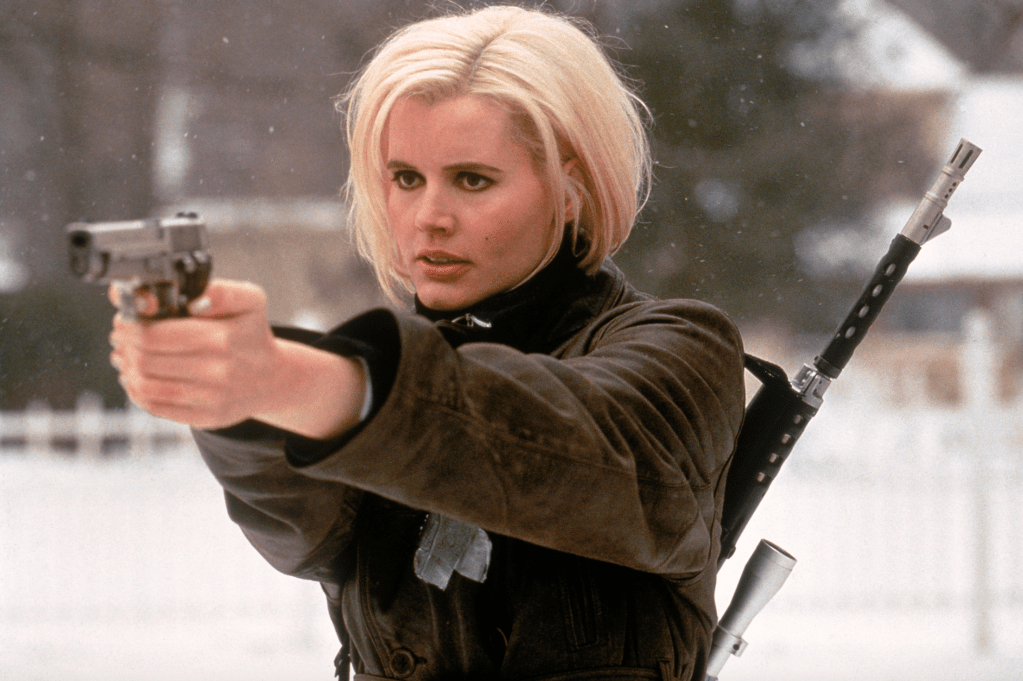
Davis in The Long Kiss Goodnight.
BEYOND BEING DIRECTED BY THE SAME GUY and starring the same lead actress, Cutthroat Island and The Long Kiss Goodnight (1996) intersect in their being too long and not doing very well at the box office. (And also having an explosion near the end that makes you wonder whether you’d ever seen an explosion so big in all your moviegoing life.) But The Long Kiss Goodnight still did a lot better commercially, which I guess isn’t saying much, and is in general a lot better than its sibling in nosediving. It at least somewhat ameliorates some of the injuries inflicted by Cutthroat Island, namely the impression of Harlin and Davis as in over their heads. Smaller scale — though still big by most standards — and better conceived, The Long Kiss Goodnight reminds you how good an action-movie director Harlin is when the material is decent, and effectively reintroduces Davis as the action star she couldn’t quite convince as on the high seas less than a year earlier.
It takes some time for The Long Kiss Goodnight to do that reintroducing, though, and that’s by design. Davis plays an amnesiac, Samantha, who will over the course of the movie reacquaint herself with the identity she lost more than eight years ago: a scarily efficient assassin who was a major CIA asset. In the ensuing near-decade since all her memories went dark, Samantha has been hiring detectives — first the most expensive she could, then, after enough times being disappointed, cheaper ones — to help her solve the great mystery of her life. She’s settled into a comfortable existence in the meantime. She gave birth to the daughter she was pregnant with at the time of the “erasing,” and has moved to some Pennsylvania suburbs where she lives with a nice boyfriend (Tom Amandes) and has started a career as a schoolteacher she loves.
But a few things start to dredge up Samantha’s past in a way that’s new for her. One is a bad car wreck that takes her from the driver’s seat out through her windshield; the mighty bonk awakens something deep in her, like a sudden knowledge of how to snap a neck (which she practices on the just-whacked deer whose being on the road at the wrong time caused the accident) and how to slice and dice with almost maniacal speed (which she practices while cutting some peppers and tomatoes one night for dinner). The other is the sudden arrival at her door of a man, one eye missing presumably because of something she did, who wants nothing more than to kill her. The old Samantha kicks in so forcefully that, when she’s done with him, she’s literally licking her fingers without realizing it. This all is tantalizing enough for Samantha to command her boyfriend and daughter to lay low so that she and the latest detective she’s hired — a struggling but scrappy one named Mitch (Samuel L. Jackson) — can more properly set about investigating her past.
The reasons for Samantha’s amnesia are ones no one in their right mind would want to find out after having no idea what has happened in their past, though I suppose if those discoveries dovetail with you getting back into a groove as a nimble assassin — a designation with which Samantha properly realigns herself by darkening her eyelids with kohl and chopping off her cascades of brown ringlets so that she can better dye the strands left behind into an icy blonde — then it’s not too big a problem. The Long Kiss Goodnight takes a little too long getting to its frankly spectacular final action destination, though that’s at least punctuated by similarly spectacular set pieces (one involving Davis participating in a car chase not in a car but by following along on ice skates) and energized by rhythmic dialogue from Shane Black.
Davis is so good, and has such good different-drum chemistry with Jackson, that you wish the movie had been seen more as a victory following the fallout of Cutthroat Island. Next up with Harlin instead would be this sentence from her Wikipedia that chills me: “Davis filed for divorce on Aug. 26, 1997, a day after her personal assistant Tiffany Browne gave birth to a child fathered by Harlin.” Davis never again made another action movie; Harlin would make many more. Deep Blue Sea (1999) apologia notwithstanding, maybe it should have been the other way around.
 Peterson Reviews