
Research has always been something of a turn-on for shy English professor Bertram Potts (Gary Cooper). But that’s perhaps never been as literal as when, a little after Howard Hawks’ Ball of Fire (1941) begins, he first gets a load of a lounge singer dressed in skimpy and shimmering gold named Sugarpuss (Barbara Stanwyck). Potts has been living for years in a cavernous New York City house with a sextet of professors of varying specialties; they’re collaborating on an encyclopedia that will supposedly house all of human knowledge. (When the film starts, they’ve only reached the letter “S,” and estimate it’ll be another three years before they get to the home stretch that’s “Z.”)
After a conversation with a wise-cracking garbage man (Allen Jenkins) early in the movie, Potts spirals into a crisis. He realizes the slang section he’s put together that he thought was solid may actually be outdated — to the point that those who might read it would say it’s current only if they were young 20 years ago. He starts his revision process by keeping his ears pricked and his pen and notepad out at billiards halls and buses. But nothing makes as big an impact as when he goes to a nightclub and watches Sugarpuss perform. In just the one song she sings with gum-chewing deadpan — “Drum Boogie,” with none other than Gene Krupa sweatily giving the song its pulse — she provides him with as much new material as the kind of interest that is, for once, not based purely in academia, judging by how much he’s nervously swallowing and squirming in his seat.
Potts heads to Sugarpuss’ dressing room after the performance to see if she’d be interested in working with him the next few days to help guide him as he catches up to the latest vernacular. The timing for her, it turns out, is both good and bad. Bad in that her mob-boss boyfriend (Dana Andrews) is in deep trouble and the authorities have been circling around her for questioning. Good, once she realizes it, in that she would have a place to hide out if she successfully manages to invite herself to stay in the house where Potts and his bachelor-academics in arms are staying.
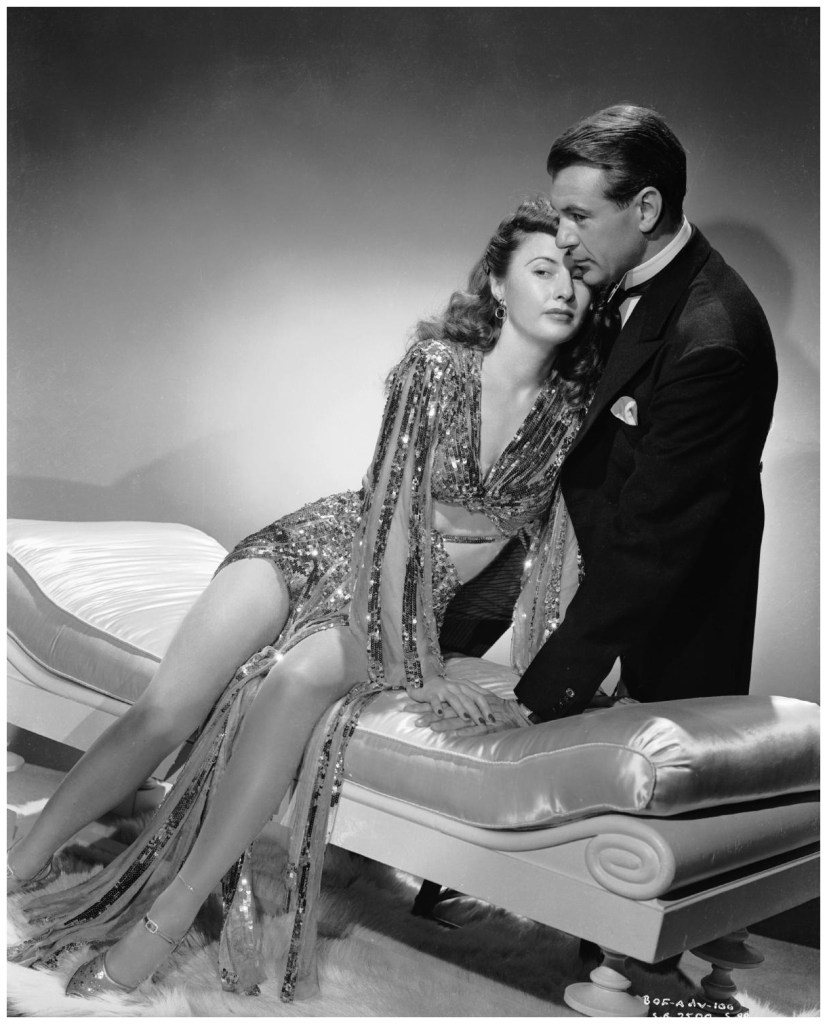
Barbara Stanwyck and Gary Cooper in a promotional photo for Ball of Fire.
Successful Sugarpuss will be. But what she doesn’t expect is how much she’ll like staying here. She develops a lot of affection for this group of nerdy guys who hardly know the attention of a woman outside their house’s stern (but loving) housekeeper (Kathleen Howard). Of the many things Sugarpuss will teach these men, who hang on to her every word in a more cute than lecherous way, the most memorable is the conga. The affection, though, is especially heaped onto Potts. Sugarpuss starts to lovingly call him Pottsy; then she notices that she actually might have feelings for the one guy in the house who comes the closest to conventionally hot.
Cooper, giving an understated performance as someone used to being reserved nudged out of his shell, is doomed from the outset to being outshone by Stanwyck. (Though it is impressive the extent to which he’s able to neutralize his good looks by feigning mild-manneredness.) Pretty much everyone — outside the gangster types played by a fake-scarred Andrews and the perfectly sniveling Dan Duryea — is met with that fate, too. Few people in the movie aren’t affecting bashful dorkiness, albeit a kind that wins us over at about the same rate it does Sugarpuss. Stanwyck, meanwhile, is exclusively afforded the opportunity to play someone who is radiantly sexy, easily funny, and tough in a way that’s concurrently subtle and immovable once that toughness has been stirred. The moralizing housekeeper christens Sugarpuss as the type of woman that could make civilizations topple. Stanwyck is so good that you believe the maid is probably right, though less because she’s wicked and more because her charisma has the fundamentals of a potency she could weaponize even more dramatically if she wanted to and reap the benefits.
Stanwyck is arguably better known for more serious roles (1937’s Stella Dallas and 1944’s Double Indemnity among them). But as it was in The Lady Eve (1941), which houses both one of her most iconic performances and allows her to dig into her knack for comedy, her work in Ball of Fire reminds you that she’s an actress for whom comedy could have been a lot more inseparable from her persona, á la Carole Lombard or Lucille Ball, had she focused less on the melodramas to which she was a lot more faithful.
Shared in Stanwyck’s dramatic and comedy work is her capacity for making the implausible, whether narratively or dramatically, feel plausible. Ball of Fire has a goofy story. There’s a great risk that the writing, all witty curlicues courtesy of Charles Brackett and Billy Wilder, might turn Sugarpuss purely into a flashy device that helps nudge this group of men into livelier versions of themselves. But you sense, in just the first few moments you’ve spent in Sugarpuss’ company, how much life she has lived, and then, after she’s spent some time out of her ordinary routine, how much she’s not necessarily as in love with the life she’d been leading as she’d thought. The last act of Ball of Fire sees the organized crime-related conflicts slightly overpower the amiable comedy it had been riding on thus far. It drags a little; it struggles to maintain the early sparks — the feeling of collective self-discovery in the air — that make it initially so fun to watch. But this is a movie where, years down the road, it’s not a largely ineffective final stretch you remember. All that will stick, really, is how brightly Stanwyck burns.
 Peterson Reviews