
The heroine of The Accused (1949) will spend far more time as a potential accusee than a literal one; the inexorably thinning space between those two states gives the movie much of its anxious charge. The film follows a successful and respected college professor, Wilma (Loretta Young), who, this quarter, is finding herself consistently undermined by Bill (Douglas Dick), a student that makes abundantly clear, whether making eye contact while suggestively chewing the sides of a pencil or flat-out flirting during class, his attraction to her. The behavior, only getting worse, is obnoxious and unsettling enough for Wilma to report him to the dean. But because that doesn’t change much, she decides to put on a brave face as best she can and vocalize her boundaries as needed.
Things take a turn for the worse, though, when, in a tight spot, Wilma agrees to let Bill give her a ride home after school one day. He’ll do the opposite: drive her to a secluded area — a thicket of trees ending in some cliffs overlooking the beach — and force himself on her. He says that, after tonight, Wilma will be asking the dean to get off his back. After pleading for Bill to get off of her — Wilma makes it clear, over and over again, how much he’s hurting her arm — she grabs a tire iron within reach and repeatedly hits him over the head with it. The repeated blows kill him; she leaves the crime scene in the kind of state that will likely make investigators think Bill had simply attempted to dive in a place he shouldn’t have. Wilma concludes that it would be useless to report any of this. Who would believe her? And, even if she was believed, would cross-examinations be free of garden-variety victim blaming?
The police go with the accident angle for a while. But it isn’t long before the brusque lieutenant leading investigators, Ted (Wendell Corey), is convinced that there was, in fact, foul play. Wilma becomes involved in the case at first not because she is a prime suspect, but because of insights she might have about Bill and the French exchange student (Suzanne Dalbert) he was seeing romantically and, according to the girl, treating badly. But Wilma will only, with time, emerge as someone more pivotal to the case than a mere character witness. Her paranoia over what’s to come is complicated by her developing romantic feelings for Bill’s older guardian, Warren (Robert Cummings).
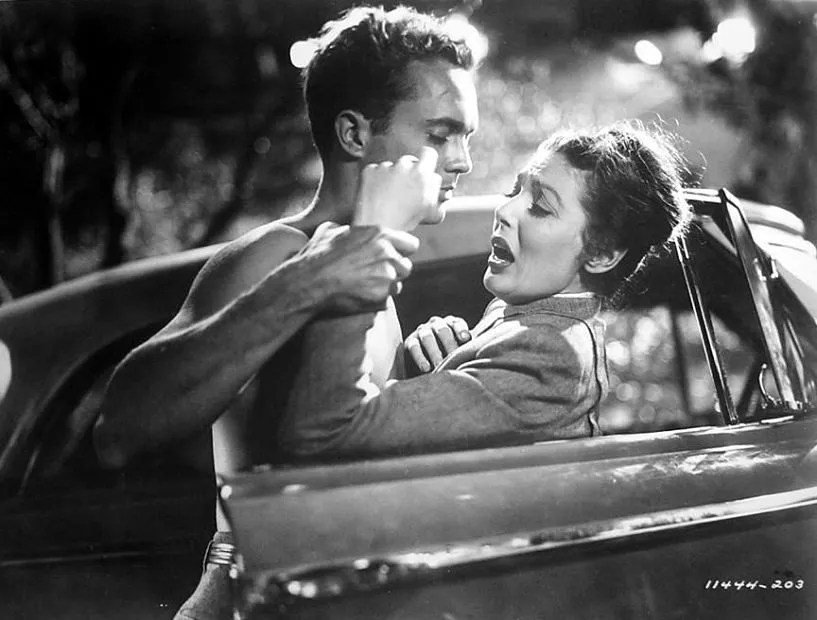
Douglas Dick and Loretta Young in The Accused.
Though its story is drawn out more than necessary to make all 101 minutes of its runtime feel totally worthwhile, The Accused is a movie that quickly feels like essential viewing. That is, for one, because of Young’s performance, a masterclass in keeping — or, more accurately, straining to keep — an internal boil outwardly cool. But that’s also because of its unwaveringly empathetic treatment of someone who has endured sexual violence. You wouldn’t expect a movie released in 1949 to always stay on this character’s side, or for it to not try to, in some way, develop some kind of misplaced sympathy for Bill. But the writing, from Pulitzer Prize-winning screenwriter Ketti Frings, never abandons its lead.
The Accused lucidly evokes the nightmarishness of the situation in which Wilma finds herself while also using it as a conduit to explore how difficult it was at the time, and in different ways now, to be a woman professional and not find your certainty in your worth and your standing in the working world ruptured by men who reinforce patriarchal dominance through sexual harassment and the like. Wilma doesn’t immediately go to the police because she knows that, realistically, she will not be met with compassion from the jump but rather a skepticism that will only morph into further hostility. Those anxieties are only confirmed by Ted, who, it’s immediately clear, would very likely not hear her out, subjecting her to the third degree as if self-defense was one and the same as cold-blooded, motiveless killing.
The Accused couldn’t persuade me that it needed to have the romantic complication positioned to possibly turn into a kind of salvation, even though Cummings, an actor who usually registers as not much more than animated white bread, is good. It also couldn’t persuade me that it was sensical for the ending, which takes place in the courtroom, to be as comically rushed, tacked on-feeling, as it is and feel very effective. But the open-endedness it concludes with also feels pretty right. It gives us some of the sense of relief we might have been hoping for while nodding to the bleak outcomes women of Wilma’s era (and, depressingly, women living in subsequent ones) might have been subjected to in a similar situation.
 Peterson Reviews