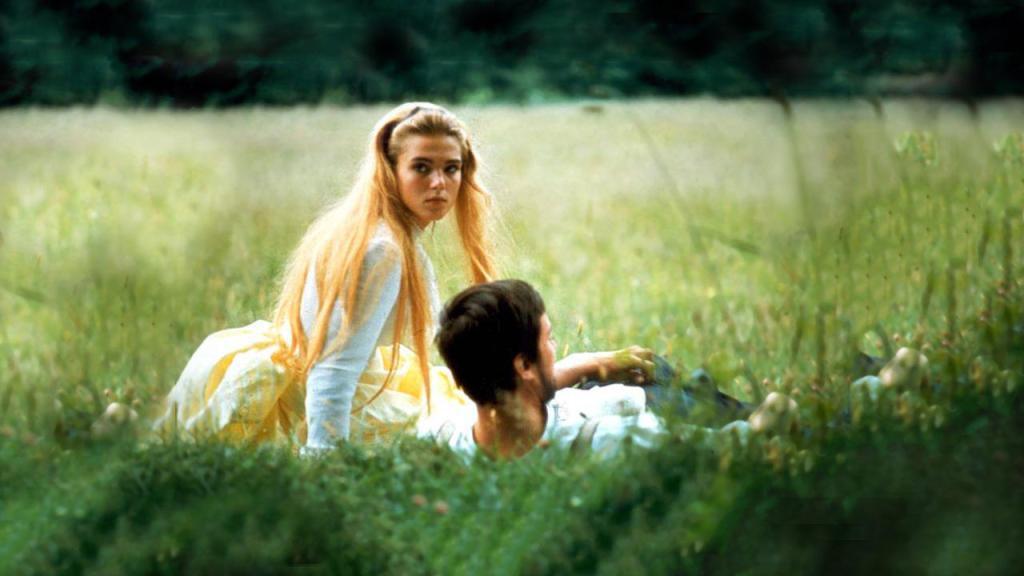
Elvira Madigan (1967) begins at the moment when its young, beautiful, and doomed lovers, Hedvig (Pia Degermark) and Sixten (Thommy Berggren), seem the happiest. We find them napping in a spot of shade in the sun-dappled Denmark countryside before they emerge from their sleepy embrace to frolic among some tall grass festooned with pink and yellow flowers and fluttering butterflies.
The couple is not thinking about how Sixten, a soldier, has deserted the army and left his wife and their two kids to be here. The couple is not thinking about how Hedvig, who’s been popularly performing for years as a tightrope walker under the name Elvira Madigan in her stepfather’s sideshow act, is now a most wanted-style figure. (By extension, Sixten is now one too; his and Hedvig’s running away together is currently the talk of the town in a Bonnie and Clyde way, the capacity for killing traded with a capacity for unrepentantly leaving the army.) But they will eventually.
The first images of Elvira Madigan are gorgeous in a way that might immediately make you, as they have made many others, confident about saying that this is one of the most beautiful movies you’ve ever seen. The setting is already pastoral in a way that looks, without any photographic augmentation, half unreal. Cinematographer Jörgen Persson gives the landscape’s natural colors and light a painterly dynamism that turns that half whole. Those less enamored of Elvira Madigan have seen its visual style as a crutch: pretty but empty, with too much of an emphasis on beauty for a story translating a real-life tragedy.
But to read the film’s look ungenerously hides how cannily it works. It’s first a harmonic backdrop for lovers still ecstatic in love, living in a world where everything seems both smaller and fuller with possibility. Then it increasingly becomes a practically cruel representation of the ecstasy that once was now lost, more and more tainted by the creeping in of reality — of the truth that the lyrical early days of a romance can only be sustained for so long before they in themselves start to feel not much different than a dream you have to make a diary entry out of to remember. The then-new boom in hippie culture, wont to romanticizing “dropping out” of life’s practicalities, lends itself to Elvira Madigan’s urgency, too.

Thommy Berggren and Pia Degermark in Elvira Madigan.
You wouldn’t think at first that Elvira Madigan would get as dark as it does had it not begun with a title card putting what’s to come plainly: that this romance will end with a murder-suicide. (The movie is based on a true story that captured the public imagination in the summer of 1889.) It is, for so long, just a series of bucolic images making young love manifest, uncomplicated with reenactments of what it took for these young lovers to get here.
When the spell breaks, it has the finality of a severing. It begins with a friend of Sixten’s (Lennart Malmer) traveling to where the pair are to confront them with what they would rather not hear: that Sixten’s wife has attempted to kill herself after this betrayal. There’s that, plus the growing inescapability of what will make sure they won’t be able to stay dropouts for long: a need for the money provided by work, which Sixten cannot get with a face known everywhere and itself synonymous with desertion. (Whether Hedvig could work is never posed.)
There is no coercive power dynamic that we see undergirding the lead-up to the murder-suicide. It’s depicted in Elvira Madigan as a rash decision mutually agreed on to not only avoid facing the consequences of reckless love, but to also better preserve the dreamstate that existed because of that reckless love. You don’t sense writer-director Bo Widerberg finding any of this particularly romantic. He seems more fascinated with the delusion and myopia love is capable of enticing. “I believe one blade of grass can be the entire world,” Sixten says earnestly mid-movie. Elvira Madigan sticks with him until he no longer can bear the realization that he no longer believes that to be true.
 Peterson Reviews