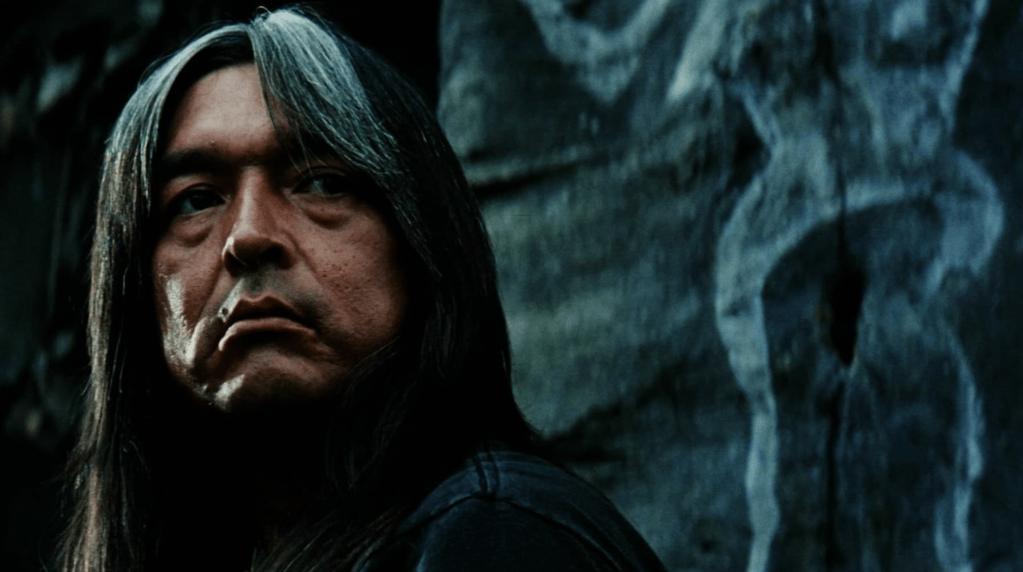
Clearcut (1991) is a revenge movie that deploys violence about as graphically as — but much more thoughtfully than — most of its genre forebears. It opens with terrible news: the legal authorization for a logging company to start clearcutting on some rural Canadian land that had before been sanctioned as a First Nations reserve. The lawyer representing the affected Tribe, Peter (Ron Lea), arrives in person at the start of the movie to deliver the message. In keeping with the this-isn’t-over attitude maintained by Wilf (Floyd Red Crow Westerman), one of the few members of the Tribe with whom he’s cultivated something of a friendship, he plans on appealing the decision.
Peter isn’t very confident about the tides turning, though: he’s a lawyer who tends to represent those put in society’s margins and doesn’t usually find much success when it counts. He knows how it is; he’s used to a routine where he appeals, has that be unsuccessful, then moves on to the next case. But Clearcut, adapted by Robert Forsyth from the book A Dream Like Mine by M.T. Kelly, won’t let him get off that easy. Preventing him is Arthur (a spectacular Graham Greene), a radical Native activist introduced to him by Wilf who takes very seriously a rage-induced hypothetical posited by Peter: that since it’s unlikely the appeal will be seen through, the only meaningful way to make things right would be to blow up logging-company headquarters and then skin alive its CEO, Bud (Michael Hogan).
Arthur’s unblinking capacity for violence is teased when, while staying at the same motel as Peter, he roughs up, ties up, and then tapes the mouths shut of the group of obnoxious white people staying in the room between them making a lot of noise who are at first unapologetic when confronted. But not long after is Arthur actually putting into motion Peter’s off-the-cuff revenge fantasy, kidnapping Bud at a gas station and forcing him along into a few-days-long voyage into the wilderness. If the “trip” is not supposed to scare him straight per se, it might at least make the ecological and existential destruction being wreaked in the name of profit feel realer by way of some skin-carving, not something painless the way the people inflicting the pain might think it will remain.
Peter is forced along; he might be less straightforwardly evil than Bud and his company, but he still is not, by Arthur’s estimations, innocent. Though his intentions are ostensibly good, he still has long profited off the painful realities of disadvantaged clients, able to remain paid and comfortable even when a case is lost. He can walk away scot-free from a situation the people he has tried to help can’t so easily, the closest thing to additional immersion the books he reads and condescendingly touts make him close enough to an expert on the matters he parachutes into. Peter is the kind of lawyer, it’s made clear, who just may feel sorrier for himself when a case is lost than the people who actually are losing.

Graham Greene in Clearcut.
Much of Clearcut’s violence can inspire a certain nauseousness, though only because of what is being done in a clinical rather than ideological sense. It’s true that this is material you wish were drawn from a Native perspective. (The film’s director, Ryszard Bugajski, as well as Forsyth and Kelly, are all white). That it doesn’t hinders some of the urgency of the movie, which, particularly in its final moments, can be tempered by a feeling of it being made by people for whom the motivating anger is not personal even when there’s no denying that there is anger there.
But Clearcut is still a movie guided by worthwhile questions, pondering the virtues and limits of pacificism and whether, even though the devastations Arthur inflicts are more literally bloody, they’re any worse than the kind of destruction engendered by Bud, his logging company, and their colonialist predecessors, whose unflagging willingness to bring calamity to the environment and the people residing within it is legitimized just because there is money to be made.
Arthur’s placidity while carving and killing is frightening. But it isn’t more so than a world where more powerful people have been able to for centuries legally inflict similar and different violences en masse because of profit. A character like Arthur is bracing: not pigeonholed by a “savage” stereotype (this movie, though a different one might, clearly isn’t comfortable seeing him as a bonafide villain), certainly not the image of a Native person strong and resilient in the face of ruin, but openly externalizing his rage against men who would never be expected to maintain a similar kind of civility when so much has been taken from them.
 Peterson Reviews