
The Wild Child‘s (1970) story begins in a forest in France in the summer of 1798 with the discovery of its titular figure: an 11- or 12-year-old boy (Jean-Pierre Cargol), apparently abandoned in the woods by his family as a tot, who has managed to successfully raise himself but has, in the process, become hardly any different from an animal. He cavorts around nude on all fours with such force that the rustling in some bushes preceding his initial appearance suggests that something the size of a bear will emerge.
Based on the real-life case of Victor of Aveyron, who’s today looked at as a kind of archetype for the image of the feral child “raised by wolves,” the boy is at first lugged by a trio of hunters into a nearby hamlet where he is treated no differently than a sideshow personality. Then he’s enrolled in a school for kids who cannot hear or speak. But the place’s methods so thoroughly don’t work on him that “giving up” on this “idiot” is the predominant attitude among staffers.
An exception is found in Dr. Jean Marc Gaspard Itard (François Truffaut, who also co-wrote and directed the film). He sees clearly that this is a boy damaged by a near decade’s worth of complete solitude, and that he deserves a chance at a life where he can appreciate life’s joys rather than exclusively exist worried about where his next meal is coming from and whether the night’s sleep will be safe.
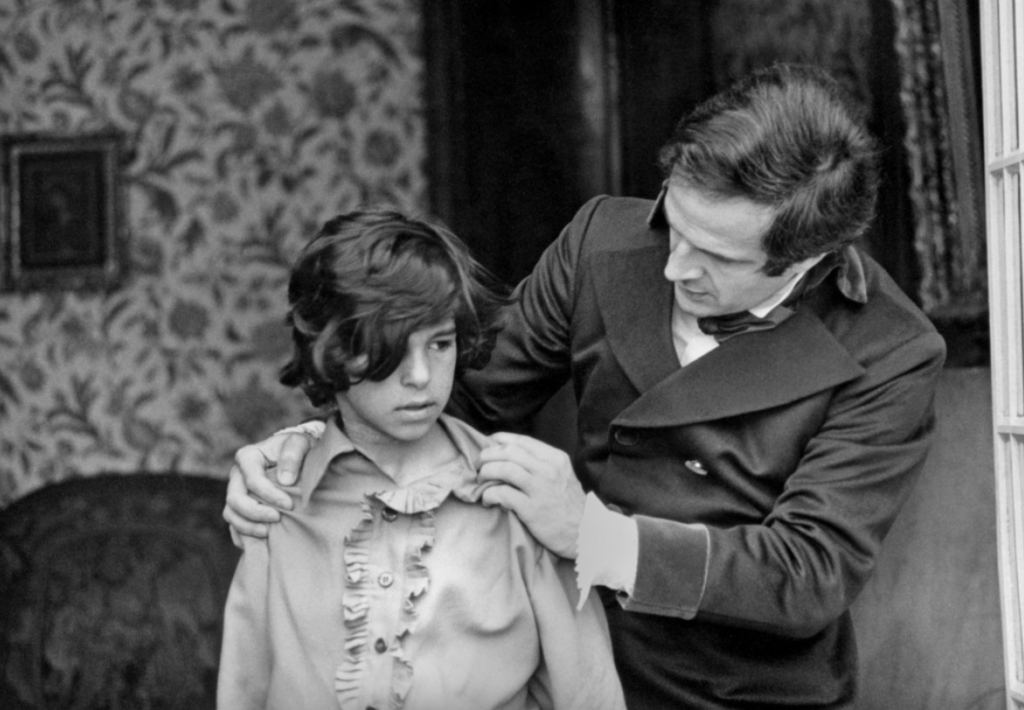
Jean-Pierre Cargol and François Truffaut in The Wild Child.
Itard names the boy Victor and essentially adopts him. He gives his young guest a room in his bucolic Batignolles home; he pays his devoted housekeeper, Madame Guérin (Françoise Seigner), an extra $150 a year to be his primary caretaker while Itard commandeers Victor’s education. Rudimentary attempts at “civilizing” Victor — cutting his curling-over fingernails, shearing his tangled mass of hair, teaching him how to walk with his back and knees straight — don’t pose many problems. But it’s far harder for Itard to not merely teach Victor how to speak but also to fundamentally understand why it’s that necessary when he can communicate what he wants with the right gestures and grunts.
The Wild Child is frequently moving sheerly because of Itard’s relentless determination to give Victor the chance that no one else will, even when it also seems aware that to “civilize” someone is not necessarily in their best interest. As much as Victor will come to enjoy the simple pleasures he hadn’t before known — swigs of milk, blowing out birthday candles among them — his yearning for the life he had known before never goes away. One of The Wild Child’s most haunting images is of Victor, his hair newly neat and the button-down shirt put on him crisp, looking at how the sunset’s warmth hits the countryside longingly from the window of the house in which he will never seem to completely be at home.
Truffaut shoots the film in clinical, rather indifferent black and white. It reinforces the feeling of a study — of this all being not much more than a dramatic staging of the copious notes lining Itard’s journals. (His entries are read in voiceover by Truffaut throughout the movie.) It isn’t long before you start to long for a presentation that didn’t feel so detached, or for an actor other than Truffaut to make Itard’s sensitivity come through rather than only be made clear in the narration. (His performance is leaden.) Consistently marvelous is Cargol, who never speaks a word outside the handful of times Victor successfully asks for a glass of milk. Most child actors are masters of the canned line reading, of mugging cutesily for the camera — something for which I can’t and won’t begrudge them. But Cargol is so convincing that you forget he’s acting. You never can predict what he’ll do next.
 Peterson Reviews