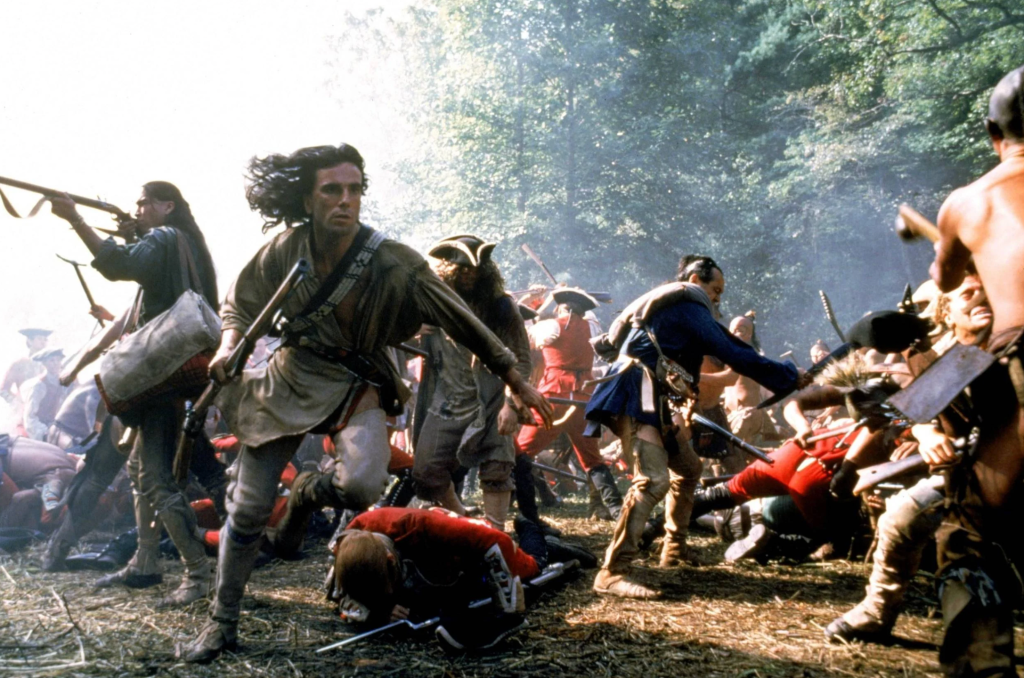
The Last of the Mohicans (1992), the most obvious outlier in Michael Mann’s body of neo-noir-heavy work, is an action-packed historical epic so astounding in its scope and sense of space that the likely flares of not quite believing what you’re seeing reverberate more from the knowledge that Mann had never before made a movie like this and never would again. Battle scenes, explosions, and other set pieces (from canoes full of people flying off waterfalls to heroes flung around like rag dolls in white water) all are done with the kind of meticulous craftsmanship that can make your brain forget that craftsmanship and that the continual survival of our leads is improbable.
Mann proves himself in this mode not dissimilar from the epics-churning King Vidor or Cecil B. DeMille, albeit if they were better filmmakers. Mann is here interested in upholding naturalism as much as possible — costumes and recreated customs were planned with painstaking historical accuracy — and in not letting spectacle eclipse dramatic substance. (DeMille’s movies, though sometimes entertaining, let the spectacle do all the work.) In The Last of the Mohicans, spectacle and dramatic substance inform each other rather than be made mutually exclusive. You quickly get caught up in what’s going on and the emotional consequences they engender.
Based on the novel of the same name by James Fenimore Cooper, plus a 1936 film adaptation starring Randolph Scott, The Last of the Mohicans is set in 1757 — the third year of the French-Indian War — and finds a focal point in Nathaniel “Hawkeye” Poe (Daniel Day-Lewis), the adopted son of Chingachgook (Russell Means) and brother to Uncas (Eric Schweig), both of whom hail from the Mohican tribe. It’s not easy to neatly summarize the movie; it’s easier to say that it has the grab-you-by-the-lapels drive of a good race-against-time thriller.
Much of it involves Hawkeye contemplating assisting British efforts to possess North America or retaining the individualist spirit he’s been raised to cultivate. Much time is also spent protecting the daughters (Jodhi May and a terrific Madeleine Stowe) of a powerful British officer, Munro (Maurice Roëves), from a subset of the French-allied Huron tribe. That tribe is led by a chief, Magua (a simmering Wes Studi), whose bloodthirstiness is undergirded by a tragedy that would not have happened if not for Munro. A romance additionally develops between Day-Lewis and Stowe, itself less interesting than seeing the latter character, long used to being cloistered, coming into her own after being put in harm’s way enough times.
Though certainly a departure, it wouldn’t be totally right to say The Last of the Mohicans is a 180 for Mann. It picks up the thread of his films orbiting around men who are most of the time everyday forces of nature who have a talent for transcending impossible circumstances. It’s also a little pulpy. But none feels quite this gigantic — except for maybe his next movie, the winding crime epic Heat (1995) — or quite this exhilarating. It’s almost completely convincing even when Day-Lewis, good in everything, isn’t always. Though he has the right stealthy athleticism for the action sequences, I never fully bought him in the pose of what amounts to a matinee idol with a dirtier face and a stringer-than-usual mane.
 Peterson Reviews