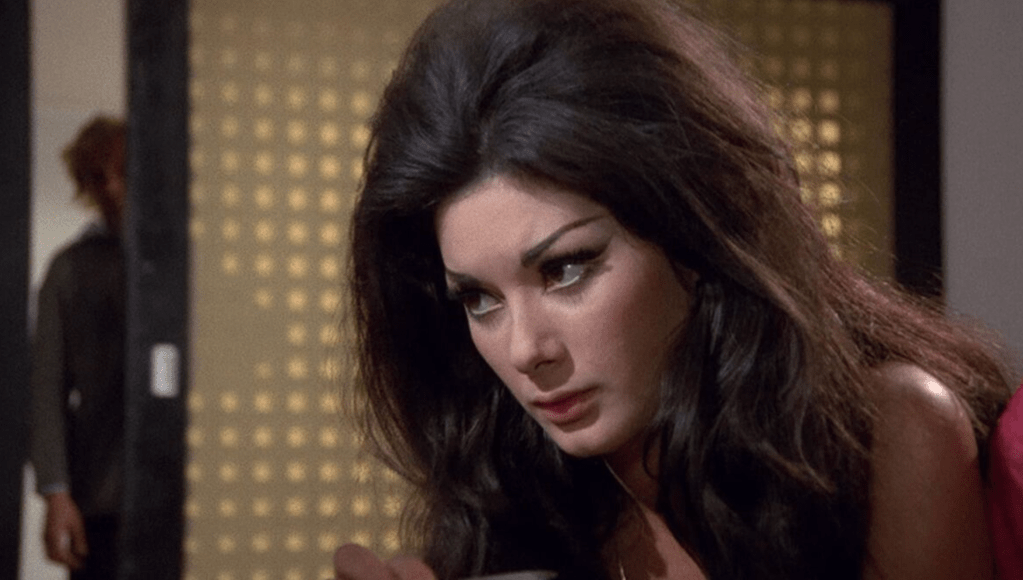
The basis of Five Dolls for an August Moon (1970) cribs almost wholesale the premise that has made Agatha Christie’s And Then There Were None (1939) stick around in the cultural memory as long as it has: a group of people, stuck together on an island, picked off one by one by a killer who could as much be among them as not.
And Then There Were None remains a delectable mystery, a prototype of page-turning suspense and painstaking structural planning. We think optimistically at first that Five Dolls for an August Moon may crib some of that delectability, too. How lavish it is with dramatic possibility is clear from the jump. The definitely more than five “dolls” that have congregated on this private island, which belongs to an industrialist named George (Teodoro Corrà), are looking to coax a scientist in the group, Gerry (William Berger), to give up the formula for his latest invention, figuring a weekend of drinking and lazing on the beach will effectively loosen him up. (He’s not likely to budge, though: his creation, a state-of-the-art resin, resulted in the death of a colleague during the testing window, which, to him, is understandably reason enough to not let it see the light of day.) There’s that, plus how there isn’t an interpersonal dynamic in the group not fraught in some way or another. Affairs between them, gay or straight, are about as common as garden-variety animus.
One of the guests says early in Five Dolls for an August Moon that she’s been having ominous premonitions about the island. This will come to sound like an understatement. When people start turning up dead, it’s basically impossible to guess who could be responsible, and what, exactly, their motivations are. It could as much be someone lurking somewhere around the island off camera — perhaps a loved one of the guy killed during Gerry’s experimenting — as it could be one of the visitors. It’s more than possible that one or more of them has an unexpressed grievance or two, not simply a desire to make money off this scientist.
Once the deaths begin — they always follow with members of the group practically ritualistically wrapping the deceased in plastic and hanging them on meat hooks in the freezer while Piero Umiliani’s circus-like score blares — Bava seems at a loss about how to maintain the initial notes of intrigue. He is, as always, a great stylist; the film’s most memorable visual decision might be how the camera follows the movements of a toppled-over container of marbles through the house to reveal the latest person murdered. But Christie’s style of suspense, so dependent on charged dialogue and distinctive characters, is not for him.
Bava is better at making shadowy mood pieces where logic and dramatic sense are less important than the maintenance of atmosphere. (1960’s Black Sunday and 1966’s Kill, Baby, Kill! are great examples of what he excels at.) A movie as plot-dependent as Five Dolls for an August Moon underscores Bava’s skillset — making a film look good (which this one always does, particularly when the cat-featured and big-haired Edwige Fenech is interrupting a frame) — and also where he can flail, which is in characterization and in storytelling that is not straightforward. Five Dolls for an August Moon isn’t a bad time; its ending is, like Christie’s own, one you don’t see coming. But there is nary a Bava fan who would point to this movie as effective indoctrination material for the uninitiated.
 Peterson Reviews