
On the other side of the Italian sound movie’s circa-1930 dawning was the temporary death of the horror genre. The culprit: an order, from dictator Benito Mussolini, that the film industry circumvent anything that in some way might taint the country’s public image.
Mussolini’s reign ended with force in 1945, but from his ashes didn’t immediately spring a second life for a genre he’d condemned nearly two decades earlier. The possibility to pick up where the country had left off with 1920’s now-lost Il mostro di Frankenstein wouldn’t come until the late 1950s, when post-war economic recovery and film-industry expansion afforded more opportunities for cinema in Italy to broaden its horizons. In the post-Mussolini 1940s, the landscape was dominated by a neo-realist movement reflective of the country’s despair and vulnerability, defined by the likes of Roberto Rossellini, Luchino Visconti, and Vittorio de Sica.
The return of horror in Italy came from a filmmaker wanting to prove himself more in a businessman-like than creative sense. Industry mainstay Riccardo Freda was convinced he could make a movie in two weeks — the kind of achievement thought impossible by the pair of producers he was talking with while proclaiming as much — and was given the chance to see the challenge through by Goffredo Lombardo, head of production and distribution company Titanus. Freda wrote the screenplay for his prospective low-budget project within 24 hours; he’d finish production a couple days quicker than what he’d initially pitched. (Not happily or productively, though: a disagreement with producers led Freda to storm off set just before the film’s completion, forcing cinematographer Mario Bava — more on him later — to finish what was left on the schedule.)
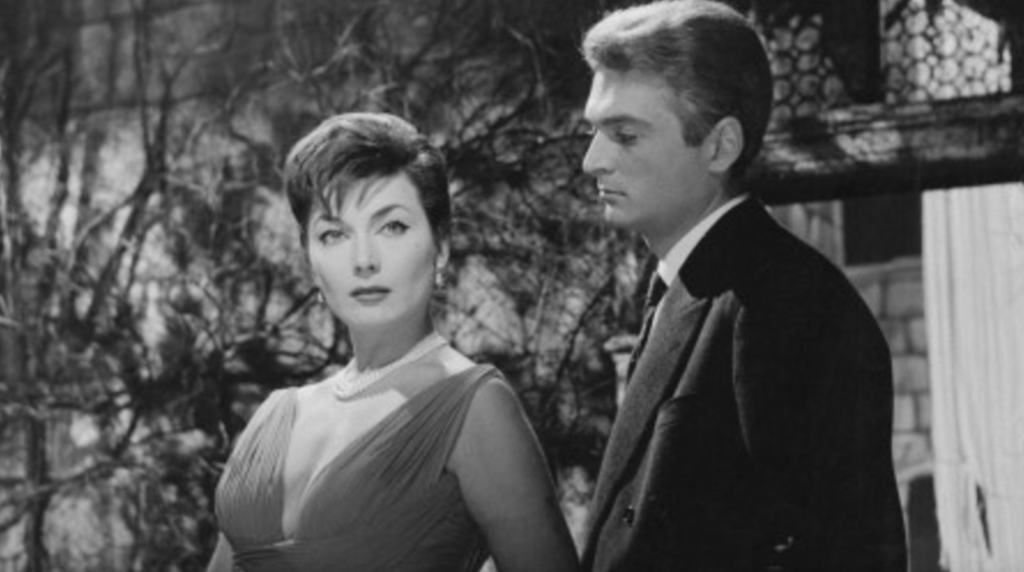
Gianna Maria Canale and Dario Michaelis in I Vampiri.
The context surrounding what is now widely touted as Italy’s first bonafide horror movie, I Vampiri (1957), is much more interesting than the film itself. It’s a rather rote detective story set in Paris (with Italian actors speaking Italian while ostensibly playing French people) with a supernatural element. The mystery: the responsible party for a series of murders of young women, who are routinely being discovered without wounds but drained completely dry of their blood. The answer is complicated; it’s made juicier by the fact that among the chief masterminds is an ancient upper-class woman played by Gianna Maria Canale who may be keeping herself looking improbably young and beautiful through deadly scientific methods. “You have no idea what a woman goes through,” Canale tells Dario Michaelis, who plays the hotshot young journalist investigating the crimes, mid-movie.
Its disarmingly terrific special effects aside, I Vampiri is best when it briefly turns away from its modern setting — often buoyed by painted backdrops so aggressively fake that you can practically see the stage lights a few yards in front of them beaming off their glossy surfaces — and into the shadowy realms of catacombs and cobweb-covered castles the narrative sometimes makes it a necessity for characters to stop by. It’s here that you can most feel the presence of Bava, who three years after I Vampiri’s release took the delectably macabre aesthetics of those particular scenes and fruitfully harped on them for a full feature of his own.
Black Sunday (1960), Bava’s first proper directorial effort, has the kind of phantasmic Gothic style so exciting to watch that you get why it was that movie, rather than the commercially unsuccessful I Vampiri, that properly got the ball rolling again for horror in Italy. I Vampiri, though not bad, has the dryness of a serial that, novel-for-Italy horror beats aside, suffers from seen-it-before mystery-movie safeness. Watching Black Sunday I’m sure then and even now so much feels like the announcement of a great that it’s no surprise that it would not only kindle a formidable body of work for Bava in the 1960s, but also inspire gatekeepers and the artists working under their tutelage to capitalize on a movie good enough to feel like the proper rebirth of a genre once thought lost. I Vampiri was a reminder that horror didn’t have to remain dead. Black Sunday gave it a reason to live.
 Peterson Reviews