

arry Keoghan’s specialty is in impish creeps and weirdos. Rarely does the shtick foreground a movie the way it does in Saltburn, writer-director Emerald Fennell’s follow-up to 2021’s both laureled and widely detested Promising Young Woman. Most of Keoghan’s menagerie of little freaks simply are the way they are; Oliver, his character in Saltburn, is determined not to be who you think he is. The Oxford freshman yearns to be more like Felix (Jacob Elordi), a classmate he befriends who’s as extravagantly tall as he is wealthy.
Felix and his aristocratic family live on an estate so palatial that it’s only natural it has its own name, the way homes tend to in a Daphne du Maurier book. Middle-class Oliver gets an invite to stay there for the summer after claiming to Felix what may or may not be true: that his dad has unexpectedly died, and that, because of his mother’s purportedly messy alcoholism, he would rather not be home. Saltburn becomes not a story poeticizing the unlikely friendship between an awkward, chronic loner and someone whose richness and handsomeness come easy; Fennell instead takes a page or two from Patricia Highsmith’s The Talented Mr. Ripley (1955), a thriller similarly about a lower-class outsider ingratiating himself into a moneyed milieu with deadly results.
Like Tom Ripley and his 2023 scion, Fennell loves ogling beautiful, expensive surfaces. And she appreciates the transitory moments of life when the mundane is suddenly imbued with the divine, like when the light beaming in from some windows makes Felix look like an angel while he sits on the radiator beneath him, or how the piercings poking through his earlobe and eyebrow glint against a dusky sky. Saltburn is objectively very pretty to look at, at least when its cameras are not taking in the sight of some puke splattering a bathroom sink and mirror or a bathtub full of water red with blood. One of the first things my friend I saw Saltburn with said as we walked out of the theater was that she liked how it really looked like a movie. When the bulk of popular films betray directors for whom visual style is ancillary rather than central, a movie like Saltburn, whose shots evince a filmmaker who’s obviously pained over them, is refreshing.

Barry Keoghan in Saltburn. All Saltburn imagery comes via a screenshot from trailer.
Saltburn’s capacity to dazzle wanes the farther Fennell wanders into the narrative of a movie she says is all about our “sadomasochistic relationship with the aristocracy.” Oliver’s relationship with this clan in which he’s inserting himself certainly fits the bill; desperate to blend into their world, he lies as he needs, which we don’t always judge him for, but also exhibits extremities like drinking the remnants of Felix’s draining bathwater and the bodily fluids swimming within, which we do.
Post-Parasite (2019), movies reveling in their recognition of the 1 percent’s shittiness are having a moment. Like the spiritual predecessors released in Parasite’s wake, Saltburn garners several laughs from the offhanded cruelty the rich are capable of, from the way they practically roll their eyes at the “attention-seeking” suicide of an ostensibly good friend of lower financial means to their refusal to miss a red wine-soaked meal just moments after someone has died. No one in the movie better embodies that funnily offhanded cruelty than Rosamund Pike, playing a family matriarch who glides around in long dresses, usually with a drink in hand, whose habitual, often charming chattiness is dependably flecked with callous observations about those financially beneath her. If they were her conversation partner of the moment, most commoners would ask her to repeat what she’d said if she weren’t already distracted by the new thought she’s already in the middle of expounding on. Pike is the best thing about the movie.
Fennell, the private school-educated daughter of a luxe jewelry designer popularly known as the “King of Bling,” is ultimately more sympathetic to her wealthy characters. They’re mostly rendered obviously awful but not so bad, whereas the grotesqueness of Oliver’s hunger for what they have is increasingly hammered in with such comic aggression that what seems to be Fennell’s contempt for those who share his wanting for something more is what finally dominates Saltburn. Oliver antecedent Ripley was at least a serious object of lurid fascination for Highsmith, who probed at him like he was a bug scuttling under a microscope. You don’t feel like Fennell could tell you much more about Oliver than his basal wants and their nasty manifestations. Saltburn, compelled by the lure of surfaces, rarely ventures below its own.

Nell Verlaque in Thanksgiving. All Thanksgiving imagery courtesy of Sony Pictures Classics.
Eli Roth whet many appetites for Thanksgiving 16 springs ago. With 2007’s Grindhouse, Robert Rodriguez and Quentin Tarantino sought to mimic the experience of seeing a double feature at a scuzzy B-movie theater in the 1970s by stacking two movies — zombie flick Planet Terror and the slasher-cum-car-movie hybrid Death Proof — on top of each other and bookending them with trailers for fake movies with names like Machete and Hobo with a Shotgun. Among those trailers — and maybe the most promising of them — was one for a Roth-helmed holiday horror movie called Thanksgiving, whose fun was partly bolstered by the fact that we’d probably never be able to enjoy it as more than a concept.
Having one of your trailers featured in Grindhouse didn’t mean that the idea it offered lived and died there, though: those aforementioned two movies eventually received their own spinoffs, Machete even getting a sequel. But Thanksgiving seemed like it would never get the shot its peers did, even though development efforts ostensibly began in 2010. As Roth recently put it to the New York Times, the delay had less to do with outside forces than his own difficulties, with the help of screenwriter Jeff Rendell, tackling the expansion of a movie that had originated with a less-than-three-minute tease where all the best ideas were presented marathonically.
The finished product foregoes the intentionally scuzzy textures of the Grindhouse universe for something more slickly commercial-looking. But most of the indelible images offered way back when — the beheading of a turkey mascot at a Thanksgiving Day parade; the ghastly knife-assisted death of a cheerleader chirpily bouncing on a trampoline; a baked-alive human presented like a turkey to a table of horrified, gagged-and-bound guests — find a way to make it in, sometimes naturally and sometimes, like in the case of the cheerleader segment, awkwardly, like Roth couldn’t bear to keep it confined to the obscurity of a double-feature project that’s also known, in addition to being charming throwback fun for its champions, for being a box-office flop.
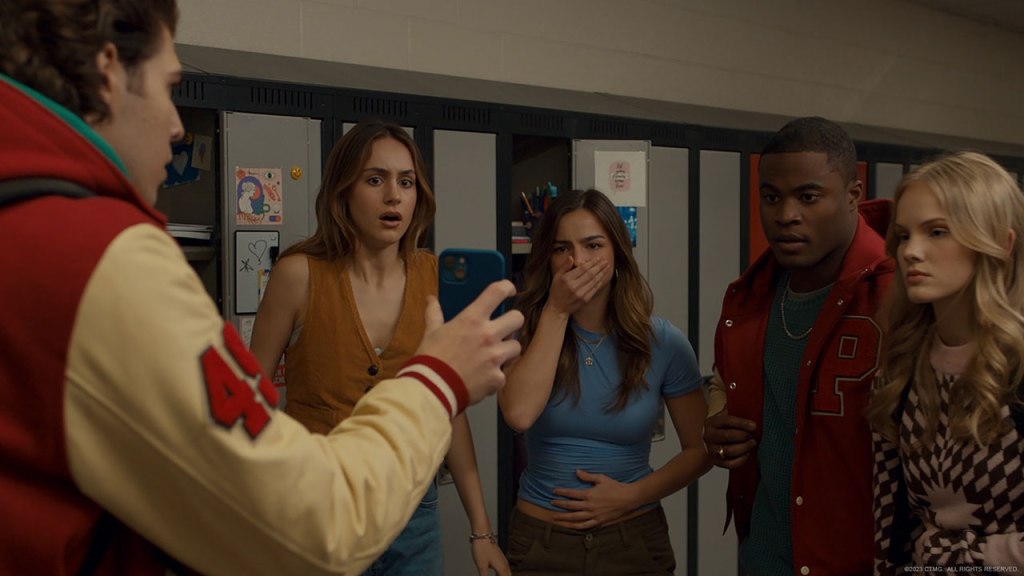
Tomaso Sanelli, Verlaque, Addison Rae, Gabriel Davenport, and Jenna Warren in Thanksgiving.
The packed pre-release screening for Thanksgiving I went to the other day suggested it would be very unlikely for the movie to suffer the same commercial fate as the project from which it originated. (So far, that’s proving to be true.) I feel moved to describe the audience as spending most of the runtime hooting and hollering, the pair of friends seated next to me offering just the right amount of quiet commentary between their own fits of giggles and kicks of their feet.
Thanksgiving is, like so many slasher movies, motivated by revenge. It opens with a Black Friday sale turned deadly, then continues, a year later, with a grisly killing spree perpetrated by someone homicidally angry with everyone he or she sees as especially responsible for the bloodiness of that night. The final step in their plan is hosting a gruesome Thanksgiving feast with the targets of their ire, some spared as horrified onlookers, others as literal courses in the meal.
Unlike other holiday-themed slasher movies, like 1974’s Black Christmas and 1984’s Silent Night, Deadly Night, Thanksgiving gleefully milks its comic potential. Requisite kill scenes are uniformly delivered with admirably committed gallows humor that speaks to why, as Pauline Kael put it in her review of 1976’s Carrie, horror and comedy is maybe the best combination of genres you can find at the movies. Horror comedies so often struggle to find the right balance between the two modes they’re fusing; Thanksgiving gets it so right that you can’t not foresee it becoming a movie groups of friends or families open to watching nasty stuff together turn to during the holiday season as one way of fostering quality time. The family that screams together stays together.
 Peterson Reviews