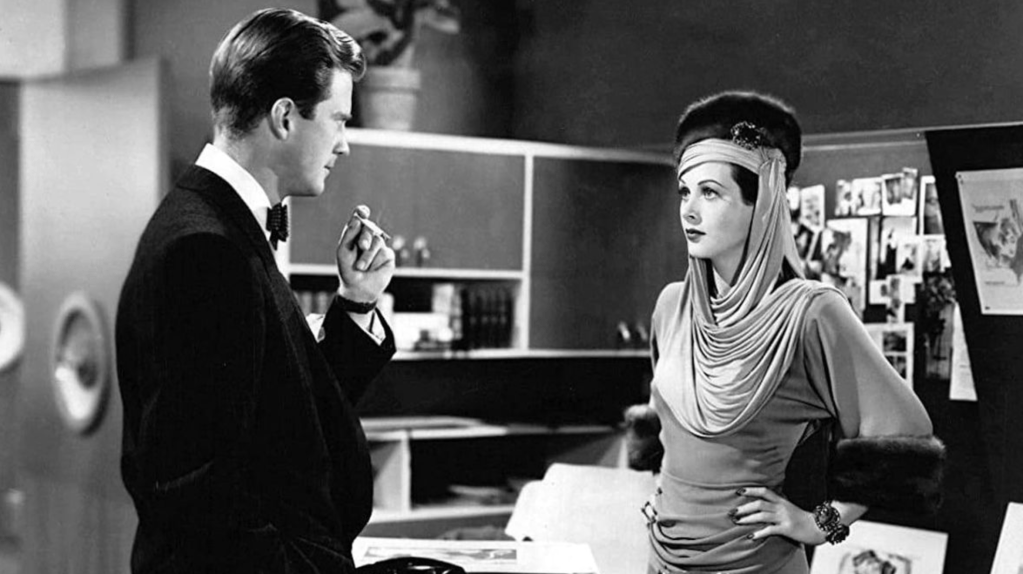
Early on in Dishonored Lady, Hedy Lamarr’s character realizes just how unfulfilled she is. Madeleine has spent the last few years staking a claim for herself among the Manhattan glitterati with her work as a fashion editor with a local magazine called Boulevard, where she’s garnered a reputation for both her taste and her ruthlessness. But her sense of security is consistently thwarted by the men at or adjacent to the office, a few of whom she’s dated, who make no attempt to hide their attraction to her and who are prone to putting her in “her place” when they find it necessary. The fast pace of her job, paired with the lack of respect she faces, is depleting her.
Not long into Dishonored Lady, after she’s worked through some of her unhappiness with a psychiatrist (Morris Carnovsky), Madeleine quits her job, changes her name, and uses the money she’s earned to withdraw into a life where she can focus on what she’s always loved most: painting. The initial halcyon days of Madeleine’s new life see her happier than she’s been in years, abetted by the emergence of a love interest who for once seems to respect her and have her best interests in mind. David (Dennis O’Keefe), her new neighbor in the humbler apartment building she moves to, is a medical researcher who enlists Madeleine to do some drawings for a paper he’s working on — an offer that both gives them a foundation on which to explore the possibility of a relationship and provides Madeleine with the most creatively nurturing project she’ll work on for the first time in a long time.
Optimism for her future with David and as an artist are inevitably foiled, though, when vindictive old male coworkers catch on to Madeleine’s attempts at self-reinvention and try bringing her back into the life she no longer wants. It’s a threat to her budding romance with David, who doesn’t know her as more than a painter trying to make it by. But that will seem like almost nothing when news strikes that an old advertiser Madeleine dated in the past (John Loder) is murdered, evidence pointing to Madeleine as the perpetrator.
The murder plot of Dishonored Lady feels tacked on and half-invested in — a way to give extra charge to a movie that otherwise would just be about a woman’s search for meaning and the difficulty of doing that in a man’s world. It’s disappointing that the film’s source material, a 1930 play of the same name from Edward Sheldon and Margaret Ayer Barnes, implicitly suggests a story of a woman’s self-reinvention is only worth engaging with if there’s something sensationalistic about it on the side, and that ultimately, a man is necessary to fully legitimize a woman’s fresh start.
But it’s also heartening that that self-reinvention be reckoned with at all, and that the film refrains from the common-for-the-era proposition that professional success makes a woman unhappy to instead more realistically say that one line of work may not be as fulfilling as another. Lamarr is excellent throughout it all, trying to hold it all together when what should be the straightforward beginning of a new chapter is chronically undermined.
 Peterson Reviews